

My illustration entitled: “The Hand That Waits” – A physician kneels beside a child’s hospital bed with a treatment plan open. The parent holds the permission form, while the child points to a detail in the diagram and the physician pauses to explain.
Genetic interventions can place practical control in the hands of one actor while another person bears the resulting biological change. This essay calls that separation the Genomic Authority Gap. Building on the Genomic Power–Authority Distinction and the concepts of Genomic Self-Authorship and Genomic Other-Authorship, it examines five hypothetical cases across research, paediatric care, commercial provision, reproduction, and public policy. The existence of a gap leaves open whether an intervention is justified. Informed consent can authorize a bounded use of another’s expertise, and substitute decision-making can sometimes protect interests that would otherwise go unmet. Where consent is unavailable, the question is what gives an actor standing to decide, for whose benefit, and within what limits.
Where control and consequence come apart
A physician may understand a proposed genetic treatment better than anyone in the room. A parent may have to decide whether a child receives it. The child will live with the outcome long after the physician and parent have made their decisions. Each occupies a different position in relation to the same intervention. Expertise, permission, and exposure to consequences belong to different people. The ethical question is how those positions should relate.
The founding thesis of Genomic Sovereigntism is that power to alter a genome is not equivalent to authority over the person whose genome is altered. The 2012 Genomic Power–Authority Distinction gave that thesis a more precise form. Power is a factual capacity to bring about a change. Authority is the legitimate standing to decide that it should occur. The distinction tells us why the capacity to intervene cannot justify its own exercise. The gap identifies the relationship in which a justification must be found.
The Genomic Authority Gap
A Genomic Authority Gap arises when the actor possessing practical power to determine a genetic intervention is different from the person who bears its constitutive biological consequences. The gap becomes especially consequential when the affected person cannot exercise meaningful agency over whether, when, or on what terms the intervention takes place.
By practical power, I mean control that can materially determine whether the intervention happens or what is done. A researcher may control what a study offers. A parent may decide whether a child enters it. An institution may control access to care on which a patient depends. Several actors can hold different parts of that power at once. By constitutive biological consequences, I mean effects on the affected person’s biological constitution. A change can matter profoundly to that person without determining their identity, character, or moral worth.
Genomic Self-Authorship is a person’s capacity to make informed and voluntary decisions about interventions to their own biological constitution, including whether to pursue, decline, or defer them. It can be exercised through the work of others. An adult who chooses a procedure may rely on a clinician’s skill while retaining authority over what they agree to undergo. Genomic Other-Authorship describes an intervention authorized or directed by someone other than the person whose biological constitution bears the consequences. Here the argument must explain why another person’s judgment can carry authority at all.
Case 1. The scientist and the research participant
Suppose a research team offers an experimental intervention intended to affect body cells in adults with a serious inherited disorder. The team determines what intervention the study offers. A prospective participant can accept or refuse that offer, yet cannot redesign the study. Both exercise a form of control. The researchers’ control comes from their role in conducting the study. The participant’s comes from their standing to decide what may be done to their body.
Free and informed consent can bridge the gap here because the participant authorizes a defined use of the researchers’ power. If the team proposes a material change in what the participant will undergo, it must reconsider the scope of the permission it has obtained. The same point applies to withdrawal. A participant may be able to refuse further procedures even where a biological effect from an earlier procedure cannot be undone. An honest consent process must make that distinction intelligible before the person agrees.
The Belmont Report places informed consent within its account of respect for persons, while treating assessment of risks and benefits and fair selection of participants as further ethical requirements. A person’s permission therefore answers one question about a trial. Investigators and reviewers still have duties concerning what may responsibly be offered in the first place. [1]
Case 2. The physician, the parent, and the child
Imagine a child with a serious inherited condition. The treating physician believes that a genetic intervention could prevent substantial and irreversible harm, and that waiting until adulthood would foreclose the benefit. The child understands that a procedure is being proposed and is frightened by it, but cannot assess its long-term risks and alternatives. A parent must decide whether to give permission, and the physician must decide whether the intervention is justified as an offer.
Childhood supplies a reason that someone may need to act on the child’s behalf. The specific prospect of harm gives the parent a reason to act in this case. Both points matter. If the proposed benefit were modest and waiting would preserve the option, the argument for deciding on the child’s behalf would be weaker. The child’s fear also deserves a response. An explanation suited to the child’s understanding may disclose concerns the adults have overlooked, even when responsibility for the final decision falls to them. The American Academy of Pediatrics’ 2016 policy statement treats parental permission and childhood assent as an active process and calls for greater participation as the child matures. [2]
Substitute decision-making can therefore bridge the gap. Its legitimacy depends on the responsibilities of the decision-maker, the child’s interests, the urgency of the decision, and the weight given to the child’s developing judgment. The very reasons that authorize a parent to act today can require the parent to yield a decision to the child tomorrow.
Case 3. The corporation and the dependent patient
Suppose a company controls practical access to specialised follow-up care for patients who have received a genetic intervention. It offers continued access only to patients who agree to a second genetic procedure intended to generate research data. One patient understands the offer perfectly and signs because losing follow-up would place them in a position they cannot afford to accept.
The company’s control over care gives it leverage over a decision ostensibly left to the patient. To assess the signature, we need to ask whether the second procedure is necessary for safe follow-up or serves a separate research purpose. If it serves a separate purpose, the patient’s dependence on existing care makes the condition difficult to justify. The company would need grounds for exercising that leverage beyond its ability to set the terms of access.
This case shows how a gap can widen even when the affected person can understand and communicate. Meaningful agency depends on the costs an institution attaches to refusal as well as on the patient’s capacity to decide. For a continuing course of care, it also matters who retains control after the initial permission is given. A patient who authorized one procedure retains an interest in how that decision is used to shape later choices.
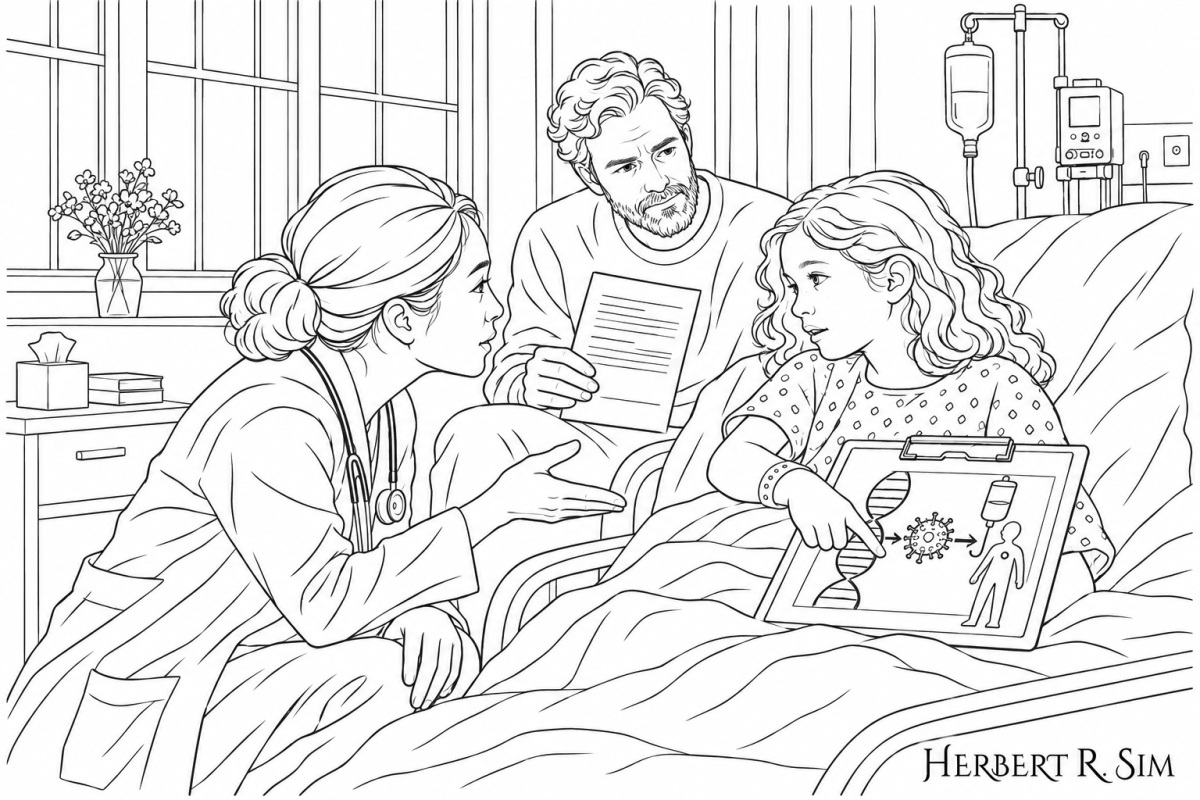
My illustration “The Hand That Waits” work-in-progress. The art represents that even when a parent gives permission, a child deserves to be heard in decisions about their own body.
Case 4. Prospective parents, an embryo, and descendants
Imagine prospective parents considering a hypothetical modification to an embryo to reduce the likelihood of a severe inherited illness. Assume there is good reason to expect a benefit to the child who might develop from that embryo. The prospective parents can decide whether to seek the procedure. A clinician can decide whether to offer it. The person who would develop from the embryo cannot take part in the decision, and the change could be transmitted to descendants.
There are two claims to justify. The first concerns acting for the prospective child. A strong case would need to explain the seriousness of the illness, the reliability of the expected benefit, and whether a later or less consequential intervention could secure a comparable result. The second concerns the reach of the decision. Authority to pursue a benefit for one child would not by itself establish authority to expose that child’s descendants to uncertain effects. Their circumstances could differ, and the parents considering the procedure cannot agree to those effects on their behalf merely by consenting to the original intervention.
The organising committee of the 2015 International Summit on Human Gene Editing argued that clinical germline editing should await resolution of relevant safety and efficacy issues and broad societal consensus about the proposed application. It also called for appropriate regulatory oversight. That statement recognises the public and intergenerational reach of the decision. It leaves a further philosophical question. If those conditions were eventually met, what would entitle the people making a particular decision to act for those who would inherit its effects? [3]
Case 5. The government and the population
Suppose a government identifies an inherited condition associated with substantial suffering. It can fund research, support voluntary care, and set standards for trials. It could also use access to public benefits to pressure people into accepting an intervention. Officials argue that higher participation would reduce suffering across the population. Their reasoning identifies a public objective. It still has to explain why securing that objective gives officials standing to decide what happens to any particular person’s body.
Compare a safety rule that bars clinics from offering a poorly understood intervention with a requirement that individuals undergo a government-preferred procedure. The first governs what a provider may offer and can be justified by the state’s duty to protect patients. The second takes control of a decision ordinarily made by the person who will bear its consequences. The same legislature might enact either rule. The justification for one cannot simply be carried over to the other.
Population-level reasoning can also conceal how burdens are distributed. A programme may be described as improving an average while its risks fall on a small group whose members have little influence over its design. Public scrutiny should ask whose welfare the policy advances, who bears its uncertainty, and what opportunities affected people have to refuse or challenge it. A public reason to make care available can be strong even where the argument for directing individuals’ choices is weak.
What kind of authority can bridge the gap?
The cases suggest that authority must attach to a particular decision and to the people who will bear its consequences. In the simplest case, a person who understands the intervention freely authorizes another to carry it out within an agreed scope. Where a person cannot decide, another actor may be able to act under a duty to protect that person’s interests. The 1997 UNESCO declaration on the human genome distinguishes the affected person’s free and informed consent from authorization where that person is unable to consent. In the latter case it directs attention to the person’s best interests and the applicable legal process. [4]
Acting for another person requires at least three kinds of justification. First, the decision-maker must explain their standing in relation to that person. Second, they must give a reason for acting now, taking account of the harms of delay and the prospects of preserving a later choice. Third, they must justify the scope of what they authorize, including serious consequences for others. These inquiries become more demanding when a change is difficult to reverse, the expected benefit is uncertain, or the decision-maker has interests that compete with those of the affected person.
One objection is that this places too much weight on authorization. If an intervention would prevent great suffering, why should the position of the person making the decision matter? Because sound reasons for pursuing a benefit can coexist with poor grounds for claiming the right to decide. A physician and a commercial sponsor might both foresee the same benefit for a child. The physician’s responsibility to the patient and the sponsor’s interest in a successful study give them different standing. A plausible benefit may justify considering the intervention while leaving the question of who may authorize it unresolved.
There is also a danger in the opposite direction. Requiring personal consent in every case would leave some people without care precisely when they need someone to act for them. Substitute authority makes such care possible. Its limits matter for the same reason as its existence. When the affected person can participate, their judgment should shape the choice. When they can decide for themselves, their own authority must come to the fore. And where a decision reaches people no current actor can adequately represent, some of the gap may remain even after careful review.
Authority on another person’s behalf
The unresolved task is to distinguish a person’s authority over interventions to their own body from the authority another person may exercise on their behalf. The first follows from the person’s standing in decisions about their own life. The second derives its purpose and limits from duties to the person affected. A parent or guardian can sometimes authorize what a child cannot yet authorize. That responsibility is a form of custodianship, and the grounds for exercising it should be open to question whenever its consequences will outlast the child’s dependence.
This is where the inquiry must turn next. If acting for someone can be legitimate, what marks the boundary between protecting that person’s interests and claiming sovereignty over their biological constitution? The hardest cases will be those in which the power to act is real, the reasons to act are substantial, and the person who will live with the result is still unable to speak.
References
- National Commission for the Protection of Human Subjects of Biomedical and Behavioral Research. The Belmont Report. 1979. Full text
- American Academy of Pediatrics, Committee on Bioethics. “Informed Consent in Decision-Making in Pediatric Practice.” Pediatrics 138, no. 2 (2016), e20161484. Article record
- Organizing Committee of the International Summit on Human Gene Editing. “On Human Gene Editing: International Summit Statement.” 3 December 2015. Statement
- UNESCO. Universal Declaration on the Human Genome and Human Rights. 1997, Article 5. Declaration