

My illustration entitled: “The Blue Butterflies in the Hall” – A laboratory worker changes one colored mark on a projected helix. Down a long hall, that mark appears in a series of life-size portraits at different ages. In the last portrait, an older figure steps out of the frame toward a doorway of their own choosing.
A person can withdraw permission for a genetic intervention after discovering that they can no longer undo what it has done. This is easy to miss when consent is treated as the decisive moment. Before an intervention, a person may be free to refuse it. Afterwards, they may be free to refuse another procedure, leave a study, or seek advice from another physician. None of those choices necessarily restores their previous biological condition. The authority to decide whether something happens and the ability to regain control after it has happened are different matters.
Genomic Sovereigntism begins from the proposition that power to alter a genome does not confer authority over the person whose genome is altered. Irreversibility adds a question about time. If a decision will outlast the authority of those who make it, what must they justify today to the person who will live with it tomorrow? The harder it will be for that person to reverse, reject, or escape the intervention’s effects, the stronger the justification required from those authorizing it.
Consent now and control later
The inability to consent now concerns the source of permission. A young child may lack the understanding needed to decide whether to undergo an intervention. A future person has no present opportunity to decide at all. In either case, someone who proposes to act must explain why they have standing to decide on that person’s behalf. A parent’s responsibility for a child can supply that standing in some circumstances. The fact that the person cannot answer leaves the decision-maker with a duty to justify the choice.
The inability to reverse later concerns what remains within the affected person’s control. An adult can fully understand and voluntarily authorize a lasting change to their own body. If they regret it, that regret does not establish that the original choice was invalid. It may reveal a consequence of the choice that was understood from the start. Conversely, a temporary intervention imposed on a person capable of refusing still raises a problem of authority, even if its effects soon disappear. Durability and consent can vary independently.
Irreversibility is also a practical matter. A proposed remedy that depends on a speculative second intervention offers little assurance to the person making a decision now. Even where a genetic change could conceivably be altered again, effects already produced during development might persist. An intervention can therefore be difficult to escape in more than one sense. The change itself may endure, consequences already set in motion may be hard to remedy, and the person may depend on an institution for the care needed to manage those consequences.
A lasting somatic change an adult chooses
Suppose an adult with a progressive inherited disorder is offered an experimental intervention intended to produce a durable change confined to certain body cells. That durability may be part of its appeal. Repeated treatment may carry burdens the adult wishes to avoid, and a lasting effect may be what makes the expected benefit worthwhile. Their authority over the decision includes the freedom to accept consequences they cannot later undo. A rule that permits adults to choose only reversible interventions would take seriously one kind of future freedom at the expense of choices they have reason to make now.
The person must still be able to tell the difference between stopping participation and reversing the intervention. They may decline a later procedure or withdraw from further research. The biological effects of the original procedure may persist. Those who offer the intervention owe the person a clear account of which choices will remain available, what uncertainties may follow them into later life, and how they can obtain information and care if their needs change.
The same distinction applies to enhancement. Imagine a healthy adult considering a permanent intervention for an advantage in a particular occupation. The adult may genuinely value the change. If access to work increasingly depends on accepting it, however, an employer’s influence can help determine a biological decision whose effects will outlast the job. The relevant questions include how freely the person can decline, whether the benefit will endure beyond the circumstances that prompted the choice, and who will carry the burdens if it does not. A permanent enhancement can be freely chosen, but its permanence makes the conditions of that choice especially important.
What parents may decide before a child can
Consider a child with a serious inherited disease that may cause damage before the child can understand the available choices. Assume the clinical evidence supports a lasting intervention and that waiting would substantially reduce its benefit. The parents’ authority is custodial. It arises from their responsibility to protect the child’s interests during a period of dependence. In this case, preserving the child’s capacity to act in the future may require deciding now. Waiting is itself a choice when the damage caused by delay may also be irreversible.
Change one feature of the example. The proposed intervention offers an elective enhancement that will remain available when the child is older. The parents sincerely believe it would help, but they are choosing a permanent change that the child will soon be in a better position to evaluate. The case for acting now is weaker because delay preserves both the option to intervene and the child’s opportunity to judge whether the expected advantage is worth having. The comparison is between the consequences of acting and the consequences of waiting.
A child’s participation need not begin with full decision-making authority. The American Academy of Pediatrics’ 2016 policy statement on informed consent treats parental permission and childhood assent as an active process, with greater inclusion of the child’s views as the child develops. A child who cannot yet decide may still understand what worries them, express reluctance, or ask for time. Those responses can reveal costs the adults have overlooked. They also matter because the person expected to live with the result is already beginning to form a view of it. [1]
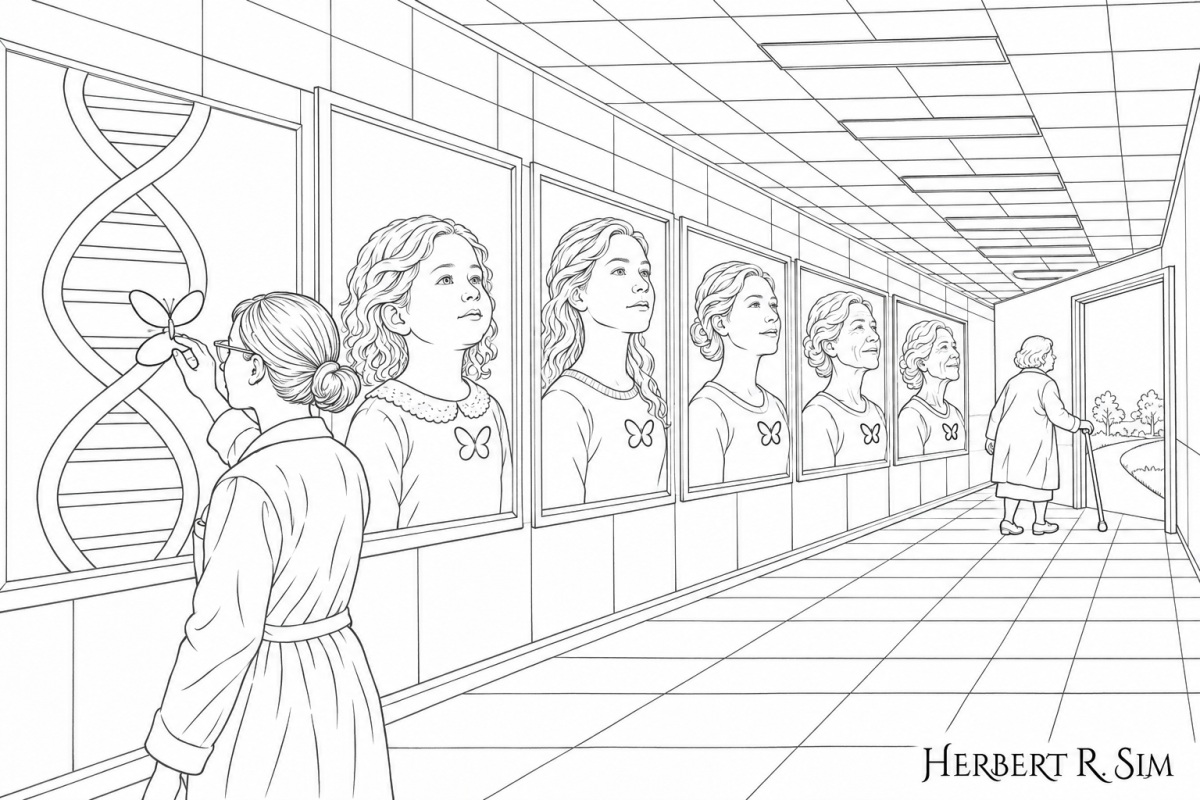
My illustration “The Blue Butterflies in the Hall” work-in-progress. The art represents that a person can still choose her own path after an irreversible genetic edit, with the blue butterfly evoking forced transformation in the “Project Monarch” conspiracy lore surrounding MK-Ultra.
Embryo editing and inherited effects
Last month, the organising committee of the Second International Summit on Human Genome Editing addressed the reported birth of twins following embryo editing in China. The committee held that proceeding with clinical germline editing remained irresponsible at the time. The episode brings into view a question that would survive even a substantial improvement in technical precision. The adults who can authorize an intervention are present at the decision. A person born after it must live with whatever effects it has, and any descendants who inherit the change enter the situation later still. [2, 3]
Embryo editing and germline intervention describe related features of a proposal. Editing an embryo concerns the stage at which the intervention takes place. Its potential to affect the germline concerns whether a change could be inherited. In the first case, the intervention precedes the affected person’s ability to decide and may have consequences during development. In the second, the possible reach of the decision extends beyond that person. Those two features can occur together, but they raise different questions about the scope of authority.
Suppose a proposed intervention could avert a severe disease in the first child. That benefit would matter even if some consequences were uncertain, and the absence of a reasonable alternative would strengthen the case for considering it. The National Academies’ 2017 report included the absence of reasonable alternatives and the prevention of serious disease or a serious condition among the criteria it proposed for considering any future clinical trials of heritable editing. The further question for Genomic Sovereigntism is whether reasons sufficient to act for the first child can justify the possible exposure of descendants. Their circumstances may differ from those in which the original choice appeared beneficial. The adults’ agreement does not supply their consent. [4]
Future generations inevitably inherit consequences of present decisions. The relevant question here is narrower. When identifiable actors intend to make a genetic intervention whose effects may be passed on, they must account for that reach in the decision they are making. They cannot eliminate uncertainty about future lives. They can be asked to justify why the anticipated benefit warrants making a choice whose effects may extend beyond the people for whom the benefit was assessed.
Reclaiming authority over what follows
Joel Feinberg’s account of a child’s right to an open future asks what options adults ought to preserve for the person a child will become. That question matters, especially where waiting would leave a decision available. Genomic Sovereigntism adds a question about who controls the decisions that come after an intervention. A person may inherit a change they cannot undo and still have a claim to decide how it is understood, managed, or responded to. The range of options available to them and their ability to govern the options that remain are both morally significant. [5]
Imagine that a person learns in adulthood that their genome was altered before birth. They request the clinical record, seek an independent opinion, and decline further participation in a research programme. They may also want access to appropriate care if a problem arises. Each decision is an exercise of authority in the present. Access to a record does not restore a previous biological condition, but withholding it could deprive the person of the information needed to make decisions about their own health. Likewise, refusing optional follow-up may leave the original change in place while ending a relationship the person never agreed to continue.
This matters for the obligations of those acting today. If an intervention gives rise to long-term care needs, a person’s ability to seek care should not depend on accepting unrelated research conditions. If future investigation may be valuable, the people who would participate should be able to make that decision when they can. Where information about the change bears on later choices, it should be preserved and made available to the affected person in a form they can use. These measures protect authority over what happens next. They supply no substitute for the judgment required before an irreversible intervention takes place.
The burden of deciding for the future
Before authorizing an intervention for another person, the decision-maker should be able to explain why it must happen now, what would be lost by waiting, and what authority the person will still be able to exercise later. The harder it is to give satisfactory answers, the less securely the decision rests on the decision-maker’s custodial role. The prospect of averting grave and irreversible harm can justify a choice that would be much harder to defend for an elective advantage. Where inherited effects are possible, the justification must also reach beyond the first anticipated benefit.
Irreversibility Principle
The harder a genetic intervention is for the affected person to reverse, reject, or escape, the stronger the justification required from those who authorize it. Where the person cannot consent, that justification must account for the cost of waiting, the availability of less permanent alternatives, and the authority the person can exercise once able to decide. Where effects may be inherited, it must also account for the people who may bear them in later generations.
References
- American Academy of Pediatrics, Committee on Bioethics. “Informed Consent in Decision-Making in Pediatric Practice.” Pediatrics 138, no. 2 (2016), e20161484. Article record
- Organizing Committee of the Second International Summit on Human Genome Editing. “Statement from the Organizing Committee on Reported Human Embryo Genome Editing.” November 2018. Statement
- Organizing Committee of the Second International Summit on Human Genome Editing. “Statement by the Organizing Committee of the Second International Summit on Human Genome Editing.” November 2018. Concluding statement
- National Academies of Sciences, Engineering, and Medicine. Human Genome Editing: Science, Ethics, and Governance. National Academies Press, 2017, chapter 5. Heritable Genome Editing
- Feinberg, Joel. “The Child’s Right to an Open Future.” In Freedom and Fulfillment: Philosophical Essays, 76–89. Princeton University Press, 1992. Originally published in 1980. DOI