
Meaningful public authority requires both a practical capacity to revise essential systems and dependable protection for the people who rely on them.

My illustration entitled: “The Aqueduct and the New Channel” – a community builds a new water channel alongside an ancient aqueduct. Both feed the same reservoir before the flow is carefully redirected. Preparing alternatives makes meaningful change possible without interrupting necessities.
When the power to change feels unusable
People may possess a formal power to replace an essential provider while knowing that using it could interrupt the service they need. A pensioner cannot live on the promise that a better payment system will eventually emerge. Yet a provider should not acquire permanent immunity from reconsideration because its service has become indispensable.
This is the difficulty I want Reauthorism to confront. Essential economic arrangements should preserve independently governed knowledge, resources and practical capacity through which affected publics can reconsider their purposes, rules and structures, even during success. By essential arrangements, I mean systems governing necessities or basic economic participation where dependence is substantial and alternatives are limited.
Preserving a capacity for change does not require exercising it immediately. People may investigate alternatives and decide to continue with the same provider. They may change a mandate, an access rule or a governing procedure while retaining the technical infrastructure. What matters is that continuation remains open to effective judgment.
I will focus on payments, particularly the delivery of pensions and income support. The service to preserve is people’s dependable access to money when they need it. A particular software platform, contractor or administrative structure is one means of providing that service, and must remain assessable as such.
Resilience and institutional change have predecessors
Aaron Wildavsky’s Searching for Safety (1988) distinguishes anticipating dangers from developing resilience through learning and adaptation. I take from this a warning against identifying safety with the avoidance of all change. I do not infer that people dependent on essential services should be exposed to uncontrolled experiments. The distribution and limits of possible harm remain decisive. [1]
Kathleen Thelen’s How Institutions Evolve (2004) examines institutional continuity and changes that can be incremental yet cumulatively transformative. It helps explain why reform need not take the form of a single rupture. Equally, gradual change deserves scrutiny: a sequence of small alterations can erode accountability as readily as improve it. That latter concern is my application of her analysis. [2]
Official continuity guidance also predates this proposal. The 2012 CPSS-IOSCO Principles for Financial Market Infrastructures, particularly Principle 17, addresses operational risk, continuity planning, recovery and testing. Its standards concern specified financial market infrastructures, including systemically important payment systems. I use its continuity reasoning without treating every benefit-payment platform as subject to identical requirements. [3]
In December 2019, the UK financial authorities proposed identifying important business services, setting tolerances for disruption, mapping supporting resources and testing severe but plausible scenarios. Those proposals were consultations, not the later final rules. Their focus on harm from losing a service provides a useful starting point for judging transition, alongside technical performance. [4]
What must remain available before failure
Continuity begins with institutional knowledge. Staff often understand exceptions, dependencies and recovery procedures that a procurement document omits. Retaining expertise requires training, succession arrangements and time for experienced workers to explain their judgment. A change of contractor should not destroy the only practical understanding of how the service operates.
Operational documentation should identify payment schedules, data definitions, access permissions, interfaces and procedures for resolving errors. Necessary records must remain usable by authorised successors and independent reviewers, with privacy and security protections. A public cannot assess an alternative adequately if all relevant knowledge remains at the incumbent’s discretion.
Transition planning must include the ability to discover that a proposal is not ready. Independent expertise, protected evaluation resources and accessible participation can make that discovery possible before users bear the consequences. Public authority includes the ability to require preparation and correction, rather than merely approve or reject a finished replacement.
Hypothetical scenario: changing a public payment service
Imagine a regional public agency whose contractor processes pensions and income support reliably. This is a hypothetical scenario. Concerned about inaccessible procedures and dependence on the contractor, the agency proposes a different platform and a governance process giving recipients and workers a continuing role in reviewing service priorities.
The proposal should be compared with improving the existing arrangement as well as retaining it unchanged. Its evaluation must cover correct payments, accessibility, staff competence, security and the ability to investigate future alternatives. A replacement that changes the supplier while reproducing dependence would require further justification.
In this hypothetical, an accountable public authority would determine acceptable transition risk within its legitimate mandate, after independent technical assessment and participation by recipients, workers and accessibility advocates. The relevant regulator would examine compliance within its remit. The supplier would provide evidence but would not decide alone how much disruption people should bear.
Published conditions should address due dates, recoverability of records, error detection and access to emergency assistance. They should distinguish inconvenience from consequences such as being unable to buy food. These conditions guide authorisation and safeguards; they cannot honestly promise that every possible error has been eliminated.
Implementation could begin with simulated cases and parallel calculations that do not issue duplicate payments. Limited live pilots could follow, with assistance and a credible route back. Pilots must examine difficult cases, including irregular documentation and assisted access, rather than demonstrate success only among users easiest to serve.
Staged migration should depend on evidence from each phase. Fallback arrangements require their own examination: an alternative channel sharing the same failed dependency may provide little protection. Restoring an earlier system also requires reconciling transactions already completed so that recovery does not create missing or duplicate payments.
Suppose testing reveals that recipients needing assisted verification cannot reliably access their payments. The authority should withhold wider deployment, require correction and set a date for reassessment. This would be a reasoned delay tied to an identified deficiency. It would neither vindicate abandoning reform permanently nor justify exposing those recipients to predictable harm.
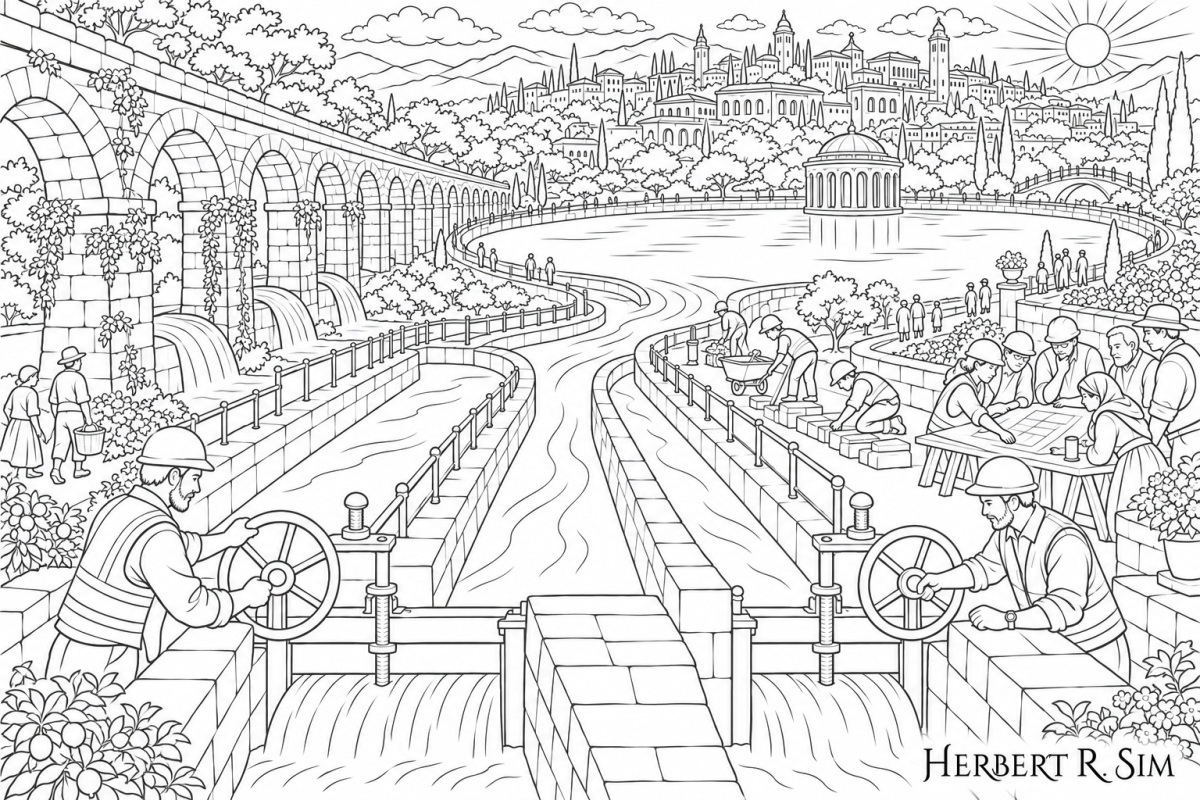
My illustration “The Aqueduct and the New Channel” work-in-progress. The art represents that meaningful reform requires building viable alternatives while keeping life’s necessities flowing, so dependence never becomes a barrier to change.
Who pays, and how can people challenge?
The transition budget should include training, documentation, temporary parallel operation, independent review and assistance for affected users. The public budget authority would authorise expenditure, while contracts would allocate suppliers’ responsibilities for defects and support. Taxpayers’ costs belong in the published assessment alongside benefits and risks.
Recipients should not become the involuntary financiers of a failed transition through unpaid bills, repeated travel or loss of essential income. The plan should provide timely assistance and a fair procedure for addressing losses. Different users may need different protections; equal treatment does not require assuming equal ability to absorb disruption.
Affected people need accessible channels to dispute both individual errors and the transition decision. I would propose independent review, funded assistance where needed and published reasons for proceeding, pausing or modifying the plan. Urgent complaints should reach someone able to authorise a practical remedy before ordinary review becomes too late.
These safeguards need defined powers and deadlines. They would not give each person a veto over the entire service. They would make challenge consequential and require the decision-maker to confront evidence from people whose experience may differ from the project team’s expectations.
Emergency restrictions must preserve a route back to judgment
The pandemic made these questions urgent within the historical setting. An April 2020 BIS Bulletin by Raphael Auer, Giulio Cornelli and Jon Frost warned that a faster shift towards digital payments could widen access difficulties for unbanked and older consumers. This was a contemporary warning about possible consequences, not a later finding that every predicted effect had occurred. [5]
In an emergency, an authority may have good reasons to postpone a demanding migration, restrict physical access temporarily or concentrate operational staff on maintaining payments. The justification should identify the threat, explain the restriction and consider less burdensome alternatives. Assisted channels must be assessed for actual availability rather than merely listed.
The UN Human Rights Office’s guidance of 27 April 2020 emphasised legality, necessity, proportionality, non-discrimination and the temporary character of emergency powers. My Reauthorist application is that exceptional operating restrictions should preserve meaningful scrutiny and a procedure for restoring ordinary opportunities to reconsider institutional direction. [6]
A justified temporary pause would retain records, explain reasons, publish a review date and specify conditions for resuming preparation. A measure cancelling independent evaluation indefinitely or making a temporary supplier’s position immune from review would require a different justification. Calling both measures necessary for continuity cannot settle their legitimacy.
Recovery also requires deliberate work. Emergency procedures, new dependencies and decisions made under pressure should be documented for subsequent examination. Restoring service is urgent, but it should be followed by restoring the resources and opportunities through which affected people can assess what should continue.
Two failures that continuity must not conceal
The first failure is reckless disruption pursued in the name of public control. A mandate to reform does not confer the knowledge needed for a safe handover. Leaders should not dismiss operational objections as disloyalty, compel vulnerable users to absorb avoidable harm or treat disruption as proof of political seriousness.
The second failure is permanent postponement pursued in the name of continuity. Every proposal can be made to look dangerous if the incumbent controls the evidence, independent capacity is never financed and zero risk is required only of alternatives. The existing arrangement also carries risks, including loss of knowledge and increasingly expensive dependence.
I would require delay decisions to identify the obstacle, the work needed to address it, responsibility for that work and a review point. Incumbents and reformers should face comparable evidential scrutiny. Where preparation repeatedly fails, the public should be able to question those responsible without gambling the next payment on an immediate replacement.
Safe revision therefore requires resources before a crisis. Documentation, retained skills and tested transition procedures cost money even when never used to replace the provider. Their value lies partly in making future choice credible. Proportionate preparation should be reviewed for usefulness, while ordinary service remains dependable.
The duty to keep change practically possible
Continuity planning, pilots, fallback arrangements and staged implementation are established practices. Reauthorism’s proposed contribution is a normative duty: essential institutions should preserve meaningful capacity for public revision before failure forces the issue, including while their performance is widely approved.
People should be able to retain a successful arrangement after informed examination and to pursue a different one through a credible transition. Preserving the service and preserving public authority support one another when institutions maintain the knowledge, resources and procedures that make change possible without treating those who depend on them as expendable.
Sources
- Aaron Wildavsky, Searching for Safety, Transaction Books. 1988. On anticipation, resilience and learning; linked through the current publisher.
- Kathleen Thelen, How Institutions Evolve: The Political Economy of Skills in Germany, Britain, the United States, and Japan, Cambridge University Press. 2004.
- Committee on Payment and Settlement Systems and Technical Committee of IOSCO, Principles for Financial Market Infrastructures. April 2012. Especially Principle 17 on operational risk and business continuity.
- Bank of England, Prudential Regulation Authority and Financial Conduct Authority, “Building Operational Resilience: Impact Tolerances for Important Business Services”. 5 December 2019. Historical announcement of coordinated consultation proposals.
- Raphael Auer, Giulio Cornelli and Jon Frost, “Covid-19, Cash, and the Future of Payments”, BIS Bulletin, No. 3. 3 April 2020. Contemporary analysis by the authors, whose views are not necessarily those of the BIS.
- Office of the UN High Commissioner for Human Rights, Emergency Measures and COVID-19: Guidance. 27 April 2020.