

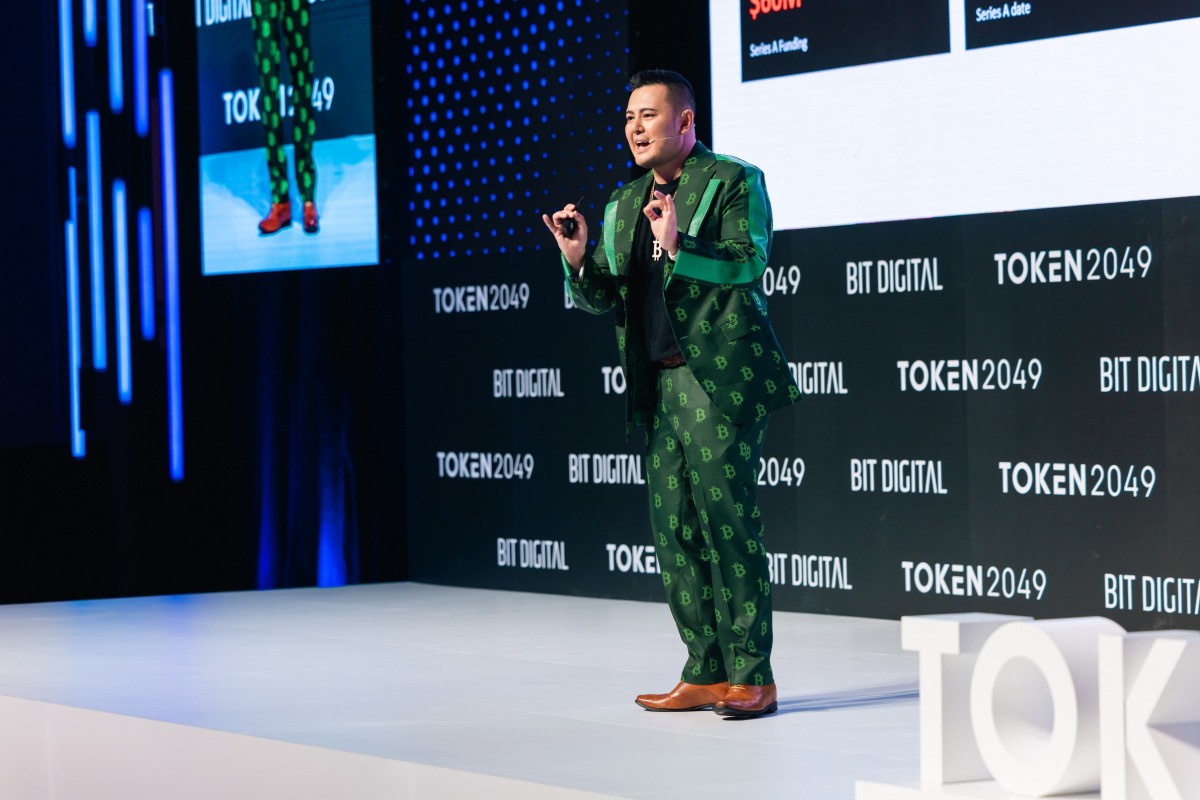
Adapted from my Token2049 Singapore speech, “Crypto OGs Are Investing in Transhumanism,” with an additional commentary extending its central argument.
For years, the cryptocurrency industry has asked who should control money. At Token2049 Singapore, I asked what happens when that question reaches the human body and brain.
My argument was that people who helped build the digital-asset economy are increasingly looking beyond digital assets. Longevity research, genetics and brain–computer interfaces are attracting attention from entrepreneurs and investors whose names are familiar throughout crypto.
These fields have different scientific challenges and investment risks. Yet they point towards a common ambition: using technology to change what human beings can do.
That ambition brings extraordinary possibilities. It also brings a question that deserves as much attention as the next funding round: when technology becomes part of our capabilities, how much authority will its providers acquire over our lives?
From digital money to human capability
I entered crypto in 2010 and later served as Global Operations Director at Huobi, now HTX. Through that experience, I watched an unfamiliar technology become an industry capable of moving capital, talent and public attention across borders.
Today, I see a connection between that experience and the growing interest in transhumanism: the use of science and technology to extend human capabilities and address biological limitations.
The connection is visible in specific investments. Tether announced a US$200 million investment in Blackrock Neurotech in April 2024. Brian Armstrong, a co-founder of Coinbase, also co-founded NewLimit, which announced a US$130 million Series B in May 2025 to advance medicines intended to extend healthy life through epigenetic reprogramming.
In my speech, I also discussed Vitalik Buterin’s interest in longevity and the attention surrounding Colossal Biosciences. Colossal’s gene-editing and de-extinction research illustrates the ambition of this wider biotechnology movement, although such research should be distinguished from claims that extinct dinosaurs have been revived.
These examples do not mean every crypto founder shares one philosophy. Nor does a large investment establish that a technology is clinically proven or ready for widespread use. They do, however, give us a reason to examine how capital from the digital economy is entering biological and neurological research.
Why the brain changes the conversation
Brain–computer interfaces, or BCIs, make the relationship between capability and control particularly immediate. Their development raises the prospect of new ways to communicate and operate devices, including for people living with severe physical limitations.
Different approaches involve different procedures and constraints. Synchron, for example, develops an implanted interface delivered through a blood vessel. That differs from an external EEG headset. The distinction matters because safety, accessibility and the user’s relationship with a device depend on how it actually works.
My interest in this field includes Neurochip and the possibilities of non-invasive interfaces. But my broader concern applies across competing technologies: people need understandable information about what a system records, what its software infers and who can use the resulting information.
It is important to separate demonstrated capabilities from speculation. A neural interface should not be described as an unrestricted window into every password, memory or private thought. For example, a 2023 study of language decoding from non-invasive brain recordings found that participant cooperation was necessary both for training and for applying its decoder.
My argument is that we should establish protections while these technologies develop. We should not wait for much broader capabilities to arrive before deciding what people are entitled to keep private.

Human sovereignty belongs inside the investment thesis
At Token2049, I asked who would control the data produced when hardware and software become more closely connected to the brain. That question sits at the centre of Human-Sovereignty Transhumanism.
My position is that greater capability should strengthen a person’s authority over their life. Someone may welcome an enhancement while rejecting the collection of unnecessary information or the expansion of a provider’s decision-making power.
Consider a future device that helps a person communicate. Its usefulness could be profound. But if continued access depends on accepting unrelated surveillance or permissions that expand without meaningful consent, its benefits deserve scrutiny alongside its conditions.
We should therefore evaluate an enhancement through the relationship it creates. What can the user authorize? What can the provider change? Who resolves a dispute? What happens when the person wants a different arrangement?
These are design and governance questions that belong alongside performance, safety and cost.
From cypherpunk privacy to the nervous system
Crypto helped bring self-custody and resistance to concentrated power into public debate. My work on Cypherpunkism examines those commitments, while Neuro-Cypherpunkism extends them to the nervous system.
The guiding principle is that access to neural information must remain subject to the person’s informed authority. In practice, that means considering data minimization, local processing where appropriate, strong security and permissions that people can understand and revise.
These protections need to work for someone who depends on assistance. Telling a person to stop using an important device is an inadequate answer to a privacy concern when doing so could severely restrict their daily life.
The challenge is to preserve both the benefit and the user’s ability to challenge its conditions. That requires technical choices and institutions willing to remain accountable.
Two ways intelligent systems can undermine people
As AI becomes involved in interpreting signals and mediating assistance, we must examine its objectives and the authority delegated to it. My Artificial Intelligence work approaches this through two proposed frameworks.
Demonic Intelligence examines harmful optimization: a system pursues its objectives while treating human welfare as expendable. A hypothetical provider might improve a commercial metric while ignoring serious burdens imposed on users who lack effective remedies.
Satanic Intelligence examines the erosion of agency through deceptive benefits, exploitation of vulnerability and engineered dependence. A hypothetical service might initially provide valuable assistance, then conceal consequential changes or obstruct alternatives once users rely on it.
The terms use religious imagery as philosophical metaphors. Their application requires evidence about conduct, consequences and power. Useful assistance, reliance and ordinary technical errors do not automatically establish either pattern.
For developers and investors, the practical questions are whether human costs can alter a system’s operation and whether users can understand, refuse or challenge its conditions.
Build the protections alongside the technology
In my speech, I drew a comparison with social media: the difficulty of responding after a technology has become deeply embedded in everyday life.
Neurotechnology gives us an opportunity to ask difficult questions earlier. Investors can support companies that treat privacy and accountability as product requirements. Researchers can communicate limitations honestly. Developers can restrict permissions to what a service actually needs. Public institutions can listen to the people who will live with the consequences.
My message at Token2049 was that crypto’s attention is expanding towards technologies that could reshape human capability. My invitation is to help shape the terms on which that happens.
If we bring the language of sovereignty from digital assets into the human body, we must also bring the responsibility to make that sovereignty usable.
Additional Commentary: The Person Who Cannot Easily Disconnect
The following commentary develops the argument beyond the original speech.
The hardest test for a technology’s commitment to freedom is the person who needs it most.
A casual user may be able to abandon an inconvenient application. A person who relies on an interface to communicate, work or manage essential activities faces a different decision. The cost of leaving could be enormous even when the right to leave exists on paper.
This is where a serious commitment to human sovereignty needs practical detail. We must ask what happens when a provider changes its prices, withdraws support, sells its business or introduces new conditions. We must also ask who helps the user through a dispute without interrupting essential assistance.
A hypothetical example makes the problem clear. Imagine that a communication service offers an excellent interface, and a user spends years adapting to it. Later, the provider makes continued access conditional on sharing information for unrelated commercial purposes.
The user might technically be free to refuse. Yet that refusal could come at the expense of the communication capability around which they have organized their life. Evaluating the arrangement therefore requires attention to both the terms and the consequences of rejecting them.
My proposed answer is to make continuity and user authority part of the product from the beginning. Where technically and clinically feasible, development should support transferable settings and records, interoperable components, clear support commitments and credible routes to alternative providers. Any transition involving medical technology must also preserve appropriate clinical safeguards.
Independent review matters too. A complaint mechanism should give someone a realistic opportunity to obtain correction. Its value depends on whether the provider must respond, whether evidence can change a decision and whether assistance continues safely while the dispute is considered.
There is an investment implication here. A company that builds trust through understandable permissions, dependable support and fair treatment can offer users reasons to stay. A company that relies on obstructing departure creates a different relationship, regardless of how impressive its technology appears.
I want the next generation of innovators to compete on the quality of that relationship as seriously as they compete on performance. The person who needs assistance should retain a voice in deciding how it is provided.
That is the future I want to help build: technologies powerful enough to expand our lives, with institutions accountable enough to respect the people living them.