
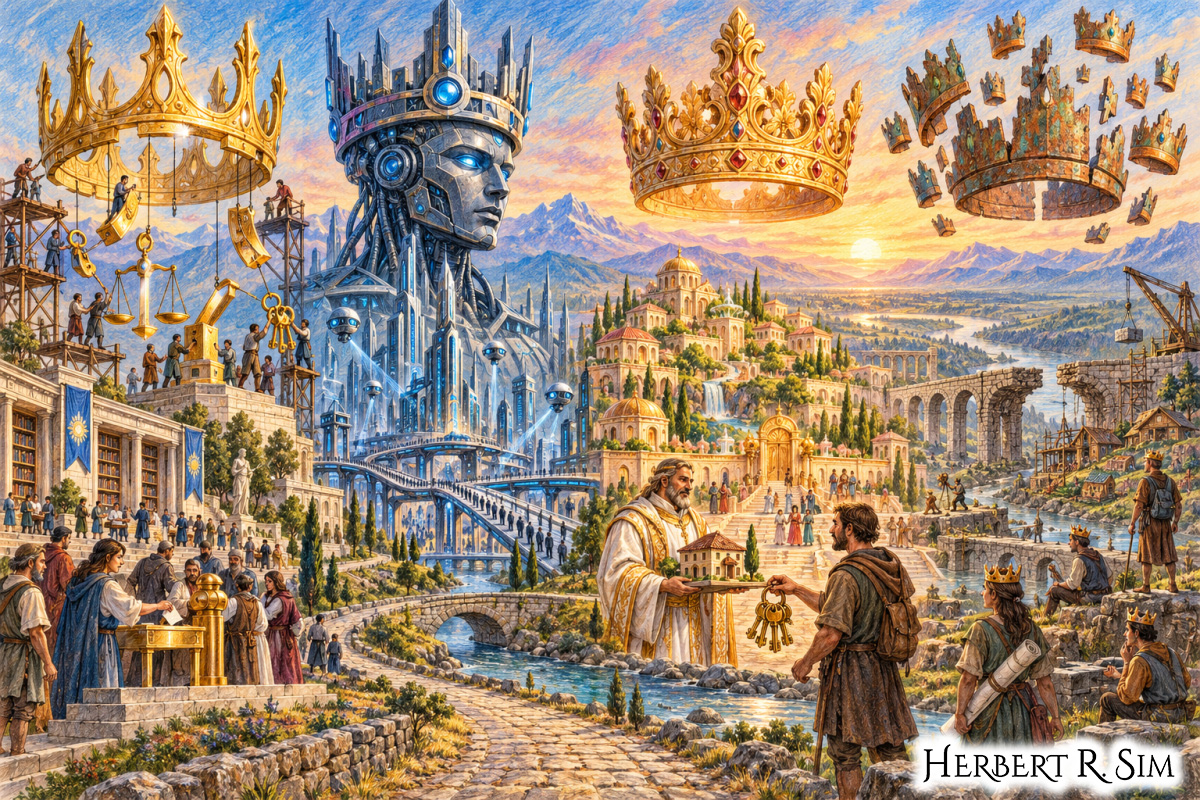
My illustration entitled: “The Four Crowns of Civilization” – Four colossal crowns hover above a shared landscape. Beneath the first, citizens divide a crown into tools of public authority; beneath the second, a machine wears it; beneath the third, a private provider offers comfort in exchange for the keys to the city; beneath the fourth, individuals hold separate crowns beside unfinished communal works.
Imagine waking in 2049. An intelligent system has organised your appointments, medical technologies support your health, and digital networks connect you to work, money and knowledge.
These capabilities could belong to radically different worlds. In one, you understand their conditions and retain meaningful authority. In another, questioning the system threatens your livelihood. In a third, extraordinary benefits exist primarily for people whose wealth or biological capabilities secure privileged standing.
The machines alone cannot tell us which world we inhabit.
The year 2049, chosen with a nod to Blade Runner 2049, offers a horizon for examining how technological power might shape civilisation. The central question is who controls artificial intelligence, human enhancement, digital infrastructure and economic participation.
I propose four possible futures: the Sovereign Civilization, the Algorithmic Civilization, the Corporate-Feudal Civilization and the Fragmented Civilization. They are analytical scenarios that may overlap. Their purpose is to clarify choices being made before dependence turns those choices into difficult facts of life.
1. The Sovereign Civilization
In the Sovereign Civilization, technological capability grows alongside people’s practical authority over their lives.
Artificial intelligence assists with research, administration and difficult decisions. Its permissions have boundaries. People can discover which consequential actions have been delegated, challenge errors and withdraw authority where withdrawal is legitimate and feasible.
Human enhancement offers opportunities to restore functions, extend healthy life and explore different forms of embodiment. Adoption remains voluntary. People who decline enhancement retain equal standing, while those who adopt it receive credible information about maintenance, risks and continuing support.
Digital infrastructure supports privacy and movement between providers. Essential records remain usable when a company fails. Economic systems allow independent enterprise, cooperative ownership and competition that newcomers can realistically enter.
Consider an ordinary worker changing employers. Qualifications transfer, essential healthcare continues, and leaving one organisation does not erase access to savings, communications or personal records. The freedom to move exists in practice.
This civilisation still faces scarcity, crime and disagreements about acceptable risk. Its distinguishing feature is the organisation of power: consequential decisions require justification, restrictions remain reviewable, and affected people possess usable means of correction.
Shared institutions sustain these protections. Reliable energy, education, public knowledge and accountable administration provide foundations that individuals could rarely build alone.
Its central achievement is continuity of agency. As technologies change, people retain the ability to understand their circumstances, shape common arrangements and pursue alternatives.
2. The Algorithmic Civilization
In the Algorithmic Civilization, opportunities increasingly depend on automated classifications and recommendations.
Systems rank applicants, allocate work, recommend treatment, select information and identify suspicious behaviour. Their outputs shape what people can obtain and which actions appear sensible.
Many decisions may be accurate and useful. The danger arises when institutional dependence on those decisions exceeds people’s ability to understand or contest them.
Imagine a resident seeking a new occupation. An employment system predicts poor suitability, a training service follows that prediction, and a lender treats the resulting lack of qualifications as evidence of risk. Each decision reinforces the next.
There may be no explicit prohibition against changing careers. The available routes nevertheless converge on an assessment the resident cannot effectively challenge.
People gradually learn to organise their behaviour around what systems reward. They select projects that produce favourable measurements and avoid unusual choices that might damage an enduring profile.
This civilisation need not be governed by one conscious machine. Government agencies, businesses and professional institutions could jointly create it through their reliance on compatible classifications.
The decisive question is whether human review can alter outcomes. An appeal becomes ceremonial when reviewers lack information, time or authority to disagree.
The path away requires limits on automated delegation, independent assessment and room for decisions that depart from statistical expectations. Technical performance must remain answerable to the people living with its consequences.
3. The Corporate-Feudal Civilization
In the Corporate-Feudal Civilization, a small number of institutions control access to essential capabilities.
The expression describes a possible relationship of dependence. It does not suggest that every large company is oppressive or that this future would reproduce historical feudalism exactly.
Its defining feature is the concentration of powers people need to live independently: computation, identity, payments, housing, medical support and access to customers.
Imagine a highly capable entrepreneur whose business depends on one integrated provider. The provider supplies the intelligent tools, authenticates customers, processes payments and maintains the entrepreneur’s enhanced prosthetic equipment.
A dispute over one service affects the entire relationship. Leaving requires replacing several essential systems simultaneously. The entrepreneur possesses advanced capabilities while having little bargaining power over the conditions attached to them.
Providers may deliver impressive convenience and security. Their dominance can grow precisely because joining is attractive. Dependence deepens as alternatives disappear or become incompatible with accumulated records and investments.
Ownership may increasingly mean ownership of assets whose productive use requires continuing institutional permission.
A sovereign response would examine separable services, interoperable systems, independent maintenance and enforceable limits on extending one restriction into unrelated activities.
Public authorities also require scrutiny. They might constrain concentrated power, become dependent on it or participate in comparable arrangements themselves.
The central danger is a society where effective citizenship depends on remaining acceptable to organisations that control the practical means of participation.
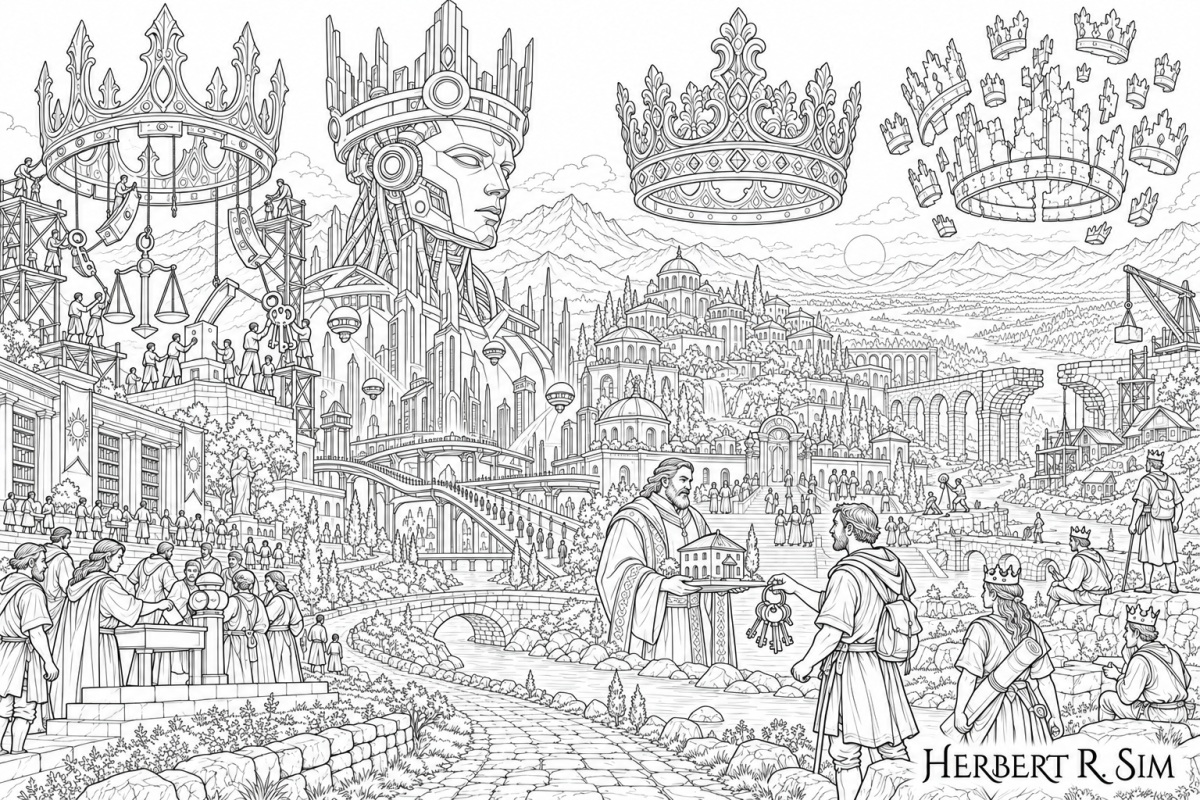
My illustration “The Four Crowns of Civilization” work-in-progress. The art represents that every civilization must answer who governs, what they control, and how their power can be challenged.
4. The Fragmented Civilization
In the Fragmented Civilization, technological differences harden into durable divisions of power and standing.
Some populations obtain expensive enhancements, exceptional educational support and powerful computational assistance. Others face exclusion, unreliable infrastructure or pressure to adopt technologies whose conditions they cannot negotiate.
Different capabilities alone do not establish injustice. People already vary, and a free society should accommodate substantial diversity. The deeper danger appears when differences become a basis for unequal rights or inherited exclusion.
Imagine a city where enhanced workers receive access to occupations, neighbourhoods and political influence unavailable to others. Schools prepare their children for further enhancement, while less privileged communities are treated as permanently unsuitable for advanced participation.
Advantage reproduces itself through institutions. Economic resources purchase capability; capability secures authority; authority shapes the rules governing future access.
Fragmentation could also occur between technological communities that cannot easily communicate or recognise one another’s qualifications. Even beneficial diversity may become isolating when shared institutions fail.
Preventing this outcome requires equal basic standing across differences in embodiment and capability. It also requires meaningful opportunities to learn, participate and obtain essential support.
Protecting people who decline enhancement belongs within that commitment. So does protecting enhanced people from compulsory service based on assumptions about what their abilities entitle others to demand.
A common world needs institutions capable of recognising difference without converting it into a hierarchy of human worth.
Four Scenarios, Interconnected Risks
These futures are not mutually exclusive destinations. One society might combine excellent public infrastructure with opaque automated administration. Another might offer strong privacy while permitting essential medical support to become concentrated in one provider.
Algorithmic allocation could reinforce corporate dependence. Concentrated ownership could finance unequal enhancement. Fragmentation could make accountable cooperation harder, encouraging further reliance on automated control.
The Sovereign Civilization must therefore be built across several relationships at once. A privacy safeguard cannot compensate for complete economic exclusion. An appeal procedure offers limited protection if challenging a decision immediately removes essential bodily support.
Assessment should follow the person through the connected arrangement. Which capabilities depend on which permissions? What happens during disagreement? Can a failure be corrected before it spreads?
The distribution of authority becomes clearest when cooperation breaks down. A system’s treatment of refusal and error reveals protections that ordinary convenience can conceal.
Building Toward 2049
Present decisions can widen or narrow future possibilities. Procurement can require transferable records. Medical development can include continuity planning. Digital services can separate essential functions from optional permissions. Economic policy can make room for independent builders and shared infrastructure.
These measures involve costs and trade-offs. They should be examined through evidence, public reasoning and the experience of affected people.
We should also preserve the ability to revise them. No generation can know every consequence of the systems it creates. Durable sovereignty requires institutions that can learn without treating established dependence as a reason to ignore harm.
The future will contain people whose capabilities, preferences and forms of embodiment differ from our own. Our responsibility is to leave them workable foundations for self-direction and cooperation.
By 2049, technological civilisation could make people more capable while leaving them less free. A sovereign future requires deliberate choices that keep expanding power accountable to human lives.