

My illustration entitled: “The Sky Held by One Cable” – A breathtaking civilization of floating islands hangs above an ocean of clouds. Each island appears independently supported, yet their suspension cables ultimately converge at one enormous clasp inside a private fortress.
Imagine an independent designer beginning an ordinary working day. Her account has been suspended pending a security review. At first, the problem appears limited to email. Then she discovers that the same account authenticates her document storage, customer management software and online shop.
She cannot retrieve current orders. Without access to her correspondence, she struggles to establish what customers purchased. Another service sends its recovery instructions to the email address she can no longer open.
One interruption has become several. Each lost capability makes the others harder to recover.
This hypothetical situation illustrates the problem of cascading dependencies: arrangements in which losing access to one system disables other important capabilities, sometimes including the means of obtaining correction.
For human sovereignty, the concern extends beyond inconvenience. A gatekeeper may acquire influence over an entire livelihood through control of one indispensable connection.
How Dependence Becomes a Cascade
Dependence is unavoidable in a cooperative society. Businesses need suppliers. Patients need professional expertise. Communications require infrastructure maintained by others.
A cascade arises when a disruption propagates through these relationships. A suspended payment facility prevents a business from renewing its hosting. Its website disappears, customers cannot contact it and lost income makes outstanding payments harder to resolve.
The resulting harm exceeds the immediate effect of the original decision.
This distinction matters because evaluating each service separately can conceal the structure connecting them. A hosting agreement may appear reasonable. A payment agreement may also appear reasonable. Their interaction can nevertheless leave a person unusually vulnerable.
We therefore need to examine what depends on a service, what that service itself depends on, and whether its failure disables the routes through which users could recover.
One Decision Can Govern Several Domains
A gatekeeper’s effective authority depends partly on the consequences of exclusion.
Refusal by one bookshop ordinarily leaves other places to buy books. Refusal by an organisation controlling identity verification, payments and essential records can affect several parts of life simultaneously.
The organisation need not explicitly demand obedience. People may avoid criticism or accept unfavourable conditions because they fear the wider consequences of losing access.
This power can emerge without a deliberate plan. Integration may begin as a useful effort to simplify administration. Over time, users organise more activities around the convenient connection.
The relevant question is how much practical authority the arrangement gives its controller. A narrow contractual role can produce broad influence when many other capabilities have come to depend on it.
Apparent Diversity Can Conceal a Common Dependency
Having several providers does not necessarily provide several independent paths.
Two communications services might rely on the same recovery account. Different online businesses might depend on one payment intermediary. Multiple applications may require approval from the same distribution channel.
The surface presents choice while the underlying structure preserves a shared point of failure.
We should distinguish diversity of names from independence of operation. A useful alternative must remain accessible under at least some of the circumstances that disable the original arrangement.
This does not require every system to possess separate infrastructure. Such duplication would often be costly and impractical. It requires identifying where shared dependence creates severe consequences and deciding whether those connections need additional protection, alternative access or stronger accountability.
When Recovery Depends on What Has Failed
The most troubling arrangements make correction conditional on access to the disabled service.
A person may need an account to submit an appeal about that account’s suspension. Proof of ownership may exist only inside inaccessible storage. A business may need frozen funds to pay for the professional help required to recover them.
These situations create a circular obstacle. The person must first recover something in order to use the procedure intended to recover it.
A sound recovery process should include an appropriately independent route. That might involve alternative verification, access to limited records or review through another channel.
Security remains important. Recovery procedures must resist impersonation and fraud. Their design should nevertheless account for legitimate users who have lost the very credentials or resources ordinarily required to prove their position.
The Ethical Importance of Proportionate Intervention
Gatekeepers sometimes have good reasons to restrict access. They must respond to fraud, compromised accounts, threats and serious contractual breaches.
The possibility of cascading harm does not eliminate those responsibilities. It changes what careful intervention requires.
An organisation should consider whether a restriction can be confined to the affected function. Suspending outgoing payments, for example, may not always require preventing access to transaction records needed for an appeal.
Urgency may justify acting before an explanation is complete. Subsequent review should examine the continuing need for the restriction and its broader consequences.
The severity of an allegation and the severity of every resulting deprivation are separate questions. A justified investigation should not automatically authorise avoidable disruption across unrelated activities. Decisions need boundaries proportionate to their purpose.
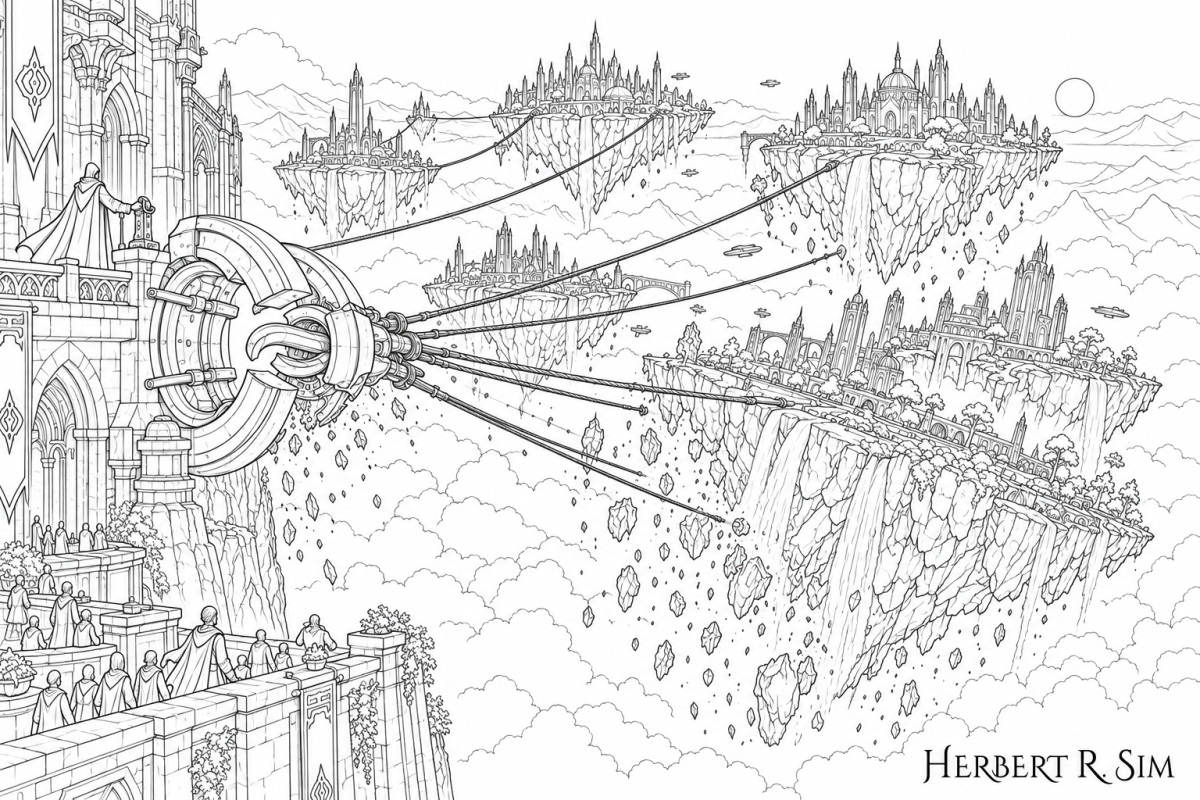
My illustration “The Sky Held by One Cable” work-in-progress. As the clasp opens, the nearest island drops, pulling others off balance.
The art represents that surface diversity can conceal a shared dependency capable of bringing everything down.
Preserve What Makes Recovery Possible
I propose a practical design commitment: where feasible and safe, restrictions should preserve the capabilities needed for correction, transition and basic continuity.
For an enterprise, this might mean retrieving invoices, contacting customers or exporting work already completed. For someone using an assistive device, it might mean maintaining an essential function while a billing dispute is resolved.
The appropriate provision depends on the relationship. Access to information cannot disregard another person’s privacy. Temporary continuation may be impossible where it would expose others to serious harm.
Nevertheless, these questions should be considered explicitly. Recovery should not be left to chance after a comprehensive shutdown.
Providers can identify minimum functions in advance and establish who may authorise their continuation. Users can then understand what protections remain available during a dispute.
Separate Powers Where Consequences Are Severe
Some dependencies are best addressed by separating control over functions that need not rise and fall together.
A person should be able to consider whether identity recovery, payment access and document storage require the same credentials or provider. Institutions can similarly examine whether one administrative decision unnecessarily controls several essential services.
Separation can limit the reach of an error. It can also prevent a disagreement in one relationship from becoming leverage over another.
There are costs. Additional accounts create management burdens, and poorly maintained alternatives may introduce security weaknesses. A complicated arrangement can become unusable.
The aim is considered independence at consequential points. Where separation is impractical, stronger safeguards may include independent review, documented recovery procedures and contractual limits on extending restrictions beyond their justified scope.
Portability Must Precede the Emergency
An exit route is most useful when prepared before access disappears.
Export tools should produce usable records, and people should understand which materials they may lawfully retain. An alternative supplier should be able to receive relevant information without demanding an impossible reconstruction of the original relationship.
Regular, proportionate checks can reveal whether a backup opens, whether a recovery address works and whether an alternative payment method is actually available.
These preparations require time and knowledge. Providers that encourage substantial dependence should help users understand foreseeable risks and available protections.
Responsibility cannot rest entirely with individuals, especially where the dependency is concealed. A customer may have no reasonable way to discover that apparently separate services share an indispensable intermediary. Meaningful choice requires sufficient disclosure of consequential connections.
Assess the Consequences for the Person
The same interruption can have very different effects on different people.
A large company may possess reserves, specialist staff and several established suppliers. A sole trader may have one income channel and little capacity to survive a lengthy review.
Assessment should consider how quickly harm develops, which essential activities are affected and what resources the person has for responding.
Duration matters alongside reach. A short interruption can cause lasting damage when it coincides with wages, rent or a critical delivery. Reinstatement does not automatically repair lost customers or missed opportunities.
Institutions should therefore consider timely review, correction of downstream records and appropriate remedies. Measuring only whether access was eventually restored overlooks the period during which a person’s practical freedom may have collapsed.
A Sovereign Future Needs Paths That Remain Open
Cascading dependencies connect the four frontiers of bodies, code, markets and machines. Software access can affect income. Income can sustain medical support. Identity credentials can govern access to both.
Protecting sovereignty requires attention to these connections as well as to individual products. We should ask which decisions can spread across domains, whether recovery remains independently accessible and what capabilities must survive while disputes are resolved.
Reliable integration can create enormous benefits. Its design should include limits on the reach of failure and accountable procedures for those affected.
A person’s freedom becomes more secure when losing one relationship does not also destroy the practical means of repairing it, replacing it or continuing ordinary life.