

My illustration entitled: “The Meeting of Our Possible Futures” – Several radically different transhumans gather around a simple stone table overlooking a magnificent landscape: a winged person, an aquatic person, a heavily bionic person, an ageless elder and an unenhanced human.
Imagine a public meeting attended by people with different forms of embodiment. One uses substantial external machinery to move. Another depends on a sensory interface disturbed by the room’s signalling equipment. Others need ordinary lighting, clear spoken discussion and seating that requires no technological connection.
Everyone possesses equal standing. Yet the same arrangement does not enable everyone to participate.
If future enhancements make bodily requirements more diverse, this difficulty could become increasingly prominent. The examples here are hypothetical, but the question is practical: how should people share institutions when their needs conflict?
Human Sovereignty Transhumanism must explain how equal personhood can become workable coexistence, through reciprocal accommodation and a fair distribution of the burdens involved.
Equal Rights Need Material Conditions
A right to enter a building offers limited freedom if its entrances, controls and evacuation arrangements cannot accommodate the person.
Likewise, formal access to transport matters little when boarding requires an unavailable configuration or payment method. Workplace equality remains incomplete when participation assumes a bodily capacity that some workers lack.
The design of shared environments distributes opportunity.
Human sovereignty therefore requires attention to the conditions through which rights are exercised. The question extends beyond whether institutions recognise a person to whether their arrangements permit meaningful participation.
A common world must be usable by different people, without requiring any one form of embodiment to supply the unquestioned template for everyone else.
No Body Is the Automatic Default
Existing environments reflect accumulated choices about dimensions, speed, communication and acceptable assistance.
Familiarity can make those choices appear neutral. A request for change is then described as a special burden, while the costs already imposed by the existing arrangement remain invisible.
Future enhancement could reverse the hierarchy without correcting the problem. Buildings designed exclusively for connected, faster or stronger users might exclude people who decline modification.
Neither familiarity nor technical novelty establishes priority.
The starting point should be equal consideration of actual needs. Design assumptions must be open to justification, with attention to who benefits, who is excluded and what realistic alternatives could improve participation.
Reciprocity Does Not Mean Identical Sacrifice
Reciprocal accommodation means treating the requirements of others as reasons that deserve serious consideration, while accepting justified limits on one’s own preferred arrangements.
It does not require everyone to make equal adjustments or bear equal costs.
A wealthy institution may be able to alter infrastructure more easily than an individual can change essential equipment. A minor scheduling inconvenience differs from losing access to work or community life.
Reciprocity should reflect those differences.
The aim is a defensible relationship among participants, rather than an exchange in which assistance is available only to those able to offer something equivalent in return. People with extensive support needs remain entitled to consideration.
Identify the Actual Conflict
A fair decision begins by describing what each person needs and what the proposed arrangement prevents.
Institutions should distinguish essential access, significant discomfort, preferred convenience and demonstrable safety concerns. These categories require context and the affected person’s account.
An unfamiliar body should not be presumed hazardous. Equally, a requested accommodation should not automatically override a substantiated risk to others.
The assessment should examine functions and consequences rather than labels such as enhanced, natural or normal.
It should also question the activity’s existing organisation. A conflict apparently arising between bodies may instead reflect an inflexible schedule, inaccessible interface or avoidable dependence on a single mode of communication.
Participation Must Begin Before the Decision
Affected groups should help identify problems, compare options and evaluate outcomes.
Inviting comments after design choices are fixed offers little influence. Participation needs accessible information, time, communication support and a realistic possibility of changing the proposal.
No representative can speak perfectly for everyone sharing a bodily characteristic. Institutions should recognise differences within groups and hear people whose circumstances are less visible.
Technical expertise remains important, but should inform deliberation rather than replace the experiences of those using the space.
Participants should not need to disclose unnecessary intimate information to explain a relevant requirement. The process must make needs intelligible while protecting privacy and avoiding public judgments about the worth of particular bodies.
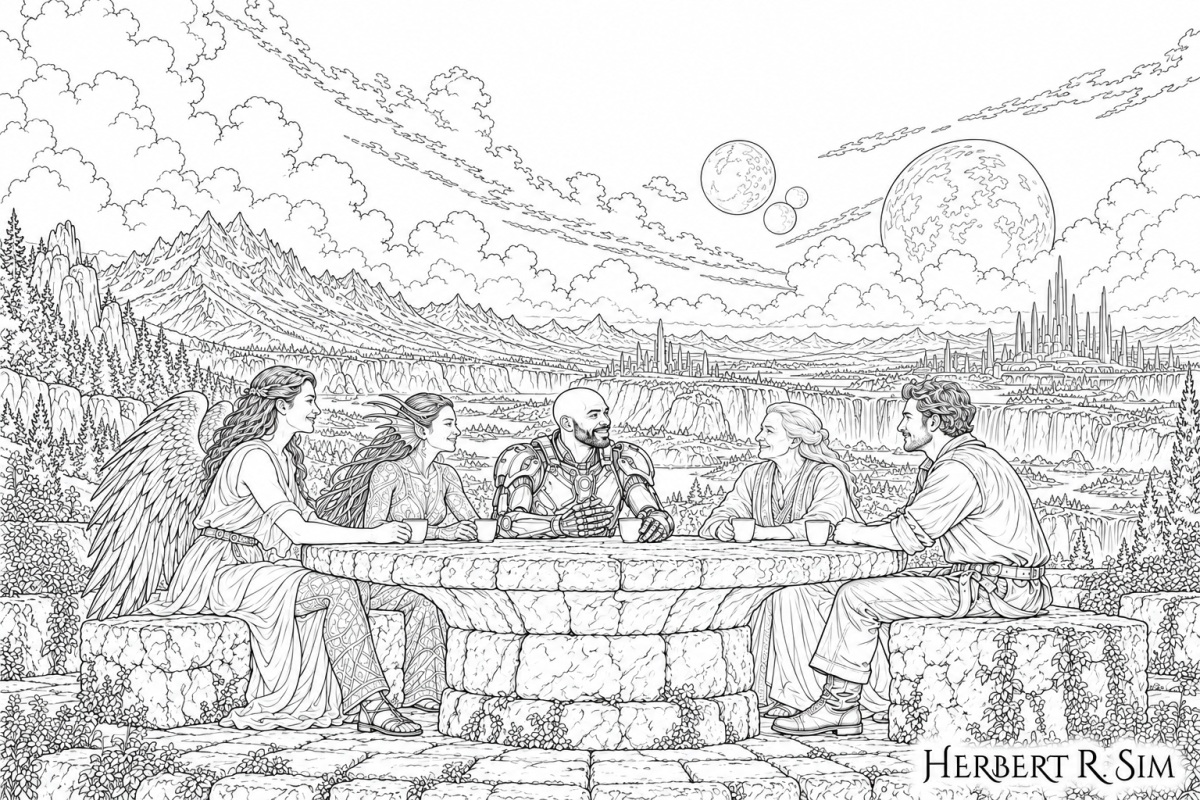
My illustration “The Meeting of Our Possible Futures” work-in-progress. All sit at equal height beneath an immense sky. The art shows that humanity can remain a community while its forms diverge.
Compare Arrangements Before Restricting People
Decision-makers should examine several workable responses rather than assume that one person’s exclusion is inevitable.
Possibilities might include adjustable environments, alternative interfaces, different routes or changes to how an activity is organised.
A design serving several needs together may be preferable to separate arrangements. Yet no single configuration can be presumed suitable for every body.
Where differentiated provision is necessary, it should offer meaningful access to the same purposes. A nominal alternative that is slower, isolated or routinely unavailable may preserve exclusion under another name.
Institutions should compare effectiveness, safety, dignity, cost and ongoing support. The preferred option should explain why its burdens are justified relative to the alternatives.
Share Costs According to Relevant Reasons
Fair burden-sharing requires more than assigning every expense to the person requesting accommodation.
Relevant considerations include control over the environment, ability to provide resources, benefits received and responsibility for avoidable barriers.
Manufacturers should consider foreseeable compatibility needs. Employers and transport operators should examine how their ordinary arrangements distribute access. Public institutions may need to support infrastructure whose benefits extend beyond one organisation.
Whether an enhancement was chosen can inform discussion without settling it. Voluntary action does not automatically cancel a person’s claim to participation, just as an individual choice does not create an unlimited claim on common resources.
Costs should be identified honestly and distributed through reasons that affected people can question.
When Resources Cannot Satisfy Every Need
The strongest objection is that divergent requirements could exceed available space, money or technical capacity.
This concern cannot be answered by promising universal compatibility.
Where genuine limits remain, priority should consider the seriousness of exclusion, urgency, available alternatives and whether particular people repeatedly bear the burden.
Essential participation should generally carry greater weight than marginal convenience. Interim arrangements should reduce harm while institutions pursue feasible improvements.
Decisions must identify unmet needs and explain why further accommodation is presently unavailable. They should remain open to review as resources or knowledge change.
Scarcity may justify a constrained outcome. It does not establish that the least powerful group should always absorb the constraint.
Accommodation Must Not Become Compulsory Enhancement
An institution might claim that modifying the person would be cheaper than changing the environment.
That comparison cannot by itself justify requiring enhancement.
Bodily intervention carries interests that an infrastructure budget cannot adequately represent. Refusal must receive serious protection, including where a technological majority regards modification as ordinary.
The same principle protects enhanced people against demands to remove or disable essential equipment merely to preserve familiar appearances.
Operating restrictions may sometimes be justified by specific hazards. They should remain necessary, proportionate and connected to the activity concerned.
Accommodation should support coexistence between persons. It should not become a disguised programme for making all bodies conform to whichever form currently dominates.
Bring the Meeting Back Into View
Return to the public meeting. The organisers would first ask participants which barriers prevent meaningful attendance. They would investigate whether the signalling equipment can be adjusted, whether routes and seating can accommodate mobility requirements and whether discussion can remain accessible without requiring a connected interface.
Technical assessment might reveal a configuration that serves everyone. If not, the group could compare options that preserve shared deliberation through different channels. Separate channels should not mean that some participants receive information late or lose opportunities to influence the discussion.
Costs would then be assigned with attention to institutional resources and responsibility for the venue. An individual should not automatically finance a building alteration simply because their body exposes a limitation in its design.
If a temporary compromise remains necessary, organisers should explain it, identify who bears its disadvantages and arrange review. Repeatedly asking the same participants to miss meetings would reveal that the compromise has become a pattern of exclusion.
No participant receives unrestricted control over the room. Each receives a claim to serious consideration within a process that can examine needs, consequences and alternatives. The result may involve adjustments by several parties, but those adjustments should follow defensible reasons rather than assumptions about whose body naturally belongs. Success means that participants can meet as members of the same community, with an opportunity to take part and a route to improve arrangements that still exclude them.
Keep the Common World Open to Revision
People need accessible ways to challenge failed accommodations, overlooked needs and unfair distributions of cost.
Review should examine actual use rather than rely solely on design intentions. A supposedly accessible arrangement may fail during congestion, maintenance or emergencies.
Human Sovereignty Transhumanism should connect equal personhood with reciprocal responsibilities: participation in decisions, proportionate adjustments and accountability for persistent exclusion.
The objective is a shared world whose institutions can adapt as its people differ.
Humanity can diverge in form without dividing into superior and tolerated bodies. Building that future requires treating accommodation as a continuing responsibility of common life, with neither enhancement nor its refusal setting the unquestionable terms.