
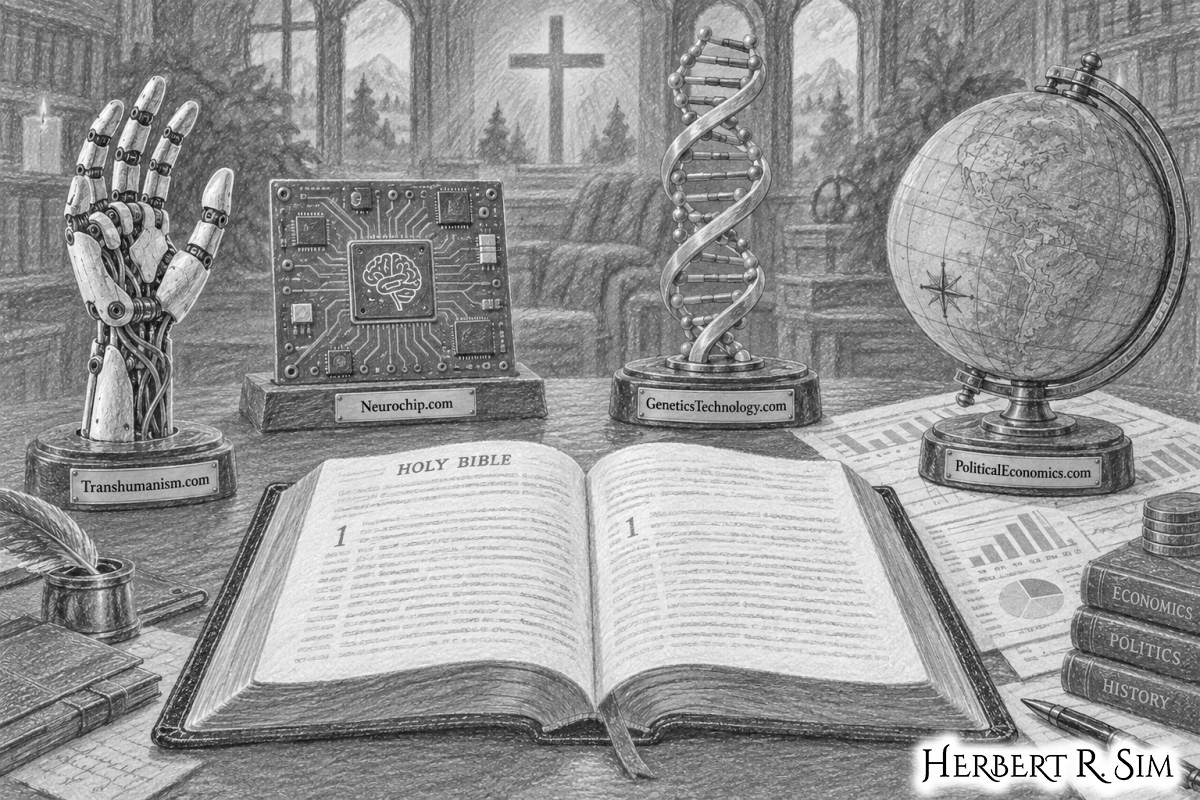
My illustration entitled: “Four Domains, One Conscience” – An editorial still life places four objects around an open Bible: a prosthetic hand, a neural circuit board, a DNA model and a globe resting on economic documents. Small engraved plaques carry the four domain names.
As a Protestant Christian, I find that some of the most important questions about technology begin with questions about faith. What does it mean to be human? How should we use the power to change our bodies? What happens when the systems we depend upon demand obedience at the expense of conscience?
These questions explain the purpose I see in acquiring four domains: Transhumanism.com, Neurochip.com, GeneticsTechnology.com and PoliticalEconomics.com. Each names a different field, but together they express a common concern: how humanity will exercise growing power over life, thought and economic participation.
The Bible does not provide a technical manual for tomorrow’s inventions. It provides a moral foundation for examining our ambitions. I want these domains to become places where scientific possibilities can be considered alongside responsibility, humility and the freedom to remain faithful to God.
The human being and the promise of enhancement
Transhumanism.com brings me to a fundamental question: what should human beings seek to become?
The possibility of extending life, restoring physical abilities and overcoming disease deserves serious attention. A Christian commitment to compassion gives us reasons to welcome medicine that relieves suffering. Caring for the sick is a responsibility, and scientific knowledge can help us fulfil it.
Yet the desire to improve human life can become an ambition to make humanity answerable only to itself. Genesis describes people as made in God’s image. For me, this means human worth precedes physical strength, intelligence, productivity or longevity.
If enhancement becomes available, the person who declines it must retain the same dignity as the person who accepts it. We should also question promises that technical progress will resolve every human failing. Longer life cannot, by itself, cure cruelty or teach us to love our neighbour.
My interest in Transhumanism.com is therefore both hopeful and questioning. I want to explore the possibilities of human enhancement while examining the spiritual assumptions behind its promises.
The connected mind and the mark of the beast
Neurochip.com concerns a more intimate frontier: the relationship between electronics and the human nervous system.
A technology that helps someone communicate or regain a lost ability could bring immense good. But any approach that enters such a personal part of life also raises questions about consent, privacy and control. Who decides how it is used? Could an individual refuse it without losing access to ordinary life?
Revelation 13:16–18 describes a mark associated with the beast, restrictions on buying and selling, and the number 666. What draws my attention is the relationship between allegiance and economic participation. A person’s ability to live within society becomes conditional upon compliance.
I cannot conclude from that passage that a particular implant is the mark of the beast. Scripture does not identify a neurochip, and speculation should not be confused with certainty.
Nevertheless, the passage gives Christians reason to scrutinise systems that join bodily identification, compulsory allegiance and economic exclusion. The ethical concern becomes especially serious when a useful technology becomes a condition of participation.
I acquired Neurochip.com to explore this frontier with an open mind and an alert conscience. Its medical possibilities deserve study; so do the conditions under which those possibilities might become instruments of power.
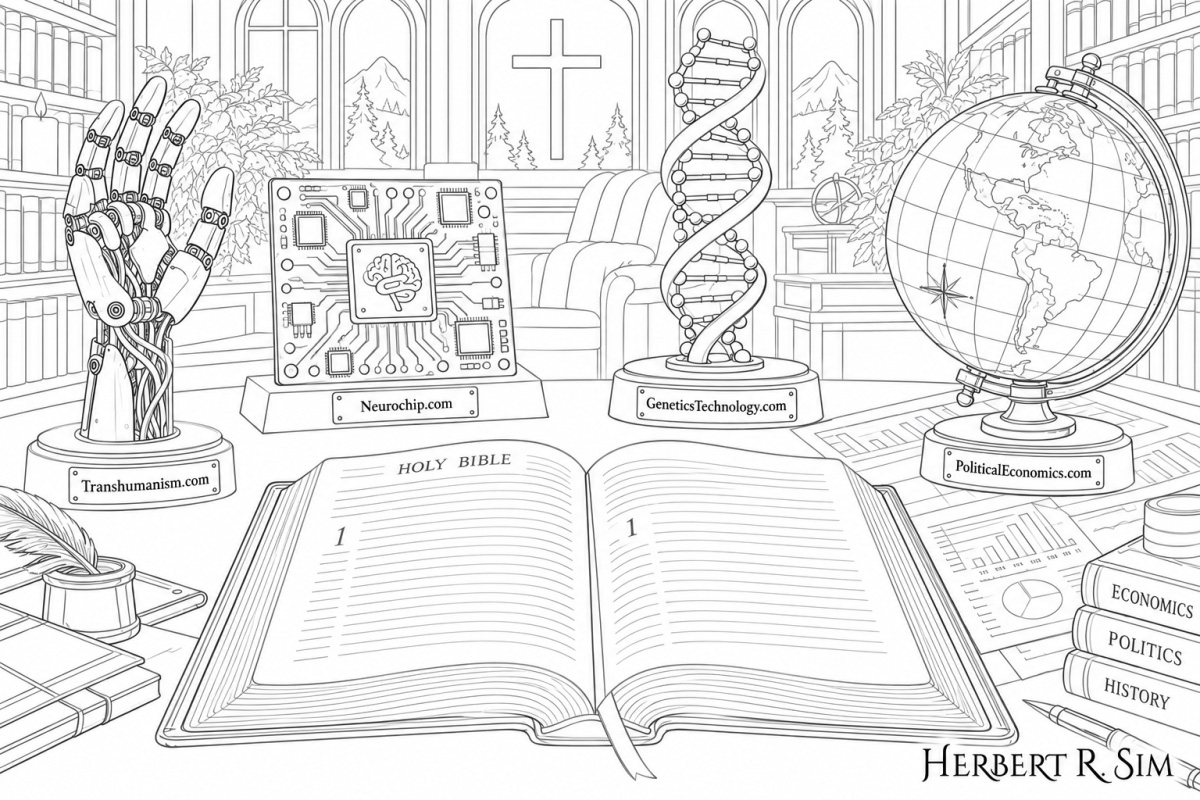
My illustration ains, One Conscience” work-in-progress. The art places faith at the heart of human enhancement, neurotechnology, genetics and economic power, asking that progress remain accountable to God and human dignity.
Genetics and the Days of Noah
GeneticsTechnology.com addresses the power to intervene in the biological inheritance of life.
Understanding inherited disease may offer opportunities to prevent suffering. Yet the ability to alter life also demands that we ask what purposes should guide us. Healing an illness and selecting the characteristics of future people raise different moral questions.
My Christian reflections lead me to the Days of Noah. Genesis 6 describes a world marked by corruption and violence. In Matthew 24:37–39, Jesus recalls people continuing ordinary life, unaware of the judgment approaching them.
Neither passage explicitly describes genetic engineering. I would therefore present the connection as a moral analogy: human activity can continue confidently while people fail to recognise the seriousness of their condition.
Some readers connect the difficult account of the “sons of God” and the Nephilim with speculation about altered humanity. That interpretation is disputed and cannot establish a scientific account of ancient genetic manipulation.
For me, the more useful question is whether our growing ability to change life will be accompanied by greater moral responsibility. Could commercial ambition turn future children into designed products? Would people with disabilities be treated as less worthy?
GeneticsTechnology.com gives these questions a home. Scientific possibility should invite careful reflection on the people who will bear its consequences.
Political economy and principalities
PoliticalEconomics.com connects these concerns to the institutions that organise collective life.
Technologies operate within arrangements of ownership, law, finance and authority. A medical device may offer freedom, while the terms governing its use create dependence. A scientific advance may benefit humanity, while access to it deepens inequality.
Ephesians 6:12 describes a struggle beyond flesh and blood, involving principalities, powers and spiritual wickedness. I understand this as a reminder that confronting evil requires more than identifying individual opponents.
It does not justify declaring every government, business or institution evil. It does prompt me to examine how greed, deception and domination can shape systems and become accepted as ordinary practice.
Revelation’s restriction on buying and selling makes political economy particularly relevant. Control over participation can exert tremendous pressure on conscience. People may formally possess a choice while facing unbearable consequences for exercising it.
I want PoliticalEconomics.com to examine the relationship between power and livelihood: who establishes the conditions of exchange, whose interests those conditions serve, and whether people can resist injustice without being deprived of the means to live.
Four domains, one responsibility
These four domains represent connected areas of inquiry. Transhumanism.com concerns human enhancement; Neurochip.com, the connected mind; GeneticsTechnology.com, biological inheritance; and PoliticalEconomics.com, the structures governing our choices.
My faith gives me reasons to pursue these subjects with hope and caution. Scientific discovery can serve our neighbours. It also expands the responsibilities of those who develop, own and govern it.
I do not claim to possess a timetable for prophecy or a definitive identification of future instruments of evil. I want to ask questions early, encourage thoughtful discussion and judge promises by their effects upon human beings.
The purpose of acquiring these domains is to create room for that inquiry. As our power grows, we must keep asking whether we are using it to care for one another – and whether our ambitions remain accountable to God.