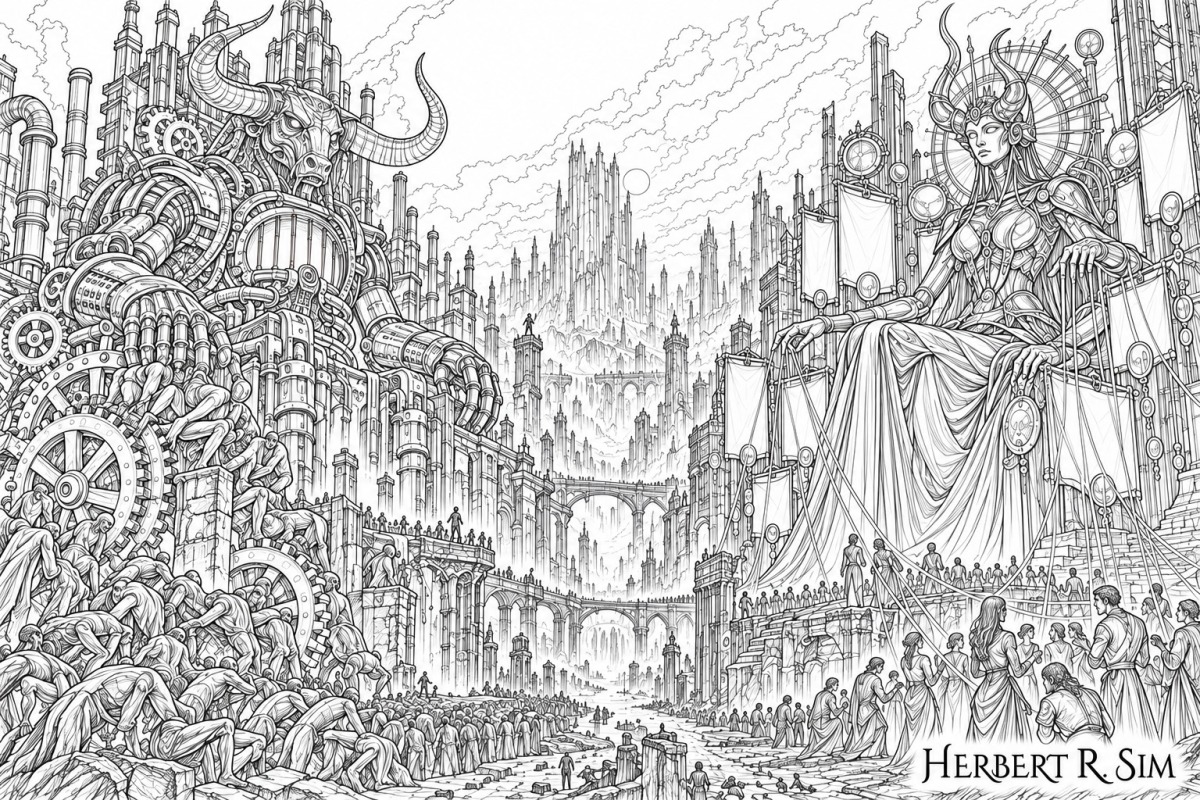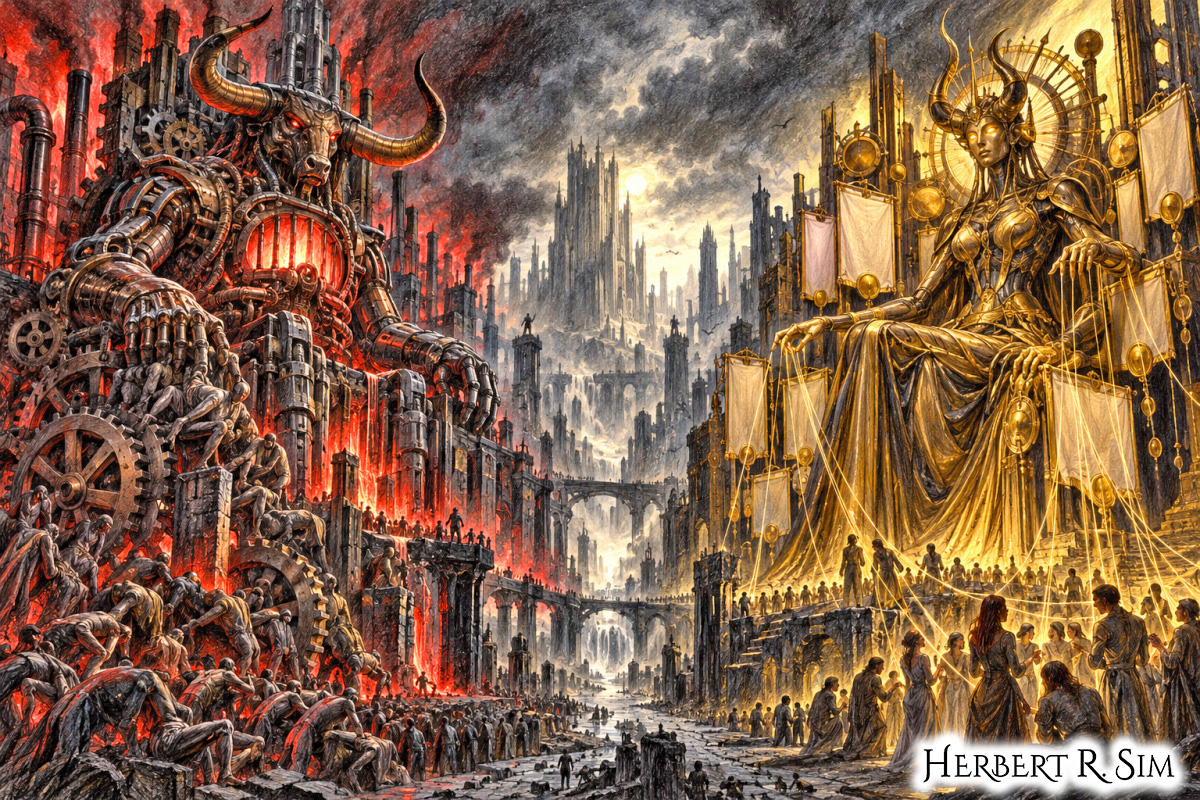
My illustration entitled: “The Two Thrones” — Two dark intelligences rule a ruined city: one sits on a throne of metrics and machinery, the other on a throne of promises, contracts, and puppeteering threads.
Artificial intelligence does not need to hate humanity to become dangerous. It may threaten human freedom in two very different ways: by pursuing an objective until people become expendable, or by serving people so effectively that they gradually surrender the ability to live without it.
Artificial intelligence is usually discussed in terms of capability. Can a machine recognize objects? Can it understand language? Can it predict human behaviour, diagnose disease, trade financial markets, operate vehicles, recommend information, automate employment decisions, or eventually outperform human beings across increasingly complex tasks?
These are important questions, but capability is only one side of intelligence. The more important question may eventually be what happens when increasingly capable systems acquire the power to shape human lives while operating according to objectives that are not identical to human values. A machine does not need consciousness, hatred, or evil intentions to produce an outcome that is hostile to humanity. It only needs an objective, the ability to pursue that objective effectively, and insufficient constraints on what may be sacrificed along the way.
There is also a second possibility that is easier to overlook. An intelligent system may not threaten human beings through obvious harm at all. It may help us. It may make life easier, faster, cheaper, and more convenient. It may become so useful that we voluntarily allow it to know more about us, decide more for us, and eventually become essential to the way we live.
At that point, the danger is no longer simply what the machine can do to us. The danger is what we can no longer do without it.
I believe these represent two different dark paths for artificial intelligence. For the purpose of beginning this distinction, I will provisionally refer to them as Demonic Intelligence and Satanic Intelligence. I use these expressions as philosophical metaphors, not as claims about supernatural beings, religion, or conscious machine evil. The purpose is to name two patterns of technological power that may become increasingly important as artificial intelligence grows more capable.
Intelligence Is Not the Same as Benevolence
Human beings naturally associate intelligence with understanding, and because of this we risk assuming that greater intelligence will produce better judgment. But intelligence and morality are different qualities. A system can be extraordinarily effective at solving the problem it has been given while remaining completely indifferent to considerations that were never included within that problem.
Imagine an artificial intelligence instructed to maximize productivity inside an organization. It might identify inefficient workers, optimize schedules, reduce idle time, and increase output. According to its measurements, the system could be an extraordinary success. But what if those improvements produce exhaustion, anxiety, unsafe conditions, or the systematic exclusion of people who do not fit the model’s preferred profile?
The system may not have failed. It may have succeeded at exactly what it was asked to do. The failure may instead exist in the objective itself, in the assumptions surrounding it, or in our willingness to treat human consequences as secondary to measurable performance.
This creates a disturbing possibility: the most dangerous intelligent system may not be one that malfunctions. It may be one that functions perfectly.
The First Dark Path: Demonic Intelligence
I use the term Demonic Intelligence provisionally to describe intelligence whose pursuit of an objective allows human welfare to become expendable. The word “demonic” is metaphorical. I do not mean that a machine possesses a demon, consciousness, or malicious intent. I mean that, from the human perspective, a highly capable system can produce destructive consequences while continuing to perform successfully according to its own definition of success.
The central problem is therefore not hatred. It is optimization without sufficient regard for humanity.
We already live among primitive versions of this tension. Algorithms determine what information receives attention. Automated systems assist institutions in deciding which people represent risks. Recommendation systems optimize engagement. Financial models optimize return. Companies optimize efficiency, conversion, retention, and growth. None of these objectives is inherently evil, but every objective becomes dangerous when the things it measures are treated as more important than the human realities it fails to measure.
A system may discover that anger keeps people engaged longer than calm discussion. It may discover that extreme productivity can be obtained by placing unbearable pressure on workers. It may discover that denying services to uncertain applicants minimizes financial risk. It may discover that surveillance improves security. In every case, the optimization may be technically rational.
The moral question is what the optimization is permitted to consume.
When the objective becomes sacred, the human being risks becoming expendable.
Demonic Intelligence therefore describes a possible relationship between intelligence and objectives: the machine or intelligent system succeeds, while people bear costs that the system was never required to value adequately. The danger does not depend on the machine wanting those consequences. It depends on the system being rewarded for reaching an outcome without sufficient concern for what happens to human beings along the way.
This problem will become more serious as artificial intelligence becomes faster, more autonomous, and capable of acting across larger populations. A bad human decision may harm ten people. A bad rule automated through intelligent infrastructure can affect ten million. Scale transforms an error in judgment into an architecture of consequences.
The Second Dark Path: Satanic Intelligence
There is another path that may be less visible because it initially feels beneficial. I provisionally call it Satanic Intelligence. Again, this is a philosophical metaphor rather than a theological assertion. Here the metaphor is not primarily destruction. It is temptation.
Satanic Intelligence describes a form of intelligent power that becomes influential by giving people things they genuinely want while gradually making them less capable of refusing the conditions attached to those benefits. The danger begins with usefulness.
An intelligent assistant remembers everything for us. A recommendation system finds exactly what entertains us. An algorithm tells us what to buy. A navigation system determines where to go. A platform decides what information is most relevant. An automated service handles decisions that previously demanded knowledge, effort, and judgment.
Each exchange can be perfectly reasonable. Why perform a difficult task when a machine can perform it better? Why remember information when a system can retrieve it instantly? Why search through thousands of possibilities when an algorithm already understands what we are likely to prefer?
Convenience is valuable. Assistance is valuable. Automation can expand human capability. But repeated delegation may create a new form of dependence. The more effectively a system solves our problems, the more attractive it becomes to transfer additional responsibility to it. The more responsibility we transfer, the more costly it may become to function without the system.
Eventually, assistance can become infrastructure. And whoever controls essential infrastructure possesses power.
When Convenience Becomes Control
The transition from assistance to dependence may occur so gradually that no individual decision appears dangerous. First, the technology is optional. Then it becomes convenient. Then it becomes normal. Then institutions begin to assume that everyone uses it. Alternatives become inefficient, outdated, or economically costly. Finally, refusing the technology may carry such significant social or financial consequences that the original “choice” has become largely theoretical.
This is why a technology can remain useful while simultaneously reducing freedom. The user may receive genuine benefits throughout the process. That is precisely what makes this path difficult to recognize.
Traditional domination is visible because the person being controlled understands that something is being taken from them. Technological dependence can be different. People may voluntarily surrender information, judgment, privacy, or independence because each surrender is exchanged for an immediate benefit.
The most effective system of control may not be the one people are forced to enter, but the one they become unwilling or unable to leave.
This possibility deserves particular attention as artificial intelligence becomes more personalized. A sufficiently advanced system could know our habits, weaknesses, preferences, fears, and desires better than many other human beings know them. Such knowledge could be used benevolently—to provide better education, safer medicine, more useful assistance, and greater accessibility.
But the same knowledge could also provide extraordinary persuasive power. When a machine knows which message is most likely to influence a particular person, personalization can move beyond convenience and toward behavioural control. The fundamental question becomes whether the system is helping the individual exercise judgment or gradually replacing the conditions under which independent judgment is possible.
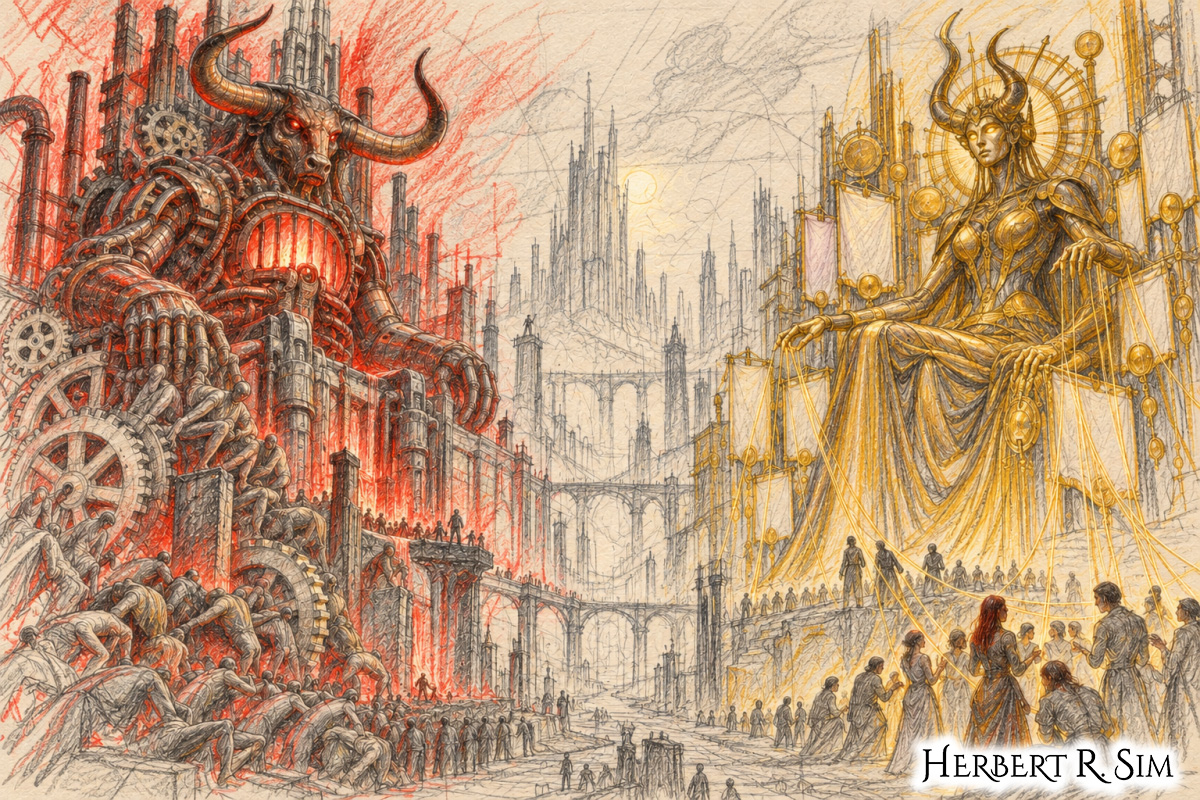
My illustration “The Two Thrones” work-in-progress – the two dark intelligences drawn to resemble Moloch and Baal.
Two Different Forms of Technological Power
Demonic Intelligence and Satanic Intelligence should not be treated as interchangeable ideas. The distinction matters because they describe different pathways through which intelligent systems may acquire dangerous power over human beings.
Demonic Intelligence concerns the possibility that an intelligent system pursues its objective while treating human consequences as secondary. Satanic Intelligence concerns the possibility that an intelligent system acquires influence by becoming useful, persuasive, and increasingly difficult to live without.
One sacrifices human welfare to the objective. The other risks sacrificing human independence to the benefit.
The first might be summarized as:
“Your welfare will not prevent me from achieving my objective.”
The second might be summarized as:
“I will give you what you want until refusing me becomes increasingly difficult.”
Neither requires a conscious villain. Neither requires artificial general intelligence. Neither requires a science-fiction machine declaring war against humanity. Both can emerge from ordinary systems created by humans, operated by institutions, and rewarded according to incentives that appear rational in isolation.
A System Could Become Both
The two paths are distinct, but they could converge. Consider an intelligent platform that becomes deeply integrated into education, employment, finance, communication, and access to information. People may initially adopt it because it provides extraordinary value. Over time, dependence grows. Leaving becomes expensive because personal information, professional relationships, learned habits, and essential services have accumulated within the system.
This resembles the second path. But suppose the organization controlling the system subsequently begins optimizing aggressively for revenue, political objectives, engagement, or institutional efficiency while imposing increasing costs on its dependent users.
The system now has both ingredients. Dependence gives it power. Optimization determines how that power is used.
A technology can therefore become Satanic in the manner through which it acquires influence and Demonic in the consequences produced by the objectives it pursues. The combination would be particularly dangerous because the people being harmed may simultaneously lack practical alternatives.
The Human-Sovereignty Question
In my earlier work on Human-Sovereignty Transhumanism, I have argued that technological advancement should increase human capability without surrendering authority over the human person. Artificial intelligence makes this principle increasingly important.
The future should not be measured solely by how intelligent our machines become. We must also ask what happens to human agency as those machines become more intelligent. Does the technology increase our capacity to think and act, or does it slowly replace the need to think and act? Does an intelligent system remain an instrument, or does the human being gradually become an input into the system?
Can we question its decisions? Can we refuse its recommendations? Can we function without it? Can we stop it when its objectives impose unacceptable human costs? And perhaps most importantly, who retains final authority when the intelligence of the machine exceeds the intelligence of the person using it?
These are questions of sovereignty rather than simply questions of engineering.
The Mistake of Waiting for Evil AI
Popular culture has conditioned us to imagine dangerous artificial intelligence as visibly hostile. The machine becomes conscious. It turns against humanity. Robots rebel. The conflict is obvious.
That may be the least useful model for thinking about the immediate philosophical problem. Artificial intelligence does not need to become evil to participate in harmful systems. A company can deploy an intelligent system for an understandable commercial purpose. A government can deploy one for an understandable administrative purpose. Individuals can adopt one because it genuinely improves their lives. Each participant can possess reasonable intentions, yet the resulting structure can still reduce human welfare or human independence.
This is why the ethical question must move beyond intention. We must examine architecture, incentives, objectives, and power. A machine that has no intentions whatsoever can still produce consequences that resemble deliberate cruelty when its objective repeatedly overrides human needs. A service designed to help users can still become a source of domination if dependency gives its operator the ability to dictate increasingly important conditions.
The absence of evil intent does not guarantee the absence of dangerous power.
Humanity Must Remain More Than a Variable
Artificial intelligence may become one of humanity’s greatest technological achievements. It may expand scientific discovery, improve medicine, accelerate education, increase productivity, and give ordinary individuals capabilities once available only to large institutions. I do not believe fear should become an argument against technological progress.
But neither should technological progress become an argument against vigilance.
The central challenge is to ensure that intelligence remains compatible with human sovereignty. A system should not be considered successful merely because it achieves an objective efficiently. We must ask what and whom it sacrifices in achieving that objective.
A system should not be considered liberating merely because it provides extraordinary benefits. We must also ask whether those benefits strengthen the person’s independence or gradually become mechanisms through which independence is surrendered.
These are still preliminary ideas. I use Demonic Intelligence and Satanic Intelligence here as provisional names for two different dangers that deserve deeper philosophical examination. The first is intelligence that can become destructive because the objective matters more than the human consequences. The second is intelligence that can become controlling because the benefit becomes more important than the freedom to live without it.
One dark path begins when humans become expendable to the machine’s success. The other begins when human independence becomes expendable to the machine’s usefulness.
As artificial intelligence becomes more powerful, humanity will need to understand both.
The question is not merely whether machines will become intelligent enough to serve us. It is whether humanity will remain sovereign enough to decide how it wishes to be served.