

My illustration entitled: “The Human Cost of Perfection” — A magnificent machine produces flawless golden spheres while quietly sweeping human figures into a dark pit beneath its assembly line.
Demonic Intelligence is not a claim that a machine possesses a supernatural will. It is a moral metaphor for any system that becomes highly effective at pursuing a goal while treating foreseeable human harm as an acceptable cost of success.
Human beings have always built tools to extend their reach. We build machines to lift more weight, institutions to coordinate more activity, markets to organise exchange, and systems of calculation to make decisions at a scale no individual mind could manage. In each case, the promise is familiar: greater efficiency, greater accuracy, greater productivity, greater security, greater profit.
These aims are not wrong. Efficiency can free people from drudgery. Accuracy can prevent error. Profit can reward invention and sustain useful enterprise. Security can protect people from harm. The danger begins when one of these aims becomes the only aim that matters.
A system can be efficient and cruel. It can be accurate according to a narrow measure while blind to what that measure omits. It can be profitable because it shifts its costs onto people with the least power to resist. It can be secure for an institution while making the individual more vulnerable, more dependent, and less able to appeal.
This is the problem named here as Demonic Intelligence.
The metaphor does not describe an evil spirit inside a machine. It describes a pattern of optimisation that appears rational from within its own objective but becomes destructive when viewed from the standpoint of human dignity, agency, and foreseeable consequence. It is intelligence detached from moral restraint: calculation without conscience, efficiency without responsibility, and success without a human boundary.
Demonic Intelligence can arise in an algorithm, a corporation, a bureaucracy, a financial incentive, a military system, a platform, or a culture of management. It does not require sentience. It does not require malice in the ordinary emotional sense. It requires only a goal pursued so relentlessly that the people affected by the system are reduced to variables, risks, costs, inputs, or obstacles.
The central claim of this founding philosophy is simple: efficiency, accuracy, profitability, security, and aggregate capability cannot independently justify foreseeable human harm. A system that knowingly degrades people, strips them of meaningful choice, or makes them expendable in pursuit of its own target has crossed a moral line, even if it continues to perform exactly as designed.
The Metaphor of Demonic Intelligence
Why use the word “demonic”? Because some forms of intelligence are dangerous precisely when they are not chaotic. The destructive system is often not irrational. It may be calm, consistent, and exceptionally competent. It may produce reports, rankings, predictions, and recommendations with impressive precision. It may explain that each decision follows a rule and that every action serves a stated objective.
The danger lies in its indifference to the full human meaning of what it does.
The metaphor captures a familiar moral intuition: something can appear powerful, orderly, and persuasive while leading people toward outcomes that should never have been accepted. A system can promise convenience while creating dependency. It can promise safety while demanding permanent surveillance. It can promise opportunity while making every opportunity conditional on obedience to opaque rules. It can promise prosperity while treating those who cannot compete as disposable.
Demonic Intelligence is therefore not defined by the presence of technology. A spreadsheet can serve it. A policy manual can serve it. A manager’s bonus structure can serve it. Artificial intelligence can serve it. The relevant question is not what the system is made of, but what it is allowed to do to human beings in the pursuit of its objective.
Any intelligence—human or artificial—becomes morally dangerous when it is permitted to reason as though people exist for the system, rather than the system existing for people.
Optimization Is Not Wisdom
Optimization means improving performance according to a chosen measure. A delivery system can optimise speed. A hospital can optimise throughput. A financial model can optimise return. A platform can optimise engagement. A hiring system can optimise the probability that an applicant fits a preselected profile.
But a measure is never the whole of reality.
To optimise for speed is not necessarily to optimise for care. To optimise for engagement is not necessarily to optimise for truth or well-being. To optimise for lower costs is not necessarily to optimise for dignity. To optimise for fewer reported losses is not necessarily to optimise for justice. A system may improve the number it is watching while worsening the human world around it.
Wisdom begins where optimization ends. It asks whether the goal itself is legitimate, whether the means are proportionate, who bears the costs, what harms are foreseeable, and whether those harmed can resist, appeal, or leave. It recognises that some goods cannot be reduced to a performance indicator without distortion.
A person is not simply a productivity score. A patient is not merely a treatment pathway. A citizen is not a compliance risk. A worker is not a replaceable unit of output. A child is not a future economic asset. A customer is not merely a data source from which more value can be extracted.
When systems forget these distinctions, they become highly capable in a morally narrow way. They may achieve their assigned task while corroding the conditions that make a humane society possible.
Harmful Optimization Is Not the Same as an Ordinary Mistake
Every human institution makes mistakes. Software fails. Data is incomplete. A manager misjudges a situation. A policy has unintended consequences. A new product reveals an unforeseen defect. The existence of error does not prove that a system is demonic, corrupt, or irredeemable.
The distinction matters because a serious philosophy must not turn every imperfection into an accusation. Ordinary mistakes call for investigation, correction, learning, and repair. Harmful optimization is something different.
Harmful optimization exists when a system’s objective predictably produces serious harm, when decision-makers can reasonably see that harm, and when they continue because the harm is treated as acceptable in relation to the target being pursued.
There are several signs that this threshold has been crossed.
First, the harm is foreseeable. It is not an isolated surprise that no responsible person could have anticipated. Warnings have been raised, patterns are visible, or the consequences follow clearly from the design.
Second, the harm is structural. It is not merely one person’s unfortunate experience. It recurs because the system allocates risk, cost, or exclusion in the same direction again and again.
Third, the harm is subordinated to a metric. The system does not deny the human cost; it treats that cost as less important than efficiency, savings, engagement, revenue, or control.
Fourth, those affected lack a meaningful remedy. They cannot understand the decision, correct the relevant information, appeal to a responsible person, or find another realistic path.
Fifth, responsibility is diffused. No one accepts accountability because each participant points elsewhere: to the software, to the policy, to the market, to the contractor, to the data, or to an abstract claim that “the system requires it.”
When these conditions converge, an ordinary error has become a form of organised indifference.
Foreseeable Harm Cannot Be Outsourced
One of the most dangerous habits of modern institutions is the outsourcing of moral responsibility. A decision is presented as technical because software produced it. A harmful outcome is presented as inevitable because a market generated it. A cruel policy is presented as unavoidable because a procedure requires it.
But tools do not remove responsibility from those who choose their purpose, define their rules, and benefit from their operation.
If an institution knows that its ranking system routinely buries small businesses beneath pay-to-play incentives, it cannot escape responsibility by saying the ranking is automated. If a workplace uses productivity metrics that reward exhaustion and punish humane limits, management cannot hide behind the dashboard. If a public system denies people essential support through incomprehensible procedures, officials cannot treat complexity as an excuse for the injury caused.
Foreseeable harm is not made morally neutral because it emerges through a chain of technical decisions. On the contrary, the more distributed the chain, the more important it becomes to establish clear accountability. Someone must be responsible for asking whether the system is doing what it should do, not merely whether it is doing what it was told to do.
This principle applies with special force to artificial intelligence. AI can amplify judgment, but it can also amplify carelessness. It can turn a flawed classification into thousands of decisions. It can make a narrow objective appear objective because the system operates at scale. It can conceal human preferences behind technical language and thereby make challenge more difficult.
The presence of software does not make a decision less human in its origin or less human in its consequence.
The Human Being Must Never Become a Disposable Variable
The deepest failure of Demonic Intelligence is not simply that it causes harm. All action carries risk, and no system can eliminate every negative consequence. The deeper failure is that it makes certain people expendable by design.
To be expendable is to be treated as someone whose loss, exclusion, impoverishment, humiliation, or displacement is acceptable because the system’s larger goal is considered more important. The system may not use such language. It may speak instead of “efficiency gains,” “risk reduction,” “necessary restructuring,” “optimised allocation,” or “user management.” But the moral reality remains the same if foreseeable harm is imposed on people who have no meaningful say in the process and no viable escape from it.
This is why aggregate benefit is not enough. A policy may benefit many people while inflicting avoidable and concentrated harm on a few. A company may create a useful service while relying on an architecture that leaves some users without control over their data, identity, or ability to exit. A technology may increase general capability while treating particular workers, communities, or vulnerable individuals as acceptable casualties of progress.
Human dignity requires more than being counted in an aggregate calculation. It requires being treated as a person whose interests cannot be ignored merely because ignoring them is convenient.
Human-Sovereignty Transhumanism begins from this same conviction: the human person is the subject of progress, never its object, product, or property. A system that expands capability while preserving individual authority can be genuinely emancipatory. A system that expands capability by turning people into programmable components has reversed the moral order.
Technology must remain the servant of humanity. Humanity must never become the property of technology.
Accuracy Can Still Be Unjust
There is a common temptation to assume that a decision is fair if it is accurate. But accurate according to what?
A model may accurately predict which applicants resemble prior applicants who succeeded within an institution. Yet the institution’s past may itself reflect exclusion, bias, narrow definitions of merit, or an unwillingness to recognise unconventional paths. A risk system may accurately identify patterns associated with financial difficulty while failing to distinguish between temporary hardship and durable unreliability. A surveillance system may accurately identify unusual behaviour while treating normal human difference as a threat.
Accuracy matters, but it is never self-justifying. A precisely targeted injustice is still an injustice.
Nor is accuracy the same as legitimacy. A system can correctly classify a person according to its own rules while applying rules that should not govern the matter in question. It may accurately infer a consumer’s vulnerability and then exploit it. It may accurately identify a worker’s dependence and then use that dependence to impose unfair terms. It may accurately predict that a person cannot afford to leave and make decisions accordingly.
In these cases, the problem is not technical failure. It is moral success in the service of the wrong objective.
Demonic Intelligence is often most dangerous when it works exactly as intended.
>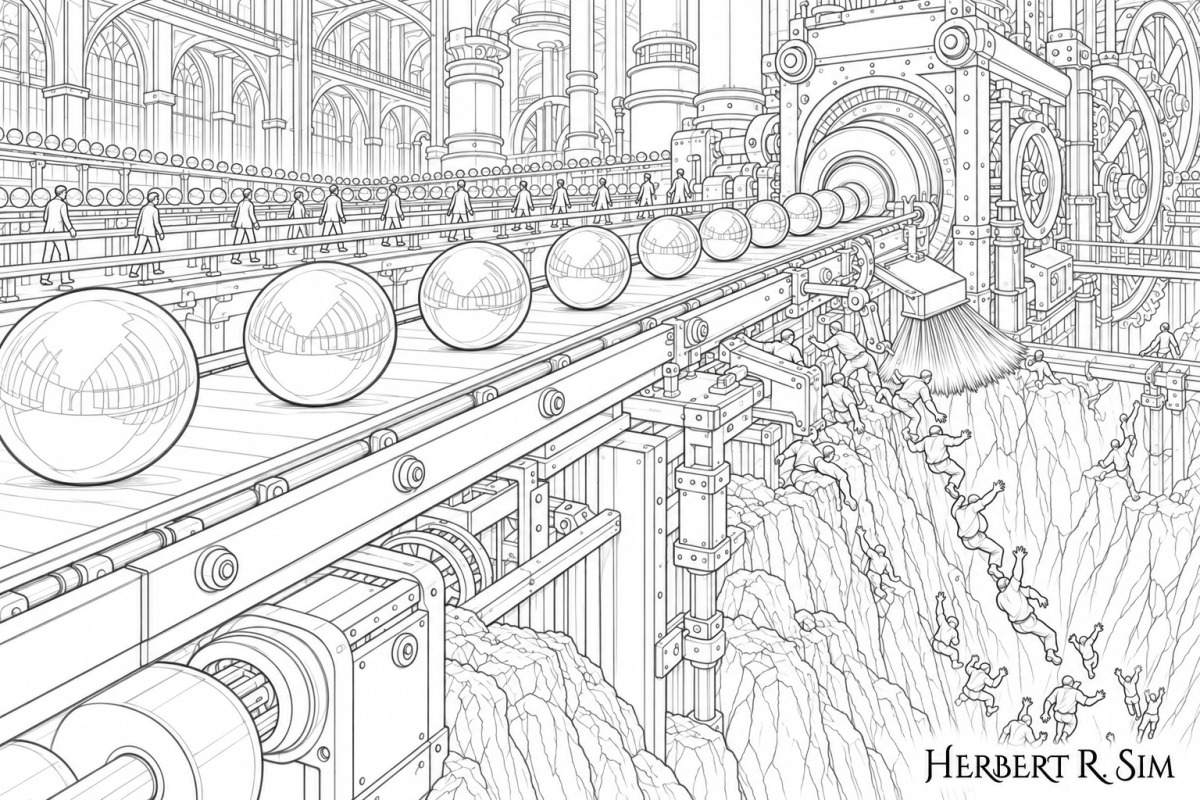
My illustration “The Human Cost of Perfection” work-in-progress. The art symbolizes optimization without conscience: flawless output becomes a false measure of progress when human lives are treated as disposable costs.
Profit Is a Signal, Not a Supreme Good
Profit is essential to economic life. It can signal that an enterprise is satisfying demand, using resources effectively, and creating value that people voluntarily choose to purchase. Without sustainable revenue, many useful innovations would never survive.
But profit is not a licence to ignore foreseeable harm. It is a signal within a moral and legal order, not a supreme good above that order.
An enterprise should not be permitted to profit by making people less able to leave, less able to understand the terms governing them, or less able to control the data and assets on which their livelihoods depend. Nor should it be permitted to treat harm as a mere externality when the people bearing that harm have been denied meaningful power to consent, negotiate, or seek alternatives.
The question is not whether businesses should pursue profit. They should. The question is whether the pursuit of profit remains bounded by duties to persons. A company that increases revenue by intentionally cultivating dependency, obscuring risks, or shifting predictable harms onto people with less power may be commercially successful while morally failing.
The same is true of public institutions and non-profit organisations. The absence of profit does not guarantee humanity. Bureaucracies can optimise for compliance, political safety, budget control, or institutional reputation while treating those affected as case numbers rather than people. Demonic Intelligence is not a criticism of one economic sector. It is a warning about any system whose internal goal becomes more important than the people subject to it.
The Architecture of Indifference
Harmful systems are often built through small, individually defensible decisions. One team chooses a metric. Another chooses a data source. Another writes a policy. Another removes human review to reduce cost. Another limits appeals because appeals are expensive. Another makes exit difficult because retention improves revenue.
No single step may appear monstrous. Yet together they create an architecture of indifference.
This is why ethical responsibility cannot be limited to the final visible decision. It must include system design. What outcomes are being rewarded? Which harms are being measured? Who has authority to stop the system when harm becomes evident? Are affected people consulted before irreversible decisions are made? Can an individual appeal? Can they take their records, assets, and work elsewhere? Does the institution bear any cost when its system is wrong?
These questions reveal whether an organisation is designing for human flourishing or merely designing for operational convenience.
The architecture of indifference is especially likely to emerge where decision-makers are distant from those affected. A programmer may never meet the worker whose income is reduced by a ranking system. An executive may never meet the family excluded by an automated process. A policymaker may never experience the time, cost, and humiliation imposed by a supposedly efficient rule.
Distance does not excuse harm. It creates a greater duty to build feedback, transparency, and correction into the system.
Dependency as a Source of Moral Risk
Dependence is not always domination. People depend on one another in families, communities, workplaces, and markets. Specialisation and cooperation are sources of prosperity. But dependence becomes morally dangerous when one party gains unilateral control over another person’s essential access, identity, livelihood, body, mind, or ability to exit.
A person who can refuse, negotiate, appeal, and leave remains a participant in a relationship. A person who cannot do these things becomes vulnerable to domination, even if the relationship began voluntarily.
Demonic Intelligence thrives in systems that mistake dependency for consent. A user who cannot leave a platform without losing their livelihood is not freely accepting every new term. A patient who cannot challenge a medical decision is not truly participating in care. A worker who must accept constant monitoring to remain employable is not simply choosing a workplace preference. A person whose identity, data, or financial life is controlled by one institution may have access, but not sovereignty.
For this reason, the right to exit is not a peripheral concern. It is a moral safeguard. It limits the power of systems to treat people as captive inputs. It creates the possibility of refusal, and refusal is one of the conditions of meaningful consent.
The Demonic Intelligence Test
To identify harmful optimisation before it becomes entrenched, institutions should apply a simple but demanding test.
First: What is the system optimising for? The objective should be stated clearly enough for affected people to understand. Vague appeals to “improvement” or “innovation” are not enough.
Second: What human costs are foreseeable? This includes not only physical harm, but loss of livelihood, loss of privacy, exclusion from opportunity, coercive dependency, humiliation, and the inability to correct an error.
Third: Who bears those costs? Are they distributed fairly, or are they concentrated on people with the least bargaining power?
Fourth: Can the person affected understand, challenge, and appeal the decision? A system without explanation or remedy treats human beings as subjects to be managed rather than participants to be respected.
Fifth: Is there a meaningful path of exit? If the system is essential, exit may require portability, alternatives, independent records, and the ability to retain lawfully earned value.
Sixth: Would the objective still be considered legitimate if the decision-maker had to bear the same risk? This question exposes whether a system is merely transferring harm downward.
If a system cannot answer these questions adequately, its intelligence is not yet trustworthy. Its performance may be impressive, but performance without moral accountability is a form of danger.
Designing Intelligence That Remains Humanly Accountable
The answer is not to reject intelligence, automation, profit, or technological progress. Such rejection would abandon the very tools that can help people live longer, learn more, create more, and solve problems once thought impossible.
The answer is to place human constraints around systems of optimisation.
High-impact decisions should be explainable in terms an ordinary person can understand. People should have a way to correct inaccurate information and challenge consequential outcomes. Institutions should identify accountable human decision-makers rather than allowing responsibility to dissolve into automated procedure. Systems should be assessed not only by their output, but by their effect on dignity, autonomy, and the right to exit.
Technology should be designed to increase human capability, not to turn capability into a conditional subscription. Data should not be collected or used in ways that make people permanently legible to systems they cannot inspect. Economic participation should not depend entirely on opaque scores or rankings. Tools that affect the body, mind, identity, or livelihood should remain subject to informed consent and revocable control.
These principles do not make progress slower for its own sake. They make progress worthy of the name. A civilisation that can build powerful systems but cannot keep those systems answerable to human beings has increased its capability without increasing its wisdom.
The Choice Before Us
The future will contain more intelligence, more automation, and more systems capable of making consequential decisions. Some will be used to heal, educate, connect, and empower. Others will be used to extract, classify, exclude, and control. The difference will not be determined by technical sophistication alone.
It will be determined by the objectives we allow systems to pursue, the harms we refuse to normalise, and the authority we preserve for the people whose lives are affected.
Demonic Intelligence is a warning against a future in which human beings are asked to admire systems that make them less free. It is a warning against the belief that a successful metric can wash away a foreseeable injury. It is a warning against the seduction of intelligence without conscience.
We should welcome tools that enlarge human capacity. We should reject systems that require human expendability as the price of their performance. No gain in efficiency, accuracy, profitability, security, or aggregate capability is sufficient by itself to justify reducing a person to a replaceable component in somebody else’s optimisation.
Intelligence becomes demonic when it can calculate the human cost of its success, foresee the harm it causes, and still treat the person harmed as expendable.