
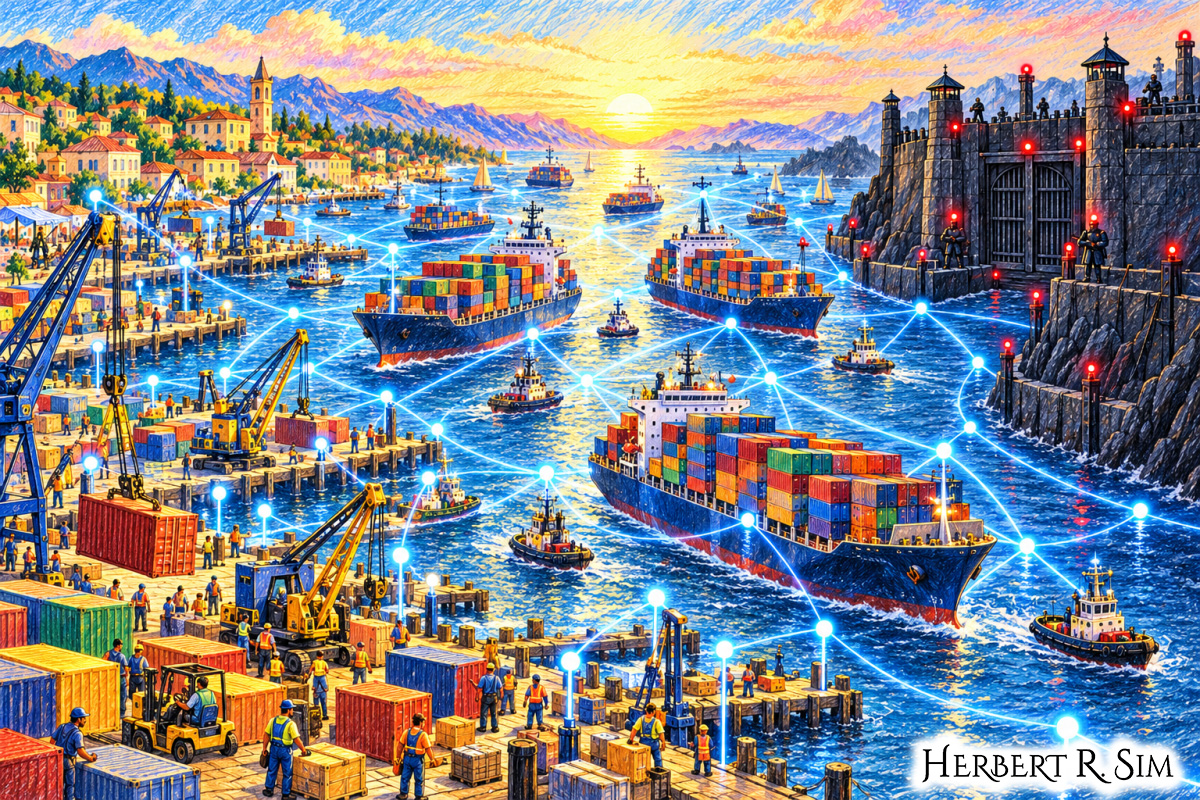
My illustration entitled: “The Port of Many Ships” — Independent vessels dock through shared open channels, while one heavily guarded private harbour restricts entry.
Economic life increasingly takes place through networks whose rules are partly technical. Payments move through payment rails. Goods are discovered through digital marketplaces. Work is found through platforms. Records are stored in proprietary systems. Communication, identity, reputation, and contracts are all shaped by the protocols through which people connect.
These arrangements can be remarkably useful. A single interface can make a complicated service simple. A company can invest in security, customer support, and product design. A managed system can offer consistency to users who do not want to understand every technical layer beneath it.
But the convenience of a closed system can obscure a fundamental political-economic fact: the rules of a network determine who has practical permission to act within it. If one institution controls the rules, the access points, the identity system, the economic records, and the conditions of connection, then participation depends on that institution’s continuing approval.
Protocol sovereignty is the principle that the underlying rules of economic networks should preserve meaningful room for independent participation, voluntary exchange, innovation, and exit. It does not demand that every service be identical or that every company relinquish its property. It asks whether the economic layer beneath services is open enough that people can build, connect, and leave without being permanently subject to a single intermediary.
Where platform sovereignty concerns the power private platforms can acquire over economic participation, protocol sovereignty examines the deeper layer: the architecture of the rules themselves.
Protocols Are Rules That Become Infrastructure
A protocol is a shared set of rules that allows different people, devices, or institutions to communicate and transact. Many of the most important protocols are so ordinary that they become invisible. They determine how information is sent, how addresses are recognised, how files are exchanged, how systems authenticate one another, and how messages reach their destination.
When such rules are genuinely open, they can create a common field of participation. Different builders can develop tools that work together. Users can choose among providers. New services can emerge without seeking individual permission from a central owner. Innovation happens at the edges of the network because the core rules permit connection.
When the rules are closed, the opposite dynamic can arise. Participation becomes conditional on admission. Innovation must be approved by the operator. Data, identity, and reputation may remain trapped inside one environment. A new entrant cannot compete simply by offering a better service; it must first obtain access to the gatekeeper’s system, customer base, or technical standards.
This difference is not merely technical. It shapes the distribution of economic power. A protocol can function as infrastructure that invites many participants, or as an enclosure in which every participant must rely on the continuing consent of one institution.
The distinction matters because technical rules increasingly govern activities that were once conducted through ordinary human relationships: finding work, making payment, proving identity, establishing trust, and accessing markets. As these activities migrate into digital networks, the design of protocols becomes an issue of economic liberty.
Open Does Not Mean Unordered
Open networks are sometimes misunderstood as networks without standards, accountability, or protection from abuse. That is not what protocol sovereignty means. A useful protocol requires rules. In fact, its openness depends on rules that are sufficiently clear and stable for many different participants to rely upon them.
The question is not whether rules exist. The question is who may understand them, implement them, and participate under them. A closed gatekeeper may publish terms while reserving the authority to interpret, change, or selectively enforce those terms at its own discretion. An open protocol can also evolve, but its rules are available to inspection and its participants can assess whether a proposed change remains compatible with their interests.
Openness therefore has several dimensions. The rules should be understandable enough to be independently examined. The technical standards should allow compatible systems to connect. Participation should not depend on arbitrary or exclusive approval. And users should have a credible ability to choose another implementation, provider, or path if they disagree with the direction of the network.
None of this removes the need for judgment. Open networks still face difficult questions about security, fraud, misuse, and coordination. But such questions should not become an excuse for assuming that central control is the only possible form of order. Decentralised coordination is harder to design than command from a single centre, yet it can distribute both power and responsibility more broadly.
The Closed Gatekeeper Model
Closed networks often begin with a sensible promise. One company builds the system, maintains the standards, protects users, and provides an integrated experience. For many people, this arrangement is attractive. It reduces complexity and places responsibility in a recognisable institution.
Problems arise when the convenience of a managed service becomes the only realistic route to economic participation. A closed system can then exercise power at several levels simultaneously. It can decide who may join. It can decide what tools may connect. It can determine which transactions are visible or permissible. It can rank participants, withhold data, change fees, alter terms, or suspend an account. Most importantly, it can decide whether users may take their economic history elsewhere.
A participant in such a system may appear to have broad freedom. They can buy, sell, publish, or work while their account remains in good standing. But their capacity is conditional. The relevant question is what remains when the relationship changes. Can they preserve their records? Can they retain their contacts? Can they use their own data outside the system? Can they connect with customers through another channel? Can they transfer value or reputation without beginning again from zero?
Where the answer is no, the system has converted access into dependency.
This does not require malicious intent by the platform operator. Dependence can arise through ordinary commercial incentives. Companies naturally want to retain customers, protect their business model, and control the experience they offer. Yet users also have an interest in retaining the economic value they have created. Protocol sovereignty is a way of recognising that both interests exist, while refusing to treat the user’s vulnerability as an acceptable cost of innovation.
Interoperability Is Economic Freedom in Practice
Interoperability is often described as a technical convenience: the ability of different systems to exchange information and work together. Its economic significance is much larger. Interoperability gives people options without requiring them to abandon everything they have already built.
When systems interoperate, a merchant can use one service for payments and another for customer communication. A worker can present verified evidence of experience in more than one market. A user can move their records to a different provider. A new company can compete by improving one layer of a service rather than reconstructing an entire closed ecosystem.
Without interoperability, every decision becomes more expensive. Switching providers means losing data, history, relationships, and sometimes the ability to communicate with those who remain inside the old system. This produces a kind of economic gravity. The largest network attracts more users because it already contains the most users; its dominance then makes alternatives less viable, which increases its dominance further.
Interoperability interrupts this cycle. It does not guarantee competition, but it gives competition a practical chance. It allows a person to compare services on their merits rather than on the cost of abandoning their past.
For Sovereign Capability Economics, this is crucial. A capability that cannot move is only partially owned. The individual may possess the appearance of choice while lacking the practical means to exercise it. Portability and interoperability turn formal options into usable options.
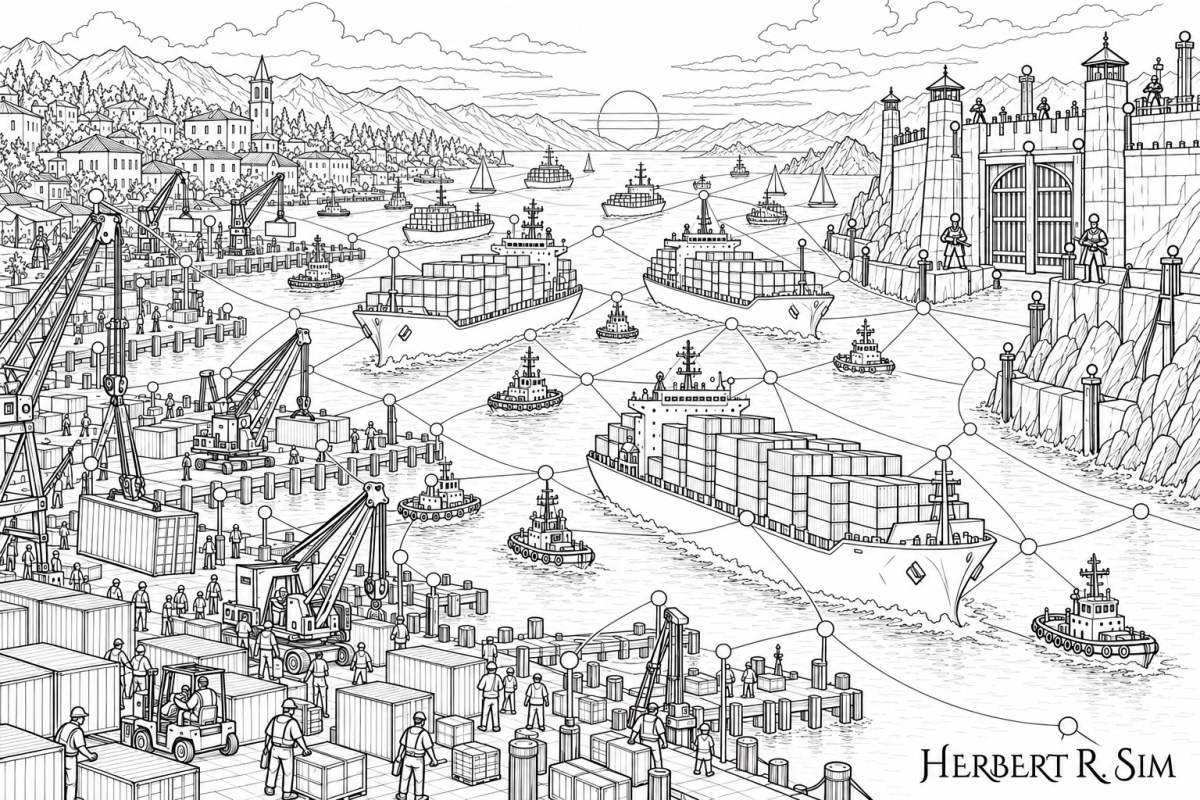
My illustration “The Port of Many Ships” work-in-progress. The art represents how open digital protocols let independent traders connect and prosper, while closed gatekeepers concentrate the power to decide who may participate.
Permissionless Innovation and the Right to Build
One of the greatest strengths of open protocols is permissionless innovation. This does not mean that anyone may harm others or ignore the law. It means that a person with an idea can build a compatible tool, service, or improvement without first convincing a dominant institution that the idea serves its interests.
In a closed system, innovation usually follows a hierarchy. The central operator decides which features are allowed, which competitors may connect, and which experiments are too threatening to permit. The system may be innovative internally, but its boundaries limit the range of innovation that can occur outside it.
In an open system, builders can compete at the edges. They can create better interfaces, stronger security tools, new payment methods, educational services, or community applications. If one service fails, the underlying network can remain available to others. The protocol is not a promise that every project will succeed. It is a refusal to make one institution the sole judge of which projects may begin.
This right to build has economic consequences. It reduces the power of incumbents to protect themselves through technical exclusion. It gives small teams and individuals an opportunity to contribute. It helps ensure that innovation remains a process of discovery rather than a privilege granted by established gatekeepers.
Bitcoin is a significant example of this principle. Its importance is not that it eliminates every institution or solves every economic problem. It is that its underlying network allows people to develop services and tools without needing a central monetary operator’s permission to connect to the system. Users may choose custodial or non-custodial arrangements. Builders may compete in the services they provide. The network does not require one company to own the basic right to participate.
Governance Without Permanent Rulers
Every economic network must change over time. Security needs improve. Errors are discovered. Participants develop new needs. The question is not whether governance will occur, but whether governance remains accountable to those who depend upon the network.
Closed systems often make governance simple: the owner decides. This can be fast and coherent, particularly in the early stages of a product. But the same efficiency can become a weakness when the system has become essential to many people. A unilateral decision can alter the economic position of millions of users who have little opportunity to contest it or avoid its consequences.
Open protocols face a more difficult path. They must coordinate among diverse participants, and disagreement can be slow or inconvenient. Yet this difficulty can be a virtue. It prevents major changes from being treated as trivial administrative acts. It makes visible the fact that a protocol is not just a product feature; it is a framework within which other people have built property, relationships, and livelihoods.
Protocol sovereignty does not require perfect consensus. It requires the possibility of informed dissent and practical alternatives. If participants disagree with a direction, they should not be compelled to accept it merely because no other option exists. Competing implementations, voluntary adoption, transparent standards, and the ability to continue using compatible tools all help make governance more accountable.
A network is more legitimate when it can evolve without demanding unconditional obedience.
Security Cannot Be a Pretext for Captivity
Centralised providers often justify closed systems by pointing to security. In many cases, this concern is legitimate. Security is difficult, and professional services can protect users from mistakes, fraud, and technical complexity. It would be irresponsible to dismiss these benefits.
But security should not be used to erase the distinction between assistance and control. A service can help a person secure assets, verify identity, or manage records without requiring that person to lose every alternative. The better design is not one that forces every user to become an expert. It is one that gives users a range of voluntary choices, including the ability to delegate while retaining a path to recover, transfer, or verify what matters.
Economic resilience comes from diversity of arrangements. Some people will prefer fully managed services. Others will prefer direct control. Many will choose a combination. A healthy network allows these choices to coexist. A closed gatekeeper model treats one institutional form as the unavoidable condition of participation.
The issue is therefore not whether people should be protected from risk. It is whether protection must always require surrender. Systems that offer security while preserving user agency are more consistent with long-term economic liberty than systems that make security synonymous with permanent dependence.
Counter Economics as Network Pluralism
Counter Economics provides a constructive response to closed gatekeeper power. It does not call for evasion, deception, or a refusal of lawful responsibility. It calls for the peaceful creation of voluntary alternatives: additional routes through which people can exchange, build, own, and cooperate.
Protocol sovereignty gives this idea a technical and institutional form. It supports a plural economy in which no single provider must mediate every transaction and no single network must hold every record. Open standards, independent tools, decentralised payment options, and portable identities can create alternatives that operate alongside established institutions.
The value of these alternatives is not measured only by immediate market share. Their presence changes the balance of power. A dominant provider behaves differently when users have realistic options. A consumer is less vulnerable when their data and economic history can move. A builder is less constrained when the underlying network remains open to new work.
Pluralism is not fragmentation for its own sake. It is the recognition that economic freedom requires more than one possible path.
The Protocol Test
When assessing a new economic network, citizens, builders, and policymakers should ask several basic questions. Can users understand the core rules that govern participation? Can different services connect on reasonable terms? Can people retain and move their lawfully acquired data, property, and reputation? Can independent builders create compatible tools? Can users exit without losing the foundation of their economic lives? Can changes to essential rules be challenged, debated, or declined?
No system will answer every question perfectly. Some functions will remain proprietary, and some forms of coordination will require strong safeguards. But these questions reveal whether a network is expanding agency or concentrating dependency.
The future of economic sovereignty will be shaped not only by legislation, corporate policy, or financial regulation. It will also be shaped by protocols: the invisible rules that define who can connect, what can be built, and whether participation remains voluntary in practice.
Open economic networks do not eliminate institutions. They place institutions within a wider field of choice. They permit services to compete without owning the entire underlying right to participate. They allow people to use powerful tools without making the tool’s operator the permanent owner of their economic future.
Protocol sovereignty means that the rules beneath economic life should enable people to connect, build, own, and leave—without first asking a gatekeeper for permission to remain free.