

My illustration entitled: “The Many Rails” — Multiple rail lines carry food, energy, money, and information toward a city, ensuring no single route can stop the flow.
Economic freedom becomes durable when people can build lawful networks of exchange alongside dominant systems, rather than depend on a single route for work, trade and value.
Most economic life takes place through established channels. People earn wages through employers, buy goods through recognised merchants, make payments through familiar institutions and reach customers through large marketplaces. These channels can be useful. They provide scale, convenience, trust and infrastructure that individuals could not easily create alone.
But convenience can become dependence when one channel becomes the only practical channel.
A farmer who can sell only to one buyer is dependent on that buyer. A small business that can reach customers only through one marketplace is dependent on that marketplace. A worker whose livelihood depends on one employer, or a community whose economic life depends entirely on a distant institution, has little room to negotiate when terms change.
The answer is not to reject all established institutions. It is to ensure that they do not become the only possible institutions.
Parallel Market Sovereignty is the capacity of individuals and communities to build lawful, voluntary networks of exchange alongside dominant economic channels. These networks may include direct trade, independent enterprise, community associations, cooperative ventures, peer-to-peer commerce, local supply relationships, open monetary tools and digital networks that allow people to reach one another without dependence on a single gatekeeper.
“Parallel” does not mean hidden, illegal or hostile. It means additional. It means that people are not forced to place every economic activity through one institution merely because that institution is large, convenient or already established.
Parallel markets strengthen sovereignty because they multiply the ways people can cooperate. They provide continuity when the main channel fails, becomes too costly or imposes terms that participants cannot reasonably accept. They turn economic life from a narrow corridor into a living network of possible paths.
Parallel Does Not Mean Underground
The language of alternative markets can invite misunderstanding. Some may hear “parallel market” and imagine activity outside the law, escape from public responsibility or a refusal to honour legitimate obligations. That is not the principle described here.
Parallel Market Sovereignty is not an argument for fraud, tax evasion, deception or exploitation. A free economy depends on honest records, voluntary agreement, respect for property and remedies against wrongdoing. Trust cannot be built through dishonesty, and no lasting network of exchange can survive if participants believe that rules apply only to others.
The parallel market is not a shadow economy. It is a constructive economy: a field of lawful alternatives that exist beside established systems and reduce the danger of any one system becoming unavoidable.
Economic sovereignty does not require escaping society. It requires the ability to participate in society without becoming captive to a single institution.
There is a vital difference between refusing accountability and creating alternatives. The first seeks exemption from responsibility. The second seeks a more balanced distribution of power. Constructive parallel markets accept the obligations of honest exchange while rejecting the assumption that only one approved channel can organise economic life.
From Isolated Alternatives to Networks
A single alternative is valuable, but it can be fragile. One small business can close. One local market can lose customers. One independent service can be overwhelmed by cost or competition. Sovereignty becomes more durable when alternatives connect with one another.
This is the difference between an isolated substitute and a parallel network.
A parallel network is made of many participants who can cooperate without needing to become one central institution. Producers can find customers directly. Small businesses can share knowledge. Communities can support local supply relationships. Independent workers can refer opportunities to one another. People can use more than one means of exchange and communication. Each connection adds capacity to the whole.
Networks of this kind do not need to be perfect or complete. They need only be real enough to provide another route. A local producer who has several buyers is less dependent than one with only one. A worker with a professional network is less vulnerable than one whose future depends on a single manager. A merchant able to accept more than one method of payment is less exposed when one channel becomes unavailable.
The aim is not to construct a separate world. It is to make the existing world less concentrated and more resilient.
The Principle of Voluntary Exchange
At the centre of Parallel Market Sovereignty is voluntary exchange. People should be free to offer lawful goods, services, skills and ideas to one another without unnecessary barriers. They should be able to associate, trade, form enterprises and create value as long as they respect the rights of others.
Voluntary exchange is powerful because it allows cooperation without requiring uniformity. People with different backgrounds, beliefs and needs can still find mutual benefit through honest trade. A customer may value a service more than the money paid for it. A provider may value the payment more than the time or goods exchanged. Both benefit when the arrangement is transparent and uncoerced.
Parallel networks preserve this possibility where dominant systems are too narrow, costly or inaccessible. They can give small producers a direct route to customers. They can help communities retain more of the value created within them. They can make room for specialised skills that large institutions overlook.
But voluntary exchange requires more than willingness. It requires trust. Participants need clear terms, reliable records, fair methods for resolving disagreement and reputations that can be earned through honest conduct. The success of alternative networks depends not on rejecting standards but on developing standards that participants can understand and help uphold.
Why Dominant Channels Need Competitors
Large institutions are not necessarily harmful. They can offer efficient services, wide access and useful protection against risk. The danger begins when their scale makes them unchallengeable.
When a large marketplace controls access to customers, when a few financial institutions control ordinary exchange, or when a small number of employers dominate a region, people may have formal rights but little economic leverage. Terms can be revised. Fees can rise. access can be withdrawn. The individual’s only response may be acceptance, because no other usable path exists.
Parallel markets change this relationship. They do not need to overthrow dominant institutions. Their mere existence can make dominant institutions more responsive. A provider that knows customers can leave must offer better service. A marketplace that knows sellers can reach buyers elsewhere must keep its conditions fair. A large employer that knows skilled workers have other options must value them more carefully.
Competition is therefore more than a contest for market share. It is an instrument of dignity. It prevents institutions from treating participation as a favour they grant rather than a relationship they must continually earn.
Local Capacity and Global Connection
Parallel Market Sovereignty is not limited to localism. Local economic relationships are important because they create visible accountability and reduce dependence on remote systems. A local customer can know a local producer. A community can identify its own needs and support useful enterprise. A network of nearby businesses can keep skills and value circulating close to where they are created.
Yet local capacity need not mean economic isolation. Digital communication and new forms of exchange can connect small producers with distant customers, independent workers with global opportunities and communities with knowledge far beyond their immediate geography.
The strongest parallel markets combine local trust with wider connection. They use technology to reduce distance without allowing technology to create a new unchallengeable centre of control. They allow people to cooperate across borders while preserving the ability to maintain direct relationships and independent records.
This balance matters. Purely local systems may lack scale and resilience. Fully centralised global systems may offer scale while eliminating local autonomy. Parallel Market Sovereignty seeks a middle course: many connected centres rather than one dominant centre.
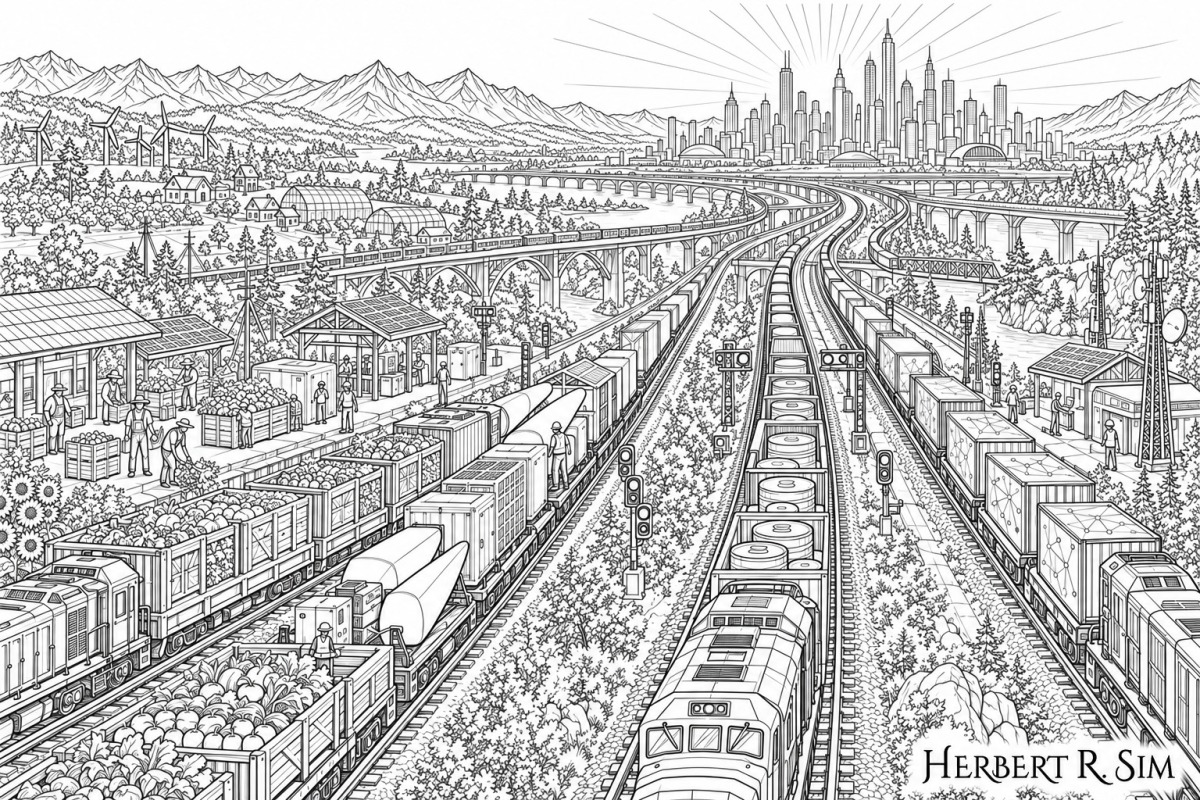
My illustration “The Many Rails” work-in-progress. The art represents how parallel, independent networks keep a society free and resilient by ensuring essential exchange can never be controlled through a single route.
Money and the Ability to Choose
Every network of exchange eventually confronts the question of money. Money is not merely a financial tool. It is the means by which people carry the value of their work across time, distance and different relationships. If people cannot choose how to store or exchange value, they remain dependent on the institutions that control the only available channel.
The growth of Bitcoin has made monetary choice a more visible question. Bitcoin is not a solution to every economic problem, and it does not remove the need for judgment, security or legal responsibility. Its importance lies in the possibility it represents: individuals may be able to hold and transfer value through a system that does not depend on a single central intermediary.
That possibility belongs naturally within a discussion of parallel markets. It adds another route for voluntary exchange and another way to think about custody, direct control and monetary independence. It does not require people to abandon all existing systems. It asks whether they should be required to depend entirely on them.
Choice in money, like choice in work or trade, is a safeguard against concentrated power. The more people can understand and responsibly use different means of exchange, the less any one institution can turn access to value into a form of control.
Parallel Networks Need Ethical Foundations
Alternative networks are not automatically good because they are alternative. They can reproduce the same failures as the institutions they seek to supplement: hidden power, exclusion, dishonesty, insider privilege and opaque decision-making.
For this reason, Parallel Market Sovereignty must be guided by clear ethical principles. Participation should be voluntary. Terms should be understandable. Records should be honest. Members should respect property and fulfil agreements. Disputes should have fair avenues of resolution. Leadership, where necessary, should remain accountable to participants rather than insulated from them.
These standards are not restrictions on freedom. They are the conditions under which freedom becomes trustworthy. A network that cannot protect its participants from deception will eventually drive them back toward large institutions, because people will prefer imperfect centralisation to unpredictable disorder.
The goal is not a market without rules. It is a market in which rules are transparent, proportionate and open to challenge—and in which no single institution has the power to make itself the only path to participation.
Building Parallel Capacity
Parallel markets are built through ordinary acts of economic initiative. They do not appear through declarations alone. They require people willing to create value, learn skills, form relationships and take responsibility for the quality of what they offer.
For individuals, parallel capacity may begin with developing a portable skill, maintaining direct professional relationships, preserving copies of important records or cultivating a second source of income. For a small business, it may mean building a customer list rather than relying entirely on one marketplace, using more than one supplier or accepting more than one method of payment.
For communities, it may mean supporting local producers, forming cooperative ventures, improving access to practical education or creating networks through which knowledge and opportunities can circulate. For technologists, it may mean building open tools that allow people to communicate, exchange and preserve their work without surrendering control over everything they create.
No single action creates sovereignty. Sovereignty grows through accumulated capability. Every additional route to work, trade, knowledge and value makes a person or community less vulnerable to the closure of a single gate.
Parallel Markets and Institutional Accountability
Parallel Market Sovereignty should not be understood as a refusal to improve existing institutions. Existing institutions matter, and many can become more transparent, responsive and open. The existence of alternatives is often what encourages that improvement.
An institution that faces no competition may begin to confuse convenience with entitlement. It may believe that users will endure any policy because they have nowhere else to go. A parallel network corrects this assumption. It shows that people can organise differently. It gives them leverage to demand better treatment without waiting for permission.
In this sense, parallel markets are a form of peaceful accountability. They do not rely on coercion or destruction. They rely on the possibility that people can take their labour, custom and creativity elsewhere.
The ability to build another path keeps the first path honest.
An Economy With More Than One Centre
The ultimate aim of Parallel Market Sovereignty is not fragmentation for its own sake. It is an economy in which power is distributed widely enough that people can continue to act when one centre fails them.
Such an economy contains large institutions, but it also contains small enterprises, direct networks, local relationships, open tools and multiple forms of exchange. It welcomes scale without demanding submission to scale. It permits cooperation without making dependence permanent.
Economic freedom is not measured by whether everyone uses the same system efficiently. It is measured by whether people can create, exchange, preserve value and direct their futures without asking one institution for permission at every turn.
Parallel markets provide that possibility. They create lawful, peaceful and voluntary routes beside the dominant road. And in doing so, they make the road itself less capable of becoming a prison.