

My illustration entitled: “The Open Switchboard” — A community routes energy, communication, and trade through many independent channels.
Economic freedom depends not only on what institutions permit, but on whether people can choose among institutions without surrendering their livelihood, property or future.
Most economic relationships begin with a choice. We choose where to work, where to buy, where to keep savings, which provider to use and which marketplace to join. At least, that is how the relationship appears from a distance.
But the appearance of choice is not the same as the reality of choice.
A worker may be able to apply to several employers, yet have no practical ability to move because every employer is far away, requires the same costly credential or offers terms that cannot support a family. A small business may appear free to use different services, yet find that changing providers means losing years of customer relationships, records and access to the market. A person may technically be able to leave a financial institution, but face fees, delays or the loss of essential access if he tries.
In each case, the individual has options in theory and dependency in practice.
This is why economic freedom requires institutional optionality: the practical ability of an individual, household, business or community to choose among institutions, refuse unreasonable terms and move to another workable arrangement without disproportionate loss.
Optionality is not the same as redundancy. Redundancy concerns having backup paths when one path fails. Institutional optionality concerns the quality of a person’s relationship with the institutions on which he depends. It asks whether he can compare, negotiate, change and leave—or whether his apparent choices are too costly, too opaque or too similar to matter.
Where institutional optionality is high, organisations must earn trust. Where it is low, people become captive users of systems they did not choose and cannot realistically leave.
Freedom Is the Power to Change Terms
Economic relationships are not free merely because people entered them voluntarily at the beginning. Freedom must continue throughout the relationship. If a person can choose a provider on Monday but cannot leave on Tuesday without losing access to essential services, then the original choice was more fragile than it seemed.
This is especially true when institutions change their terms. A company may revise fees. An employer may alter working conditions. A marketplace may change its rules. A financial provider may introduce new requirements. Some changes are inevitable in a changing economy. Yet the moral question is whether the people affected can respond as active participants or only endure the new conditions.
Institutional optionality gives people the power to respond. It allows them to compare another employer, seek another supplier, move their business, take their customers elsewhere, shift their savings or organise a new form of cooperation. It turns a relationship from one of dependence into one of consent renewed over time.
An institution is accountable when people can leave it without losing the foundations of ordinary life.
This does not mean every change must be easy or costless. Real transitions involve work. New arrangements take time to establish. But the cost of changing should be proportionate. When exit requires sacrificing one’s accumulated identity, property, reputation or livelihood, the institution has acquired more power than a free relationship should allow.
How Optionality Disappears
Institutional optionality rarely disappears through a single law or policy. It is more often weakened by the gradual accumulation of barriers that make people remain where they are even when the relationship no longer serves them.
Switching costs are one barrier. A person may need to pay a fee, learn a new system, change equipment, reapply for approval or rebuild a network of contacts. Some switching costs are natural. Others are designed to make departure painful.
information asymmetry is another. People cannot compare institutions if important terms are hidden, unclear or constantly changing. An informed choice requires understandable prices, conditions, risks and procedures. When one side possesses all relevant information, the other cannot exercise meaningful judgment.
loss of accumulated history can also trap people. A small enterprise may spend years building customer ratings, transaction records or professional credibility within one marketplace. If that history cannot be carried elsewhere, leaving means starting again from nothing. The institution does not simply provide a service; it becomes the owner of the person’s economic past.
concentration reduces optionality when many apparent alternatives are controlled by the same source or operate under identical conditions. A town may have several employers but only one dominant industry. A consumer may have several providers but all use the same infrastructure, pricing practices or approval standards. The number of logos changes, but the underlying power does not.
dependency on essential access is perhaps the strongest barrier. When a person’s ability to receive income, make ordinary payments, reach customers or maintain a home depends on one relationship, that relationship becomes difficult to challenge. The individual may be told he is free to leave, but leaving may carry a penalty he cannot survive.
These barriers transform institutions from useful partners into unavoidable authorities.
Optionality and Bargaining Power
Optionality is a source of bargaining power. A person who has no alternative must accept the terms offered. A person with viable alternatives can ask questions, negotiate and refuse unreasonable demands.
This applies at every level of economic life. A worker with transferable skills and several possible employers has more ability to insist on fair treatment. A farmer with multiple buyers can negotiate a better price. A tenant with access to different housing options can resist exploitative conditions. A small business that can reach customers through several channels is less vulnerable to any one marketplace.
Optionality also changes the behaviour of institutions. An organisation that knows its customers can easily leave has an incentive to provide better service and clearer terms. An employer that knows skilled workers have other opportunities must value retention. A provider that cannot rely on lock-in must compete through quality rather than dependency.
This is why economic optionality benefits more than the individual. It improves institutions by forcing them to earn participation. It makes cooperation more honest because neither side can take the other for granted.
Markets do not become humane simply because they contain transactions. They become more humane when those transactions occur between parties capable of saying both yes and no.
The Myth of the Easy Exit
Many institutions claim that people are free to leave. This statement can be technically true and morally misleading.
To understand whether exit is real, we must ask what the person loses by leaving. Does he lose only convenience, or does he lose access to income? Does he lose a small administrative fee, or years of reputation and customer relationships? Does he lose a preferred service, or the ability to participate in ordinary economic life?
An exit that requires the surrender of everything a person has built is not a meaningful exit. It is a forced restart. It may be preferable to remaining in an unfair arrangement, but it is not evidence that the arrangement is genuinely voluntary.
The right to exit requires a path to continue. A worker who leaves an employer needs the possibility of another livelihood. A business leaving a dominant platform needs a way to keep serving customers. A person leaving a provider needs access to his own records, value and history. Without continuity, exit becomes an empty gesture.
This is one reason ownership matters so much. The more a person owns his productive tools, savings, customer relationships, skills and records, the more capable he is of changing institutions without being erased by the transition.
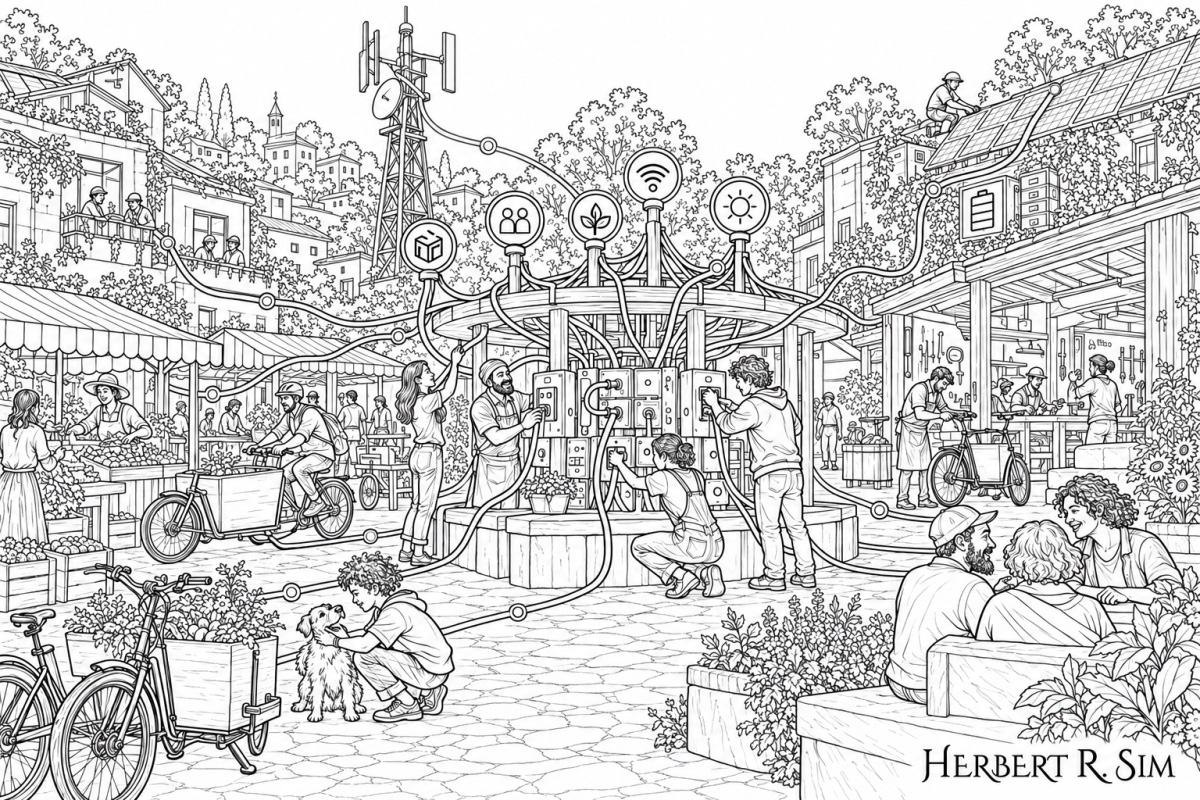
My illustration “The Open Switchboard” work-in-progress. The art represents how genuine economic freedom emerges when a community can choose and sustain many independent paths for energy, communication, and trade.
Optionality for Small Businesses
Small businesses feel the absence of institutional optionality more sharply than large corporations. Large firms often have legal staff, reserve capital, negotiating leverage and several ways to reach markets. A small enterprise may depend on a single payment channel, a single landlord, a single supplier or a single source of customers.
When that one relationship changes, the business may have no room to adapt. It can be forced to accept new fees, restrictive terms or unfavourable schedules because the alternative is immediate loss of income.
A healthy economy should make it easier for small enterprises to keep their options open. This means supporting open standards, fair competition, understandable contracts and the ability to move information and relationships when changing providers. It means resisting arrangements that demand exclusivity without offering a clear and substantial benefit in return.
It also means recognising that small businesses need time to adapt. A policy change that seems minor to a large organisation may be existential for a shop, a freelancer or a family enterprise. Institutions that value long-term trust should provide notice, clarity and reasonable transition periods rather than exploit the vulnerability of those with fewer resources.
Optionality, Technology and New Economic Paths
Technology can either expand or reduce institutional optionality. It can reduce barriers to entry by allowing individuals to reach customers, learn skills and cooperate across distance. It can also centralise access by placing work, communication and exchange inside systems controlled by a small number of powerful intermediaries.
The technology itself does not decide the outcome. Its design and governance do.
Open systems tend to increase optionality because they allow participants to change providers, keep their own records and interact without asking a single gatekeeper for permission. Closed systems may be convenient, but they can create dependency when users cannot move their identity, reputation, data or value elsewhere.
This is why the growth of digital exchange deserves serious attention. New monetary tools, distributed networks and direct online commerce may create more avenues for participation. But their value should not be exaggerated. A new system is not automatically liberating because it is technical or fashionable. The real test is whether it gives people more practical capacity to choose, build and leave.
Does the user retain control over what he has earned? Can he understand the rules? Can he move without losing everything? Can new participants enter without arbitrary exclusion? If the answer is yes, technology may increase economic liberty. If the answer is no, it may simply offer a more efficient form of dependency.
Institutional Optionality Is Not Anti-Institutional
To argue for optionality is not to argue against institutions. Institutions make large-scale cooperation possible. They organise knowledge, manage risk, coordinate services and create opportunities that individuals cannot produce alone.
The goal is not to destroy institutions. It is to ensure that institutions remain servants of human cooperation rather than masters of human dependency.
People should be free to choose stable employment, trusted providers and long-term commercial relationships. Many will rightly prefer them. But their choice should be supported by the knowledge that they can change course if terms become unfair or circumstances change.
Strong institutions have nothing to fear from this principle. An institution that offers real value should welcome the chance to retain people through quality, fairness and trust. Only an institution that depends on captivity must fear the freedom of its users.
Building an Economy of Options
Institutional optionality can be strengthened through practical choices by individuals, businesses and policymakers.
Individuals can invest in portable skills, preserve their own records, build diverse professional relationships and avoid placing every essential activity in one system. Businesses can avoid unnecessary exclusivity, maintain multiple routes to customers and suppliers, and treat their customers’ ability to leave as a reason to improve. Communities can support local enterprise, varied sources of employment and accessible knowledge.
Policymakers should ask whether rules protect the public while allowing alternatives to emerge. They should be cautious of regulations that entrench established providers by making entry prohibitively costly. They should favour transparency, fair dispute processes and conditions that allow people to move what they own when they change institutions.
These measures do not guarantee equal outcomes. Nor should they. People will make different choices, take different risks and achieve different results. But they make freedom more real by ensuring that economic participation is not permanently conditional on the approval of a single authority.
The Freedom to Choose Again
At its deepest level, institutional optionality is the freedom to choose again. It recognises that people’s circumstances change, institutions change and mistakes occur. A person who made a sensible choice five years ago may need a different arrangement today. Economic systems should allow that adjustment without demanding that he surrender his identity, property or future.
Freedom is not exhausted by the moment of entering an agreement. It lives in the continuing ability to reassess, negotiate, adapt and leave. It depends on alternatives that are visible, usable and sufficiently independent to matter.
Where institutional optionality exists, people can participate confidently. They do not need to treat every contract as a permanent trap. They can cooperate because they retain the capacity to withdraw, rebuild and continue.
That is why economic freedom depends on alternatives. Not because every person must reject institutions, but because no institution should become so unavoidable that it can turn consent into submission.
Download the PDF on Zenodo
Official Publication Record
Institutional Optionality: Why Economic Freedom Depends on Alternatives is available on Zenodo with a permanent DOI for citation and preservation.
| Title | Institutional Optionality: Why Economic Freedom Depends on Alternatives |
|---|---|
| Author | Herbert R. Sim |
| ORCID | 0009-0008-6500-5749 |
| Original publication | 30 April 2016 |
| Canonical webpage | Read the original article |
| DOI | 10.5281/zenodo.23041625 |
| Zenodo record | View and download the publication |
Preferred citation:
Sim, Herbert R. (2016). Institutional Optionality: Why Economic Freedom Depends on Alternatives. HerbertRSim.com. https://doi.org/10.5281/zenodo.23041625