

My illustration entitled: “The Solar Neighborhood” — Homes share locally generated energy through a community-owned microgrid.
Economic independence is not achieved merely by criticising dependency. It is achieved by building peaceful, voluntary alternatives that give people more than one way to work, exchange, save and cooperate.
It is easy to identify dependence. A person depends on a single employer because there are few other sources of work. A small business depends on one lender, one supplier or one marketplace. A family depends on financial arrangements it does not understand but cannot easily leave. A community depends on distant institutions that may not know its needs and may change their terms without consultation.
Criticism of these conditions is necessary, but criticism alone does not create freedom. If the only response to concentrated economic power is anger, then those who depend on that power remain dependent. The more important task is constructive: to create lawful, peaceful and voluntary alternatives through which people can regain practical control over their work, property, knowledge and choices.
This is the purpose of Constructive Counter-Economics.
Counter-Economics should not be understood as a politics of destruction. It does not require hostility toward every established institution, nor does it romanticise isolation. Human beings need cooperation. They form businesses, communities, associations and networks because they can achieve more together than alone.
The question is whether cooperation remains voluntary and contestable. Can people build an alternative when an institution becomes unreasonable? Can they choose another route when a gatekeeper controls too much? Can they retain enough ownership, knowledge and productive capacity to avoid becoming permanently dependent on systems they do not control?
Constructive Counter-Economics begins with a practical answer: when freedom is fragile, build more paths.
From Resistance to Construction
Economic dependence often creates a defensive mentality. People focus on what is being taken from them: rising costs, limited access, unfair terms, barriers to enterprise or the insecurity of relying on a distant authority. These concerns are real. Yet a philosophy of liberty becomes incomplete when it defines itself only by what it opposes.
Constructive Counter-Economics shifts the emphasis from resistance to creation. Its central question is not merely, “How do we avoid a bad system?” It is, “What can people build together that makes dependence less necessary?”
This change in emphasis matters. To resist is to react. To construct is to create capacity. A person who learns a useful skill, saves a portion of his earnings, builds direct relationships with customers, joins a cooperative, supports local enterprise or develops a second source of income is not waiting for permission to become less vulnerable. He is increasing the range of choices available to him.
The same applies to communities. A neighbourhood that relies entirely on distant suppliers, external employers and remote decision-makers may be exposed when those systems fail or withdraw. A community with local knowledge, diverse businesses, mutual trust and several channels of exchange is more resilient. It can adapt because not every essential function passes through one narrow gate.
The strongest alternative to dependence is not withdrawal from society. It is the ability to participate in society without being trapped by a single point of permission.
Economic Freedom Requires More Than Opposition
A person may oppose monopoly, excessive regulation or unfair financial practices and still remain dependent on them. A genuine alternative must give people usable options. It must allow them to earn, exchange, preserve value or cooperate in a way that is lawful, understandable and sustainable.
This is why Constructive Counter-Economics places such importance on ordinary acts of building. It values the small enterprise that serves a local need, the independent worker who develops a portable skill, the producer who finds more than one route to market and the community that creates networks of trust rather than relying entirely on formal authority.
None of these acts is dramatic on its own. Their significance lies in accumulation. Every new source of work reduces the power of a single employer. Every additional supplier reduces the power of a monopoly. Every practical skill reduces a person’s reliance on gatekeepers. Every transparent method of exchange reduces the ability of intermediaries to extract value simply because they control access.
Freedom grows through these small increases in capability. It becomes stronger not when individuals are left alone, but when they can cooperate without surrendering all control over the terms of that cooperation.
The Principle of Voluntary Alternatives
Counter-Economics must remain anchored in voluntary action. Its aim is not to replace one form of control with another. A cooperative forced upon unwilling participants is not an alternative to dependency. A community enterprise that excludes dissent or hides its decisions simply recreates the very hierarchy it claims to resist.
Voluntary alternatives have several defining qualities. People enter them by consent. Their rules are understandable. Their benefits and responsibilities are shared honestly. Participants retain the ability to leave. Authority is limited by transparency and by the existence of other choices.
This does not mean that every arrangement must be informal. Written agreements, clear standards and accountable leadership are often necessary. The point is that structure should serve cooperation rather than become a mechanism for unchallengeable power.
Voluntary alternatives also require integrity. A system cannot claim to promote liberty while relying on deception, coercion or evasion of basic responsibility. Trust is one of the most important forms of economic capital. When people cannot rely on promises, records or fair dealing, they become more dependent on large institutions precisely because they have fewer ways to judge whom to trust.
Constructive Counter-Economics therefore calls for lawful initiative, honest exchange and practical accountability. Its ambition is not to escape society’s obligations. It is to make economic cooperation more open, accessible and humane.
Ownership as a Foundation of Independence
Ownership is often discussed in terms of wealth, but its deeper importance is independence. A person who owns productive tools, savings, a share in a business or the fruits of his own work has more room to make decisions. He has something from which to build.
Without ownership, economic life can become a sequence of permissions. The worker must seek employment. The tenant must seek housing. The small producer must seek access to someone else’s equipment, market or capital. None of these relationships is inherently unjust. But when a person possesses nothing he can use without another’s approval, his freedom is precarious.
Constructive Counter-Economics encourages forms of ownership that ordinary people can understand and protect. This may include personal savings, productive equipment, a small business, partnership shares, cooperative ownership or direct control over the records and tools essential to one’s work.
The goal is not that every person become wealthy in the same way. The goal is that more people possess a genuine stake in their own economic future. Ownership gives people the ability to wait rather than accept the first bad offer. It gives them a base from which to negotiate. It gives them the capacity to recover after a setback.
Where ownership is widely dispersed, economic power is more difficult to concentrate. Where it is narrowly held, the majority must seek access from those already inside the system.
Skills, Knowledge and Portable Capability
In an age of rapid change, a skill that can be carried from one employer, place or institution to another is a form of freedom. Knowledge reduces dependency because it gives people the ability to understand their circumstances and act without always relying on specialists.
This does not mean everyone must become an expert in everything. Complex societies benefit from specialised knowledge. But ordinary people should not be excluded from economic life simply because essential information is hidden behind unnecessary complexity.
Constructive Counter-Economics therefore values practical education: financial literacy, technical competence, communication, trade skills, entrepreneurship and an understanding of contracts and risk. These are not merely instruments of personal advancement. They are defences against manipulation.
A worker who understands his employment terms is harder to mislead. A business owner who understands costs and cash flow is less exposed to predatory advice. A family that understands saving and debt can make more deliberate choices. A community that shares knowledge can solve problems without waiting for distant institutions to recognise them.
Knowledge also travels. It cannot always be confiscated, revoked or monopolised in the same way as physical property. The more people possess useful, transferable knowledge, the less their freedom depends on the continued goodwill of a particular gatekeeper.
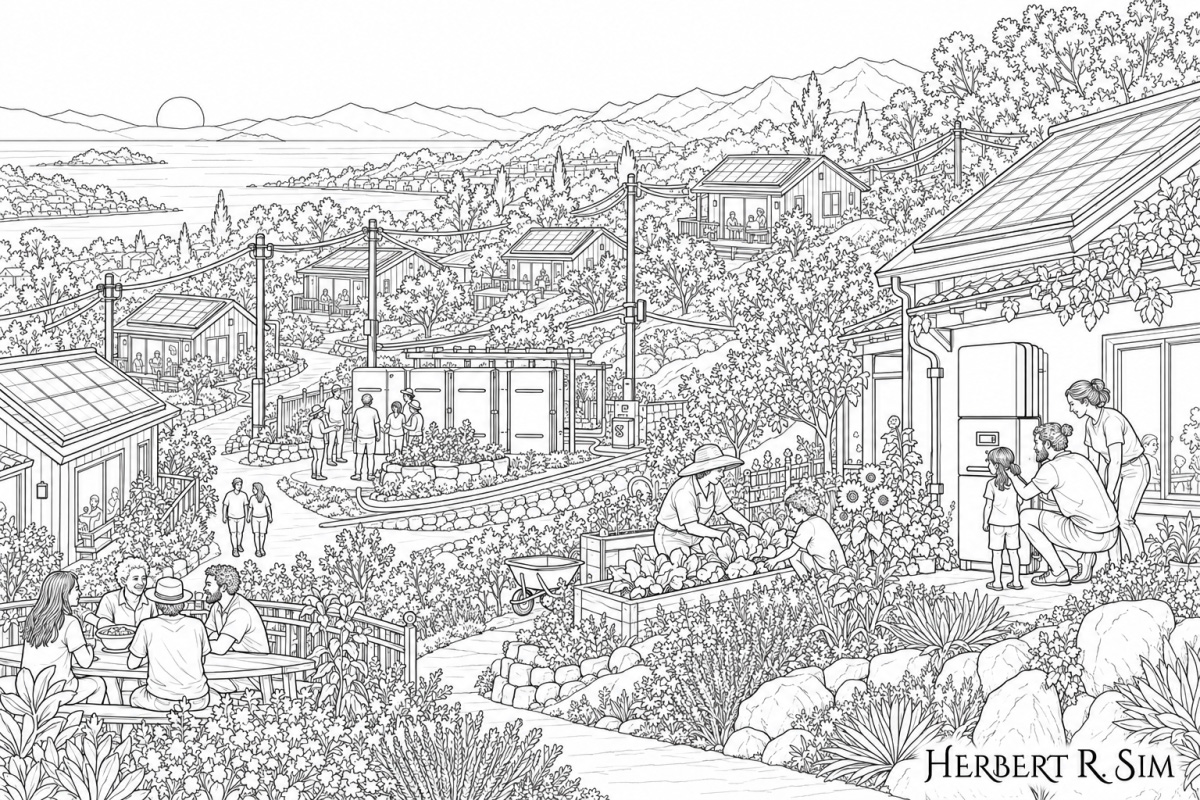
My illustration “The Solar Neighborhood” work-in-progress. The art represents how shared ownership of energy can turn a neighbourhood from dependent consumers into a resilient, self-reliant community.
Direct Exchange and the Value of Open Networks
Much economic dependence arises from distance between the person who creates value and the person who receives it. A producer may be separated from customers by layers of intermediaries. A worker may be separated from opportunity by agencies, credential systems and closed networks. A community may be separated from goods and services by a chain of distant decisions.
Intermediaries are not always harmful. They can provide useful coordination, distribution and protection. But when they become the only route through which value may pass, they acquire extraordinary power over both sides of an exchange.
Constructive Counter-Economics supports the development of more open channels of exchange: direct relationships between producers and customers, transparent marketplaces, local trade, peer-to-peer communication and technologies that reduce the cost of voluntary cooperation.
The rise of internet-based exchange has made this possibility increasingly visible. Small producers can reach audiences that once required large distributors. Independent workers can offer services beyond their immediate locality. Communities can share information quickly and form networks around common interests. These developments do not eliminate risk, but they lower some of the barriers that once confined opportunity to established institutions.
New forms of money and digital exchange also deserve serious attention. Their value lies not in novelty, speculation or rebellion for its own sake. Their value lies in whether they expand the ability of people to exchange voluntarily, preserve the fruits of their work and reduce unnecessary dependence on a single intermediary. The test should always be practical: does the system give participants more control, more transparency and more real choice?
Building Resilience Through Diversity
Dependence grows when every important need is met through one channel. A community with one major employer is vulnerable. A household with one income source is vulnerable. A small business with one supplier or customer is vulnerable. A society that relies on a small number of powerful institutions for every form of exchange is vulnerable.
Constructive Counter-Economics responds by encouraging diversity. This does not mean that every person must manage many businesses or every community must provide everything for itself. It means that essential functions should not be so concentrated that the withdrawal of one institution leaves everyone without recourse.
Diversity may involve multiple skills, multiple sources of income, multiple suppliers, different forms of association and a culture that welcomes new entrants. It may involve local enterprise alongside larger trade, mutual aid alongside commercial services, and independent initiative alongside employment.
Diversity is sometimes less efficient in the narrowest sense. One large system can appear cheaper or more convenient because it standardises everything. But absolute efficiency can create fragility. When that single system fails, changes direction or imposes new conditions, people who have no alternative discover the true cost of concentration.
Resilience is the capacity to continue when one path closes. It is therefore an essential part of economic liberty.
Cooperation Without Subordination
There is a common misunderstanding that independence means isolation. It does not. Human beings flourish through cooperation. The question is whether cooperation permits participants to retain dignity, voice and meaningful choice.
Constructive Counter-Economics imagines cooperation without unnecessary subordination. It values associations in which people contribute, share responsibility, establish clear rules and remain able to question leadership. It encourages arrangements in which the person who creates value is not treated merely as a replaceable unit.
This can include partnerships, cooperatives, trade networks, community enterprises and voluntary associations. Their form matters less than their character. Do they increase the practical capacity of participants? Do they distribute knowledge? Do they make ownership more accessible? Do they provide a fair way to resolve disagreement? Do they allow people to leave without losing everything?
If the answer is yes, then they are not merely economic organisations. They are schools of self-government. They teach people how to cooperate as equals rather than wait for instruction from a remote centre of power.
The Ethics of Building
Economic alternatives must be judged by the methods used to create them. An alternative that depends on dishonesty, exploitation or hidden coercion does not advance freedom. It merely changes who holds power.
The constructive approach therefore demands ethical discipline. Build rather than loot. Trade rather than deceive. Compete rather than sabotage. Persuade rather than coerce. Create value rather than depend on privilege. These principles are not sentimental. They are the basis of durable trust.
People will not entrust their savings, labour or cooperation to systems that lack integrity. Nor should they. The long-term success of voluntary alternatives depends on reputation, accountability and repeated proof that participants are treated fairly.
This is why the most important counter-economic act is often not dramatic. It is the reliable fulfilment of a promise, the honest delivery of a service, the fair settlement of a dispute or the patient building of a network that people can trust.
The Freedom to Build
The final purpose of Constructive Counter-Economics is the freedom to build. Not simply to consume choices designed by others, but to participate in creating the structures through which one lives.
A person with the freedom to build can develop a skill, form an enterprise, join with others, preserve value, reach customers and adapt when old arrangements fail. He is not immune from risk. No economic system can promise that. But he is less likely to be trapped by a single institution’s decision.
This is how economic dependence is reduced: not by waiting for perfect conditions, and not by destroying every existing structure, but by multiplying lawful, voluntary and trustworthy alternatives.
Constructive Counter-Economics is therefore a philosophy of practical hope. It asks people to recognise where power is concentrated, but it does not leave them there. It directs attention toward what can be created—one skill, one enterprise, one honest exchange, one cooperative relationship and one open pathway at a time.
Freedom becomes durable when people can build it together.