
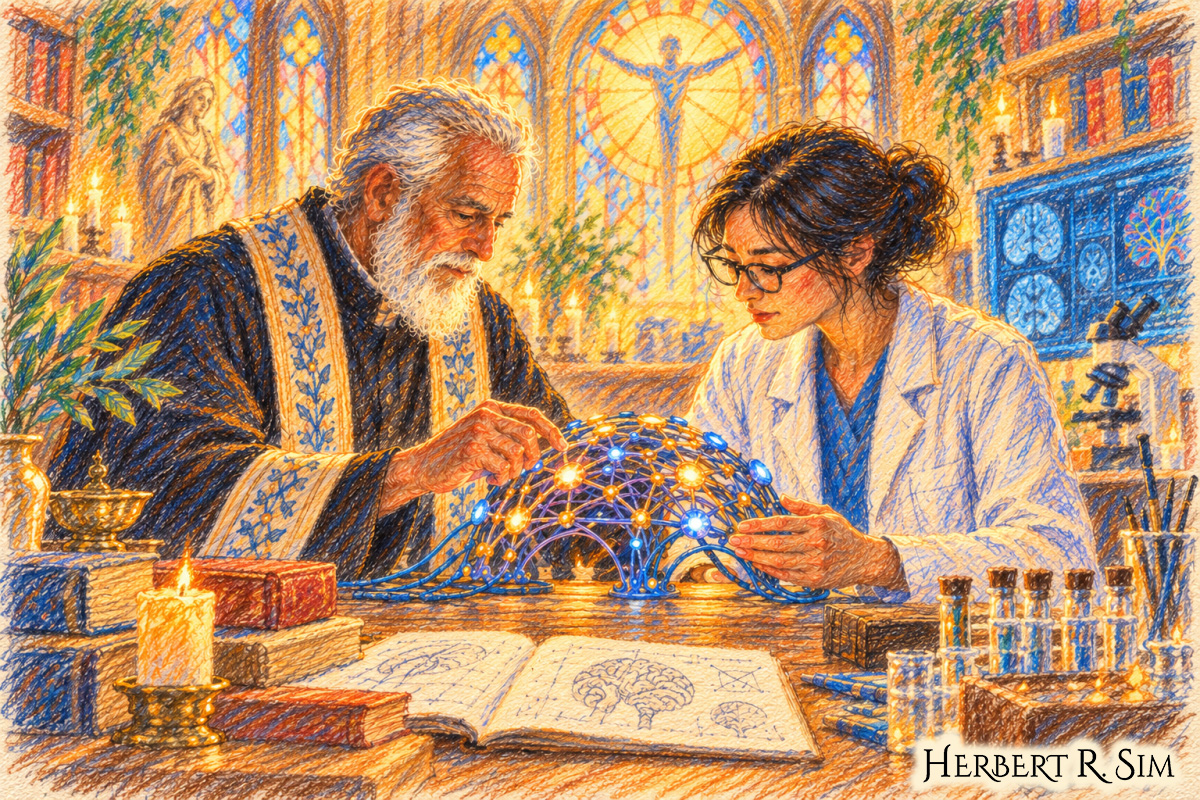
My illustration entitled: “The Ethics of Healing” — A faith leader and a scientist jointly examine a healing neurotechnology device.
Human enhancement raises a question that cannot be answered by engineering alone: if we gain the power to alter the human condition, what vision of humanity should guide that power?
Transhumanism is often presented as a secular philosophy. It speaks in the language of science, medicine, computing, genetics and the future. It asks whether ageing can be slowed, disability overcome, intelligence expanded and the limits imposed by biology gradually transcended. For some religious believers, these ambitions appear immediately suspect. They seem to challenge human humility, disturb the order of creation or place technological power where faith says only God should stand.
Yet this first impression does not settle the matter. Religious traditions have never required humanity to accept suffering passively whenever relief is possible. Medicine, surgery, sanitation, agriculture, eyeglasses and prosthetics have all changed what it means to live with the limits of the body. Most believers do not regard a vaccine as rebellion against God, or a hearing aid as an insult to nature. They see healing as an expression of compassion and human responsibility.
The difficult question is where healing ends and enhancement begins—and whether that distinction is morally decisive.
Religious Transhumanism is not a demand that faith surrender to technology. Nor is it an attempt to dress technological ambition in religious language. It is an inquiry into whether the desire to improve human life can be reconciled with a serious belief in human dignity, moral limits, spiritual purpose and accountability before something greater than human will.
That inquiry deserves more than slogans from either side.
Technology Has Always Changed Human Life
Human beings have always used tools to compensate for weakness and expand possibility. Fire gave warmth and protection. Writing extended memory across generations. Agriculture changed the relationship between people and the land. Medicine made survival possible where earlier societies could only endure loss. Every major civilisation has been shaped by technologies that altered daily life, social order and the range of imaginable futures.
Religious people were not absent from this history. Monastic communities preserved learning. Religious hospitals cared for the sick. Clergy, scholars and believers contributed to scientific discovery. The relationship between faith and technology has often been tense, but it has never been one of simple opposition.
This history should make us cautious about declaring every unfamiliar technology unnatural or spiritually dangerous. “Natural” is not always a reliable moral category. Disease is natural. Blindness can be natural. Infant mortality is natural. So are hunger, infection and physical frailty. If a doctor uses knowledge to relieve preventable suffering, most of us recognise that action as humane.
At the same time, not everything technologically possible is thereby good. The fact that humanity has always used tools does not mean every tool deserves our approval. A religious perspective can offer an important corrective to the careless belief that progress is simply the accumulation of power.
The moral worth of technology lies not in its novelty, but in the kind of human beings and communities it helps us become.
Healing, Enhancement and the Meaning of Compassion
The most persuasive case for advanced human technology begins with healing. A prosthetic limb that restores mobility, a treatment that prevents hereditary disease, an implant that helps a paralysed person communicate, or a therapy that repairs damaged tissue can be understood as acts of mercy. They do not diminish humanity; they allow people to participate more fully in human life.
Religious traditions frequently place special moral weight on care for the vulnerable. The sick, the poor, the disabled and the excluded are not inconveniences to be hidden from society. They are persons with inherent worth. If technology can reduce suffering without violating that worth, refusing it merely because it is advanced would be difficult to defend.
But the boundary between therapy and enhancement is not always clear. If a treatment restores eyesight, few object. If it gives a person vision beyond ordinary human capacity, the debate changes. If medicine prevents dementia, that may seem compassionate. If it radically extends life or increases memory beyond the human norm, some will ask whether we are still treating illness or pursuing a different kind of aspiration.
These questions matter, but the distinction should not become a false simplicity. Human life has never been divided neatly between “normal” and “improved.” Education enhances the mind. Exercise enhances the body. Reading, language and culture expand human capacity. The deeper moral concern is not whether an intervention changes us. It is whether it respects the person, serves a genuine human good and remains subject to ethical judgment.
Created Dignity Is Not Biological Fragility
One religious objection to transhumanism is that altering the human body amounts to rejecting the body as created. This objection has force when enhancement is driven by contempt: contempt for ageing, for disability, for ordinary human limitation or for the dependence we share with one another.
Yet the dignity of a person cannot rest on biological fragility alone. If it did, then every medical achievement would make us less human by making us less vulnerable. Few people truly believe this. A child saved by antibiotics has not been alienated from human dignity. A person using a wheelchair, a prosthetic arm or a pacemaker has not become less worthy because technology assists the body.
For a believer, human dignity may be grounded in being made in the image of God. If so, dignity is not a measurement of physical perfection. It is not lost through illness, disability or dependence. Neither is it automatically increased by intelligence, strength, beauty or longevity.
This point is essential. Technology may change capacities, but it must not become a new measure of human value. A society that admires enhancement while treating unenhanced people as obsolete would be morally disordered. A society that makes access to essential treatment dependent on wealth would be equally disordered. The worth of a person must remain prior to their performance.
Religious Transhumanism, if it is to be worthy of the name, must reject the fantasy that the enhanced are a superior class of human beings. Improvement in capability is not improvement in moral worth. A faster mind is not necessarily a wiser mind. A longer life is not necessarily a more meaningful life. A stronger body is not necessarily a more compassionate one.
Humility Is Not Helplessness
Faith often calls human beings to humility. This is sometimes interpreted as a command to remain passive in the face of suffering and limitation. But humility does not mean helplessness. It means recognising that power is not the same as wisdom, that human knowledge is partial, and that consequences cannot always be controlled.
That is precisely the attitude advanced technology requires.
Genetics, neuroscience and artificial intelligence may offer remarkable new capabilities, but they also create new risks. A decision made in a laboratory can affect future generations. A treatment that appears beneficial in the short term may have consequences that emerge only over time. An enhancement available only to a privileged few can intensify inequality. A system designed to improve health can be used to rank, exclude or control people.
Humility therefore should not lead us to reject research. It should lead us to pursue research carefully. It should demand transparency, informed consent, long-term study and a willingness to stop when the risks exceed the benefits. It should resist the temptation to regard those who ask ethical questions as enemies of progress.
There is a profound difference between using knowledge responsibly and imagining that human beings have become masters of all meaning. The first is stewardship. The second is arrogance.
My illustration “The Ethics of Healing” work-in-progress. The art represents faith and science meeting in humility—using healing technology to serve human dignity rather than replace moral conscience.
The Danger of a New Idolatry
Every age has its idols: power, wealth, nation, ideology, security or personal pleasure. In a technological age, it is possible to make an idol of innovation itself. We begin to assume that what is new is necessarily better, that what is efficient is necessarily right, and that what can be engineered is all that matters.
This is where religious criticism of transhumanism is most valuable. It reminds us that a human being is not merely a collection of functions waiting to be upgraded. A person is not a product. The deepest elements of life—love, faithfulness, sacrifice, forgiveness, courage and moral responsibility—cannot be reduced to processing power or biological performance.
Technological enthusiasm becomes dangerous when it promises salvation in a purely mechanical form. No machine can absolve guilt. No genetic therapy can decide what a life is for. No longer lifespan can answer the question of how a person should live. Technology may give us more years, but it cannot give those years meaning by itself.
For Christians, salvation is not a technical achievement. It is not the result of assembling sufficient intelligence, wealth or biological control. It is a relationship of grace, repentance and renewal. This does not make medicine or enhancement worthless. It places them in their proper position. They may be gifts of human creativity and compassion, but they cannot replace the spiritual work of becoming good.
Freedom, Consent and Moral Responsibility
Any serious religious approach to enhancement must also defend personal conscience. A person should not be compelled to alter his or her body in order to compete in work, education, sport or public life. Nor should a person be shamed for accepting an ethical treatment that improves health or restores lost ability.
Conscience will lead thoughtful people to different conclusions. One believer may welcome a genetic therapy that prevents a devastating illness. Another may have reservations about interventions involving embryos or inherited traits. One person may see a neural implant as a reasonable means of restoring communication. Another may decide that the risks to personal identity or bodily integrity are too great.
These decisions should not be made casually, but neither should they be confiscated by fashionable opinion. Religious freedom includes the freedom to bring moral conviction into decisions about one’s own body and future.
Freedom also requires honest consent. A choice is not truly free when a person lacks information, faces economic coercion or is pressured by an employer, insurer or government. If enhancement becomes a condition of employment or social acceptance, it ceases to be a personal decision and becomes a new form of conformity.
The moral challenge is therefore larger than individual preference. It includes justice. Who gains access to beneficial treatment? Who carries the risk of experimentation? Who owns genetic information? Who decides which traits are desirable? Who is protected when a technology fails?
Faith cannot answer these questions with a single formula, but it can insist that the weakest person must not become the price of progress for the strongest.
Mortality, Hope and the Desire to Live
Perhaps the most difficult transhumanist aspiration is radical life extension. The desire to live longer is natural. Few people welcome illness, decline or premature death. Medical progress has already extended life in ways that would have seemed miraculous to earlier generations.
But mortality has also shaped religious reflection for centuries. Awareness of death can deepen gratitude, sharpen moral urgency and remind us that life is received rather than possessed. Some believers worry that the attempt to overcome ageing entirely reflects a refusal to accept the human condition.
This concern should be heard. Yet there is a difference between accepting that death is part of life and treating death as a good in itself. A person who seeks treatment for cancer is not necessarily denying faith. A researcher who wants to delay the diseases of old age is not necessarily at war with spiritual reality. The desire for more time with one’s family, more opportunity to serve, learn, create and love can be entirely consistent with gratitude for life.
The moral test is again one of purpose. Are we seeking longer life because we imagine that duration alone will make us complete? Or are we seeking to reduce needless suffering and make the time we have more available for meaningful living? A religious perspective can support the second while warning against the illusion behind the first.
A More Human Future
The debate between faith and enhancement will not be settled by declaring one side irrational. Religious people cannot simply dismiss technological change and expect the moral problems to disappear. Transhumanists cannot dismiss religious concern as superstition and expect their inventions to become wise.
Both have something to contribute. Technology offers instruments of healing, communication, discovery and restoration. Faith offers a language of dignity, humility, moral limits, responsibility and hope beyond material success. The future needs both human creativity and moral depth.
Religious Transhumanism should therefore be neither a celebration of unlimited power nor a retreat into fear. It should be a disciplined vision of progress: one that welcomes the relief of suffering, protects the vulnerable, respects conscience, resists coercion and remembers that human beings are more than the capacities they possess.
We may become healthier, stronger, longer-lived and more capable. But the enduring question will remain the same: will these powers make us more faithful stewards of life, more compassionate neighbours and more responsible human beings?
If the answer is no, then enhancement has missed its purpose. If the answer is yes, faith and technology may not be enemies after all. They may become two different ways of asking humanity to use its growing power with wisdom.