

My illustration entitled: “The Rented Mind” — A person’s glowing neural network is connected by subscription cables to a corporate cloud, with an expiry timer looming above.
Human-Sovereignty Transhumanism is not opposed to neural technology. It is opposed to any arrangement in which technology enlarges the mind while shrinking the person’s authority over it.
A brain-computer interface may begin as an extraordinary aid: restoring communication, reducing the burden of disability, assisting memory, translating intent into action, or opening a new channel between thought and machine. Yet every new capability raises a prior question. When an enhanced mind depends on a company’s servers, licences, updates, terms of service and continuing approval, who owns that mind?
The question is not rhetorical. Modern digital life has trained us to accept subscriptions. Music, storage, software and entertainment can be rented. A provider may alter the terms, remove a feature, raise the price or close a service. That is inconvenient when the object is a film library. It becomes morally intolerable when the object is part of a person’s cognition, mobility, communication or identity.
Human-Sovereignty Transhumanism begins with a simple boundary: a human being is not a platform, and the mind is not a product category. Technology must remain the servant of humanity. Humanity must never become the property of technology.
The hidden bargain behind cognitive subscription
A cognitive subscription is not merely a monthly payment for a useful application. It is a condition in which essential functions of an enhanced person are made conditional on a vendor’s continuing permission. The dependency can be financial, technical, legal or informational. A user may need a cloud connection to operate an implant, a proprietary account to retain calibrated settings, a remote update to keep an interface secure, or a manufacturer’s approval to repair, modify or transfer a device.
The arrangement can appear voluntary at the beginning. A person signs a long agreement, accepts a free trial, and welcomes an improvement. But consent to a device is not a permanent surrender of authority. Once a tool becomes integrated with perception, memory, speech, movement or emotional regulation, the relationship changes. Leaving may no longer mean cancelling a service. It may mean losing a capacity that has become woven into everyday life.
This is the Enhancement Dependency Paradox: the more profoundly a technology helps a person, the more serious it is when another party controls the conditions of that help. Capability without sovereignty can become a refined form of dependence.
HST is therefore not anti-innovation. It is anti-subordination. Its concern is not whether advanced neurotechnology should exist, but whether the person using it retains final authority over their own body, mind, data and future.
Neural data is not ordinary consumer data
Every connected device creates information. A neural system may create far more intimate information than a phone or fitness tracker: attention patterns, motor intention, speech attempts, stress responses, sensory preferences, sleep signals, therapeutic settings and the rhythms from which systems infer mood or cognitive state. Even where a device cannot literally read a person’s thoughts, the signals around thought may be highly revealing.
Calling this information “user data” understates the issue. Neural data is connected to the conditions under which a person experiences, decides, communicates and acts. It can reveal vulnerabilities before a person has spoken them aloud. It can be used to train models that predict behaviour, classify attention, optimise persuasion or determine access to insurance, employment and credit. A data policy that is acceptable for shopping history may be profoundly inadequate for the traces of an enhanced mind.
The HST position is clear: neural data belongs first to the person from whom it arises. Any collection, analysis, storage, sharing or commercial use requires explicit, understandable and revocable authorisation. There must be purpose limitation. Data gathered to improve a person’s device must not quietly become a behavioural asset for advertisers, employers, insurers, governments or future acquirers.
To possess a neural signal is not to own the person who produced it. To analyse a mind is not to acquire a claim over that mind.
This does not make responsible research impossible. It means research must be built on genuine consent, minimisation, security and fair benefit. A person should be able to know what is collected, understand why it is needed, obtain a usable copy, correct inaccurate records, withdraw optional permissions and request deletion where ongoing retention is not necessary for safety or legal obligations.
An update must never become an act of mental governance
Software updates are often presented as neutral maintenance. In ordinary consumer devices they may fix bugs, improve security or introduce a redesigned interface. In neural technology, an update may do more. It may change sensitivity, alter the way signals are interpreted, modify filters, reshape feedback, remove functions or introduce new data collection. The closer technology sits to cognition, the less acceptable it is to treat updates as unquestionable background events.
A person must not wake to find that a remote company has materially changed the operation of their enhanced mind. That principle applies especially to systems related to communication, movement, memory assistance, sensory processing, emotional support or decision-making. Security patches may sometimes be urgent, but urgency does not erase the duty to explain, document, test and provide meaningful safeguards.
HST requires a distinction between essential safety maintenance and optional functional change. For major updates, users should receive plain-language notice of what will change, what data will be affected, what risks are known, and whether the update can be delayed or declined. They should have access to an update history, independent review where practical, and a safe rollback or recovery path when an update causes harm. No provider should hide a new commercial model or a broader surveillance practice inside a security notice.
The relevant standard is not merely “click to accept.” It is continuing consent. Consent must remain meaningful after installation, after years of reliance, after corporate mergers and after the original sales pitch has faded.
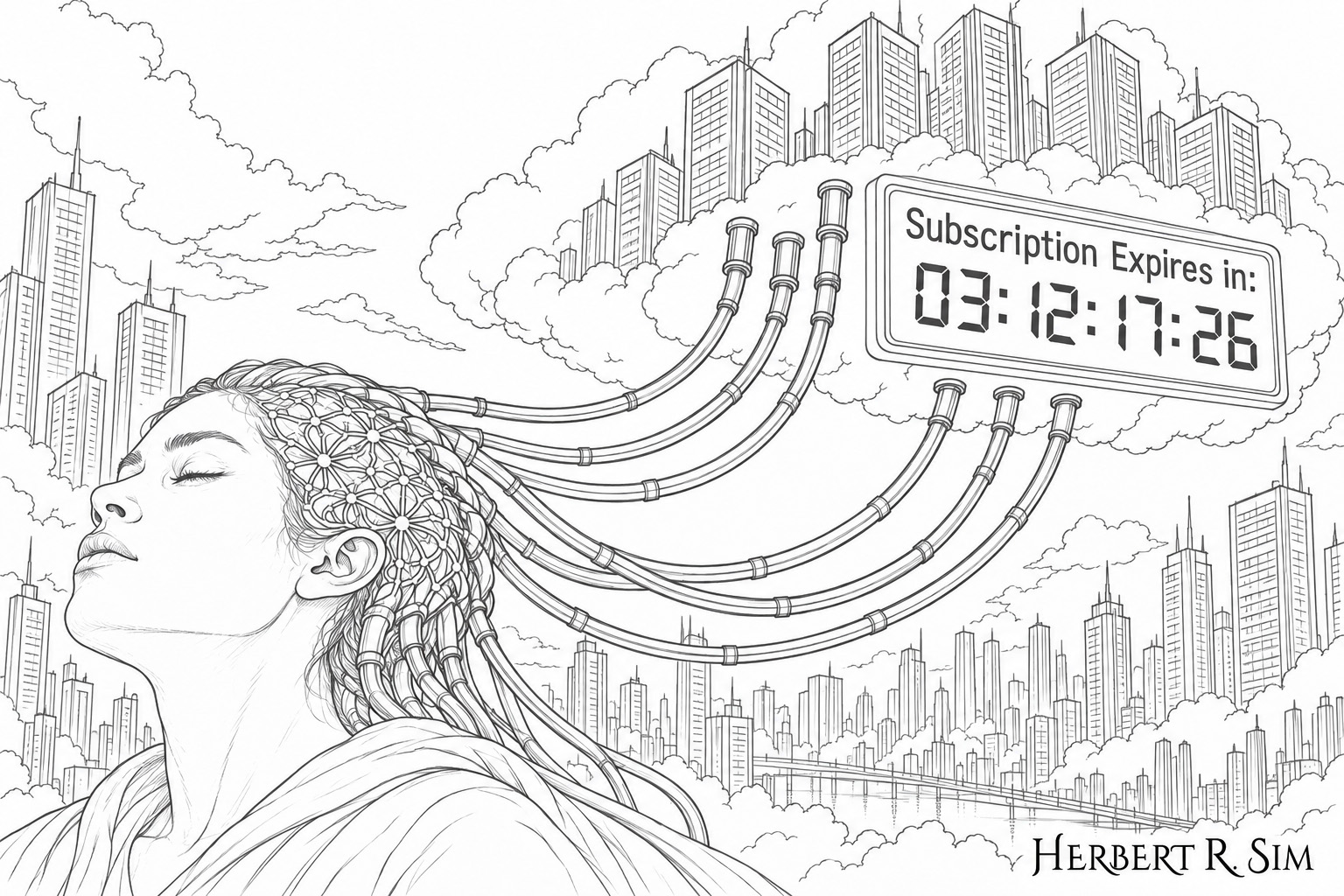
My illustration work-in-progress. The art represents the danger of treating thought itself as a rented service—where a person’s mind can be governed by another entity’s terms, updates, and expiry date.
The right to repair, transfer and disconnect
If a person can only obtain repair from one company, only use one approved supplier, only keep their settings through one cloud account, and only transfer to a successor product at the vendor’s discretion, their autonomy has been reduced. A proprietary lock-in may be commercially attractive; it is ethically dangerous when it reaches into the conditions of cognition.
A sovereign user needs practical exit rights. These include the ability to export personal settings and non-sensitive functional records in interoperable formats; to move to another qualified provider without losing unnecessary data; to obtain maintenance from competent independent professionals; and to discontinue connected services without punitive loss of core functions, except where a limited safety restriction is demonstrably necessary.
The right to disconnect is equally important. A user should be able to suspend non-essential data transmission, turn off optional monitoring and leave a service without surrendering their dignity or basic functionality. No one should be forced to remain permanently online merely because a neural device has become part of daily life.
Exit rights do not mean careless self-modification. Neural systems require strong safety standards and trained clinical support. But safety cannot become a pretext for captivity. The proper goal is safe reversibility: pathways by which a person can pause, repair, transfer, disconnect or remove a technology with informed assistance and without coercive penalties.
Consent must be free of coercion
A contract signed under economic pressure is not the same as free choice. If an employer offers a neural productivity tool and quietly makes refusal a barrier to promotion, the worker’s apparent consent may conceal coercion. If an insurer charges those who decline cognitive monitoring, or a school rewards students who submit to attention tracking, private preference becomes institutional pressure.
The Doctrine of Dual Freedom protects both sides of human choice: the freedom to enhance and the freedom to refuse enhancement. Neither choice should lead to discrimination, loss of civil standing, or artificial exclusion from education, work, care and public life. An enhanced person must not become a data source by condition of participation. An unenhanced person must not be treated as obsolete.
This is especially important because neural technologies may be marketed as tools of efficiency. Efficiency is not an ethical trump card. A society that measures only output can gradually normalise demands that people expose their attention, mood and cognitive rhythms in order to remain employable. HST rejects that path. Human dignity is not a performance metric.
From terms of service to a charter of cognitive rights
The existing language of consumer protection is too small for the challenge. An enhanced mind requires a civic framework, not merely a better privacy policy. Companies, clinicians, regulators and users need clear boundaries before dependency becomes normal.
A Human-Sovereignty approach to neural technology should include the following commitments:
- Neural self-ownership: the person retains primary authority over neural data, device settings and the use of their cognitive signals.
- Purpose limitation: neural data may be used only for clearly stated, authorised purposes, not silently repurposed for advertising, profiling or behavioural manipulation.
- Transparent updates: material changes must be explained in plain language, logged, tested and open to challenge.
- Continuing consent: permissions must be granular, renewable and revocable; a one-time signature is not lifelong consent.
- Portability and interoperability: users must be able to move essential personal settings and records between qualified systems.
- Right to safe exit: people need viable paths to pause, disconnect, repair, replace or remove technology without retaliation or unjustified loss of function.
- Security by design: neural systems must be protected against unauthorised access, manipulation and coercive takeover.
- Independent accountability: serious harms require audit, explanation, remedy and avenues for human appeal.
These are not obstacles placed in the path of progress. They are the conditions under which progress remains worthy of human beings. Trust grows when people can understand, challenge and leave a system. A technology that survives only by making exit impossible has already confessed its weakness.
Ownership is also a question of identity
The deepest danger of cognitive subscription is not a billing dispute. It is the gradual normalisation of the idea that a person’s mental life may be administered from outside. A system can begin by offering convenience, then use dependency to dictate terms. It can begin by collecting diagnostic signals, then expand into prediction, classification and influence. It can begin as a device, then become a gatekeeper to functions through which a person knows themselves and the world.
Human identity is not static, and HST welcomes voluntary transformation. People may choose bionics, neural aids, new senses or cognitive tools. But enhancement must not become identity confiscation. The enhanced person remains a full moral and legal subject: able to question the system, refuse a change, retain privacy, leave a provider and seek redress when something goes wrong.
The essential test is simple. Does the technology increase the person’s capacity to direct their own life, or does it make that direction conditional on an institution’s continuing control? This is the Human-Sovereignty Test. It asks not only what a device can do, but who has the power to alter, observe, interrupt, monetise or withdraw it.
Build enhancement that people can truly own
The future of neurotechnology should not be a choice between innovation and human rights. We can build systems that are sophisticated without being extractive; connected without becoming coercive; secure without becoming opaque; and profitable without claiming ownership over the people they serve.
Developers should compete to give users more control, not to trap them behind proprietary walls. Regulators should recognise neural data as a distinct category of intimate information. Clinicians should defend patients against hidden commercial dependency. Citizens should insist that no terms of service can override bodily sovereignty, cognitive liberty or mental privacy.
An enhanced mind may use advanced tools, but it must never become an accessory to somebody else’s business model. The person is not leasing their humanity. They are exercising it.
The proper purpose of enhancement is capability with agency: a stronger mind, not a more manageable one.
That is the non-negotiable promise of Human-Sovereignty Transhumanism. We may build remarkable technologies. We may connect mind and machine in ways that earlier generations could barely imagine. But the final authority to enhance, refuse, question, disconnect and remain oneself must always belong to the human being.