
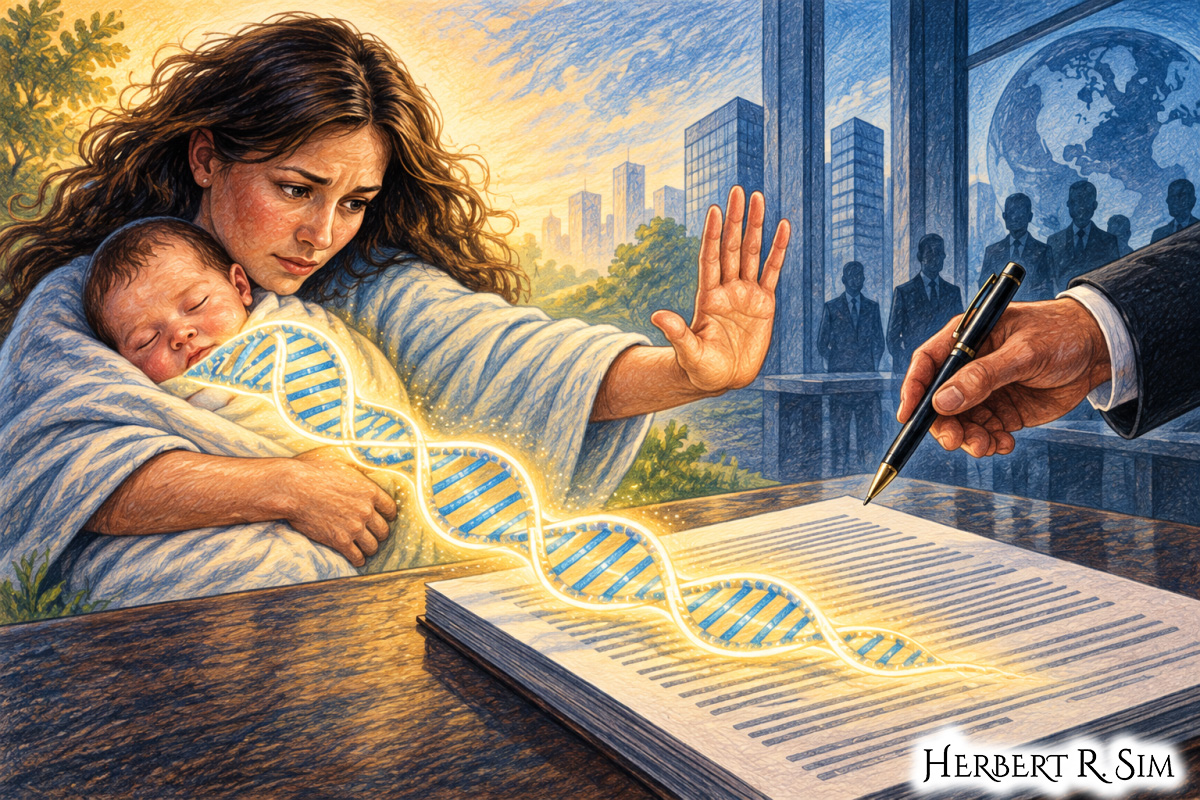
My illustration entitled: “The DNA Contract” — A newborn’s DNA helix unspools into a dense corporate agreement, while a parent reaches to protect the child from signing.
A license agreement is a contract between parties who can read, question, negotiate and refuse. A newborn child can do none of these things. Yet as genetic testing, biobanks and personalised medicine expand, it is increasingly possible for a person’s biological information to be collected, stored, analysed and commercially used before that person has ever had the chance to decide.
That should concern us. Genetic data is not ordinary consumer data. It is not a music preference, a shopping history or a record of a website visit. It is information about the body through which a person will live their entire life. It may disclose inherited risks, biological relationships and information that has meaning not only for one individual, but for parents, siblings, children and future generations.
No one should be born into a license agreement they never accepted. No corporation, insurer, government agency or medical institution should acquire an unrestricted claim over a person’s genetic identity simply because their data was gathered early, their parents consented once, or a service was offered under terms no ordinary family could reasonably understand.
Human-Sovereignty Transhumanism affirms that each person remains sovereign over body, mind, genome, data, identity and future. Science can and should serve human flourishing. But it must not turn biological life into a resource controlled by distant institutions. Technology must remain the servant of humanity; humanity must never become the property of technology.
Why genetic data is different
Every form of personal data deserves protection, but genetic information has unusual power. It can reveal a predisposition rather than a present condition. It can be analysed again as scientific knowledge changes. It can create inferences about relatives who never agreed to testing. And unlike a password or account number, it cannot simply be replaced if it is exposed.
Genetic data is also durable. A sample collected for one medical purpose may remain valuable for research, marketing, insurance assessment or commercial development long after the original patient has forgotten it exists. This persistence creates a temptation to treat consent as a permanent transfer of authority. It is not.
A person who provides a sample for diagnosis has agreed to a defined medical purpose. They have not automatically agreed to every future use of that sample, every new analysis of its information or every transfer between companies, databases and jurisdictions. Purpose matters. Consent must be tied to the purpose that was understood, not stretched to cover whatever becomes profitable later.
Biological ownership is not corporate ownership
“Ownership” can be an imperfect word when applied to the human body. A person is not a commodity and should not be treated as property in the ordinary commercial sense. But the language of ownership points to a vital question: who has the authority to decide how a person’s biological information is used?
The answer cannot be a company merely because it paid for a laboratory, developed a database or wrote the terms of service. Investment in research deserves fair reward, but no financial contribution should become a claim of dominion over the people from whom biological knowledge is derived. The individual is not raw material. They are the source of the right.
A responsible system should recognise that people have enforceable interests in access, correction, privacy, withdrawal and control over the use of their genetic information. Institutions may be trusted stewards for a limited purpose. They must not become permanent owners of identity.
The problem of inherited consent
Parents must make many decisions for children, including important medical decisions. They may consent to testing when a diagnosis is needed or when a serious condition is suspected. Such decisions can be an expression of care.
But parental authority is not an unlimited power to sign away a child’s future biological rights. A parent may authorise a necessary test; they should not be able to bind the child forever to a commercial relationship, unrestricted data sharing or a permanent genetic profile controlled by others. The child will grow into an adult with their own values, privacy interests and judgment about what they wish to know or disclose.
This is why the protection of genetic data must evolve with the person. When the child becomes capable of informed judgment, they should be able to access their own records, understand the uses made of their information and decide whether continued storage or sharing is acceptable. They should have meaningful options to limit use, withdraw consent and request deletion where scientifically and medically possible.
Intergenerational responsibility means more than making careful choices for a child today. It means preserving the child’s authority to make choices tomorrow.
Consent must be living, not buried
Too often, consent is treated as a bureaucratic event. A person clicks a box, signs a form or agrees in a moment of stress, and institutions consider the matter settled. This model is especially inadequate for genetic information because the uses, risks and value of data can change over time.
Meaningful consent should be specific, understandable, voluntary, renewed when conditions materially change and withdrawable. It should distinguish clearly between medical care, research participation, data storage and commercial use. A patient should not need legal training to discover that a test ordered for health reasons also allows broad sharing with unknown partners.
Consent must also be free from coercion. A person who fears losing insurance, employment, treatment or access to basic services is not negotiating on equal terms. No institution should use genetic disclosure as an informal condition of ordinary participation in society. Privacy becomes meaningless when people must trade it away to survive.
The risk of genetic classification
Genetic information can help medicine respond earlier and more precisely. It can also invite a new kind of classification. Employers may be tempted to screen for future risk. Insurers may seek to price biological uncertainty. Governments may imagine databases that sort citizens by inherited traits. Even well-intentioned institutions may begin to confuse prediction with destiny.
A predisposition is not a verdict. A genome does not contain the full story of a person’s character, choices or future contribution. Biology interacts with environment, education, community and personal agency in ways no database can completely capture. To treat a person as the sum of their genetic probabilities is to reduce human identity to a statistical profile.
Human-Sovereignty Transhumanism rejects this reduction. Enhanced and unenhanced persons retain equal moral worth, legal protection and political standing. So do those whose data suggests a risk and those whose data does not. A free society must prevent genetic knowledge from becoming an excuse for discrimination, exclusion or permanent suspicion.
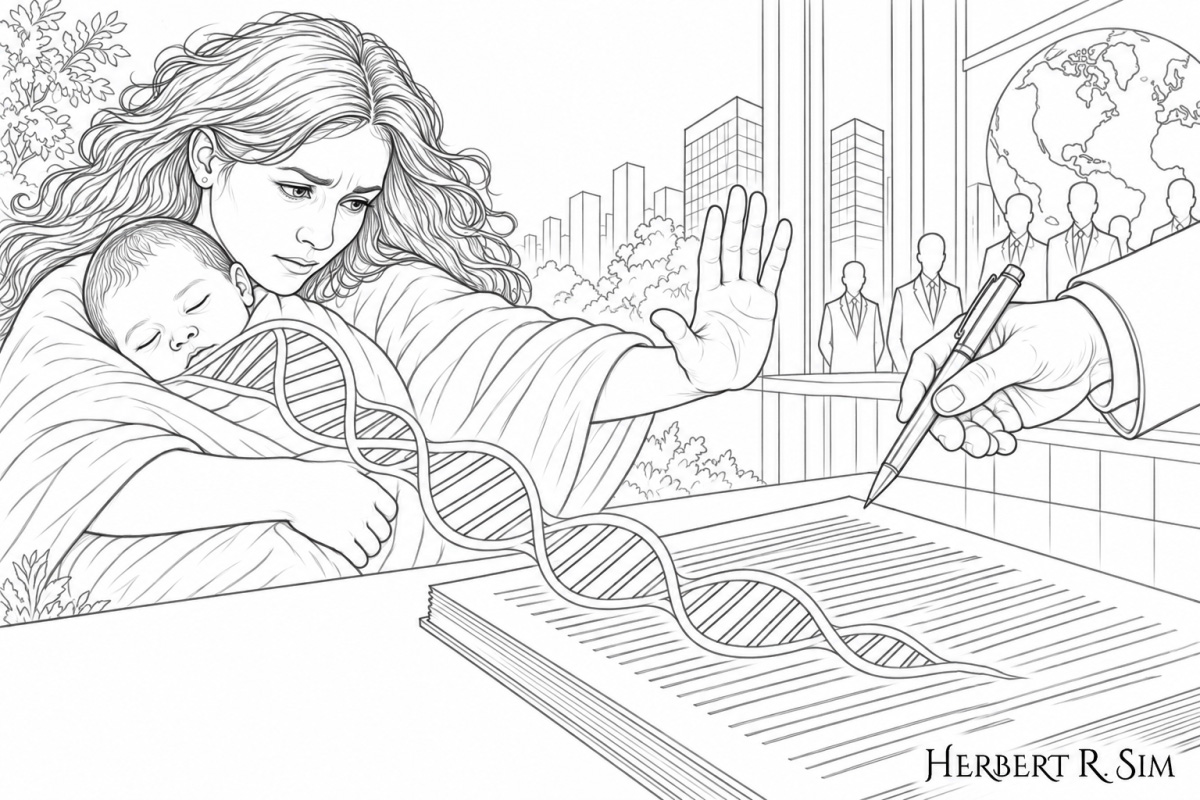
My illustration “The DNA Contract” work-in-progress. The art affirms that a child’s DNA is an inalienable human inheritance—not a corporate asset to be licensed, traded, or signed away.
Research requires stewardship and reciprocity
Genetic research can produce genuine public benefit. It may improve diagnosis, reveal disease mechanisms and support new therapies. The answer is not to isolate all biological information from scientific work. The answer is to build research relationships on transparency, stewardship and reciprocity.
People who contribute information should understand the purpose of a project and the institutions involved. They should know whether their data will be identifiable, whether it may be shared and what safeguards exist. They should not be promised privacy that cannot be delivered, nor should they be asked to trust indefinitely without accountability.
Where research produces significant social or commercial value, the people whose data made it possible should not be treated merely as invisible inputs. At a minimum, they deserve honest information, meaningful choice and respect for the limits they set. The future of science depends not only on innovation, but on public trust. Trust is earned when institutions recognise that participation does not cancel personhood.
The right to access, correct and leave
Genetic sovereignty has practical requirements. A person should be able to know whether an institution holds their biological information. They should be able to obtain a usable copy of relevant records, understand the stated purpose of retention and correct demonstrable inaccuracies. They should be able to see who has received access and challenge unauthorised sharing.
They should also have a right to leave. This does not mean that every medical record can vanish immediately or that research integrity can be ignored. It means that withdrawal must be real rather than symbolic. Institutions should provide a clear process for ending future use, restricting access and deleting information where possible. They should explain honestly what cannot be erased and why.
Exit is a condition of freedom. When a person has no practical way to withdraw from a biological data system, they are not a participant. They are a captive source of value.
Decentralising biological power
Large stores of sensitive information create large concentrations of power. A central database may be convenient, but convenience is not sufficient justification for permanent vulnerability. The more intimate the data, the stronger the case for limiting unnecessary concentration, separating access, minimising collection and ensuring independent oversight.
Genetic information should be collected only when a clear and legitimate purpose exists. It should be protected by robust security, strict access controls and transparent governance. Its use should be limited to what the person understood and authorised. Any system that claims unlimited rights to biological data should be treated with suspicion, no matter how impressive its technical language.
Decentralisation is not merely a technical preference. It is a safeguard against a world in which one failure, one policy change or one commercial acquisition can place millions of intimate lives under a new authority without their meaningful consent.
A charter for biological ownership
The following principles should guide the governance of genetic data:
- Person before platform: genetic information belongs first to the sphere of the person, not the business model of the institution.
- Purpose limitation: collect and use data only for clear, stated and authorised purposes.
- Living consent: make consent understandable, specific, renewable and withdrawable.
- Future-person protection: do not allow parental or institutional consent to become permanent control over a child’s genetic identity.
- Access and correction: give individuals meaningful access to their records and a way to challenge errors or misuse.
- Right to exit: provide practical paths to restrict future use and delete data where possible.
- Non-discrimination: prohibit genetic information from becoming a basis for exclusion or diminished civic standing.
- Accountability: identify who is responsible when information is mishandled, repurposed or exposed.
Human life cannot be pre-sold
The question of genetic data is ultimately a question of human authority. Will people direct the use of their own biological information, or will they be required to accept conditions written by institutions that outlast their understanding and control?
We should embrace genetic knowledge when it helps us heal, prevent suffering and understand life more deeply. But we must reject the idea that a person’s genome can be silently converted into a perpetual commercial asset. No child should enter the world already bound by agreements they never made. No adult should discover that their biological identity has become the property of a system they cannot question or leave.
Human progress begins with human sovereignty. Genetic technology must serve the person from whom it learns.