

My illustration entitled: “Inheritance and Freedom” — Three generations stand beneath a tree whose branches form a DNA helix, with the youngest child stepping beyond its roots.
Genetic technology holds extraordinary promise. It may help prevent inherited disease, improve diagnosis, guide treatment and reduce forms of suffering that have long been accepted as unavoidable. For many families, this promise is not abstract. It concerns the possibility of a child living with fewer limitations, a parent gaining time with their family, or a patient receiving care matched to their own biology.
Yet the power to influence the human genome also raises a question that cannot be answered only by laboratories, markets or parental hope: what do we owe to the person whose future is being shaped before they can speak for themselves?
Every child inherits a past they did not choose. They inherit a body, a family, a culture and a world already in motion. Genetic intervention may add another layer to that inheritance: choices deliberately made by others about which risks to prevent, which traits to favour and which futures to make more likely.
The genetic right to an open future is the principle that a person should enter life with the greatest possible freedom to become themselves. It does not deny the value of healing. It does not demand that parents ignore preventable suffering. It insists that the use of genetic power must protect the future person from being treated as a project, a product or an instrument for someone else’s ambition.
Human-Sovereignty Transhumanism welcomes responsible science that heals and expands human capability. But it rejects the idea that technological possibility automatically grants moral authority. The human being must remain the subject of technology, never its object or property. This is especially important when the person affected cannot yet consent.
The future child is not a blank canvas
Parents make countless decisions for children. They choose where a child lives, what language they hear, what schools they attend and which values they are taught. Many of these choices are unavoidable. Good parenting includes care, protection and preparation for a future that the child will eventually direct for themselves.
Genetic decisions are different in degree and, in some cases, in kind. They may be difficult or impossible to reverse. They may reach beyond health into appearance, temperament, physical capacity or cognitive potential. They may affect not only one child, but future descendants. This gives them a special moral weight.
A child should not be understood as unfinished material waiting to be perfected by adult preferences. They are a future person whose independence deserves respect before it can be expressed. The right to an open future asks parents, clinicians and governments to exercise restraint where the consequences of a decision may close off the child’s own later choices.
This does not require an impossible neutrality. No child begins life without constraints. It requires a distinction between protecting the child from a serious and avoidable harm, and designing the child to satisfy social competition, commercial fashion or parental expectation.
Healing is not the same as designing
There is a strong ethical case for genetic interventions directed at preventing severe disease or restoring a basic opportunity for health. To relieve unnecessary suffering is one of the highest purposes of medicine. A child protected from a grave inherited illness may gain more freedom, not less.
But the language of therapy can be stretched too easily. Once a technology is available, every difference may be described as a deficiency, every trait as a risk, and every ordinary variation as a problem waiting to be corrected. A society that cannot tolerate difference may begin to use medicine not to heal people, but to narrow the range of people it is willing to accept.
The difference between healing and designing should therefore remain morally visible. Healing seeks to protect a person from serious harm. Designing seeks to impose a preferred outcome upon a future person. The categories may sometimes overlap, and difficult cases will remain. But uncertainty is not a reason to abandon judgment. It is a reason to apply greater care, transparency and public accountability.
We should be cautious when a genetic choice is primarily motivated by status, competitive advantage or the fear that an unmodified child will be left behind. Such pressures do not expand freedom. They can transform the future child into an answer to the anxieties of the present.
The danger of genetic competition
Genetic technology will not develop in a moral vacuum. It will enter societies already shaped by competition for education, work, wealth and social standing. Parents may feel pressure to use every available advantage. Companies may market genetic services as responsible preparation. Insurers may seek information that allows them to classify risk. Governments may be tempted to encourage traits they consider economically useful.
This is the beginning of a genetic arms race: not necessarily one imposed by law, but one imposed by expectation. A decision that appears private can become socially compulsory when refusal carries a growing cost. Parents who do not wish to modify a child may be told they are denying them opportunity. Children who are not modified may be treated as less competitive before they have had the chance to define themselves.
Human-Sovereignty Transhumanism rejects this form of coercion. The freedom to use technology is incomplete if families do not retain a real freedom to refuse it. A child’s prospects must not be made conditional on whether their parents could afford, trust or desire the latest genetic intervention.
Society should invest in education, healthcare, nutrition, safety and opportunity rather than pretending that inequality can be solved by redesigning the next generation. An open future is not created by maximising every measurable trait. It is created by giving people room to choose a life that is genuinely their own.
Genetic privacy protects freedom
The genome is not merely medical information. It can reveal family relationships, disease predispositions and aspects of biological inheritance that a person may not wish to know or disclose. Once collected, genetic information can be difficult to contain. It may be copied, analysed, sold, shared or used years later for purposes far removed from the original test.
For this reason, genetic data deserves unusually strong protection. A person should know when their information is collected, how it will be used, who has access to it and how long it will be retained. Consent for a medical purpose should not become permission for marketing, employment screening, insurance discrimination or state surveillance.
Children require additional protection. Parents may consent to testing or treatment on their behalf, but they should not be able to surrender the child’s entire genetic privacy forever. As children mature, they should gain access to their own information and meaningful authority over whether it is shared, corrected or deleted where possible.
Genetic knowledge must serve the person. It must never become a permanent label that allows others to predict, limit or control their future.
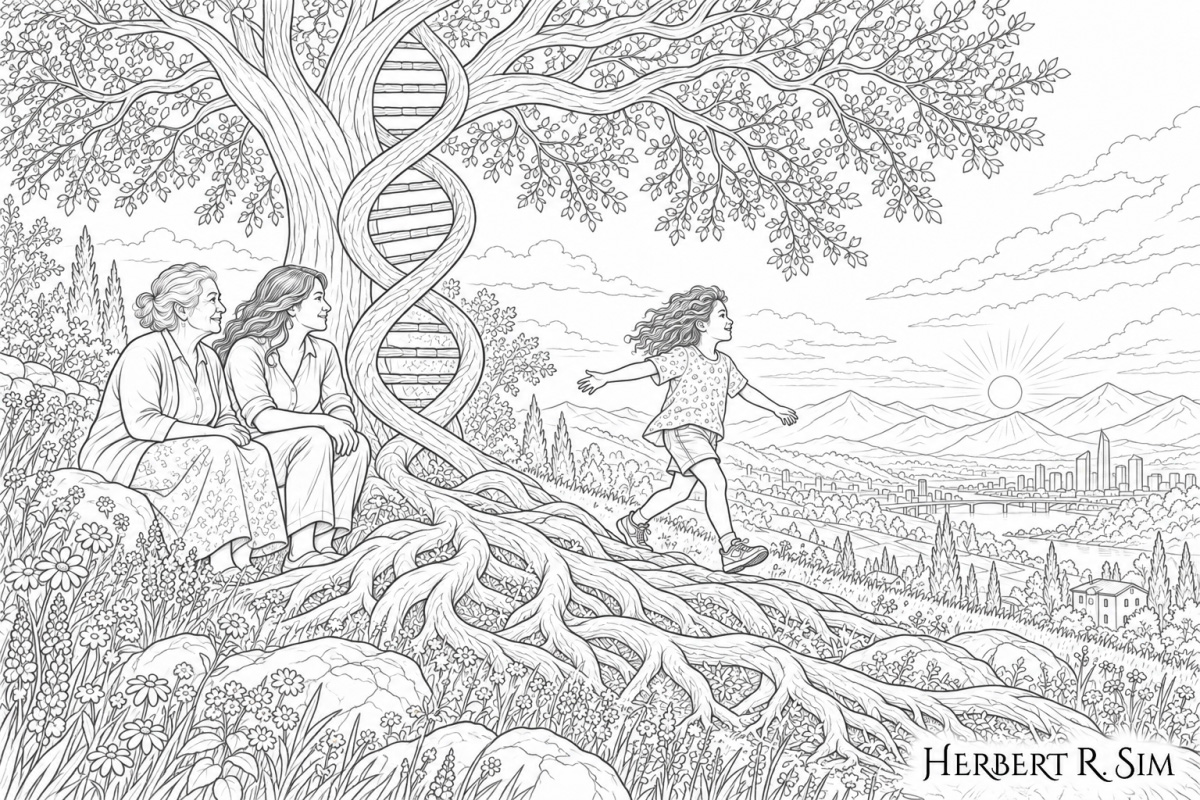
My illustration “Inheritance and Freedom” work-in-progress. The art represents how we inherit biology and history, yet retain the freedom to step beyond both and shape an open future of our own.
Consent across generations
The challenge of genetic intervention is that the person most affected may be unable to consent. This does not mean that all intervention is unethical. Parents and doctors regularly make necessary decisions for children. It means that the burden of responsibility is higher when decisions are irreversible, heritable or directed at traits that are not connected to serious disease.
A responsible standard should ask several questions. Is there a clear medical necessity? Is the evidence strong enough to justify the risk? Are less intrusive alternatives available? Is the intervention likely to preserve or expand the future child’s range of choices? Are the long-term consequences honestly known? Who will be accountable if harm appears later?
These questions cannot be answered by private interest alone. Heritable changes and reproductive technologies may affect generations beyond the original decision. They require transparent oversight, independent ethical review and public debate. The future child deserves advocates in the present.
Identity is not a defect
One of the most dangerous habits of technological thinking is to assume that whatever can be measured can be optimised, and whatever can be optimised ought to be optimised. But human identity is not a performance report. A person is not a collection of traits ranked against a market standard.
Diversity in body, mind and temperament has always been part of humanity. Some differences bring hardship and deserve compassionate medical response. Others are simply expressions of the variety through which people live, relate and contribute. The pursuit of genetic perfection can become a rejection of that variety.
We should never romanticise suffering. Nor should we confuse the elimination of suffering with the elimination of difference. A humane genetic future recognises both obligations: to use knowledge against serious harm and to protect persons from being redesigned according to narrow ideals of success.
The right to know and the right not to know
Genetic information can empower, but it can also burden. Some people may wish to learn about possible risks so that they can plan their care and life. Others may prefer not to receive knowledge that has no clear treatment or immediate benefit. Both positions can be reasonable.
As a child becomes capable of making informed decisions, they should have the right to participate in whether and how they learn about their genetic profile. Their future should not be overwhelmed by information chosen for them by institutions or relatives. The right to an open future includes not only freedom from imposed traits, but freedom from imposed narratives about what one’s biology supposedly means.
A framework for genetic sovereignty
A responsible approach to genetic technology should follow several principles:
- Medical purpose before social competition: prioritise the prevention and treatment of serious harm, not status-driven design.
- Future autonomy: prefer choices that preserve or expand the child’s later ability to direct their own life.
- Heightened safeguards: require stronger evidence and review for irreversible, heritable or reproductive interventions.
- Genetic privacy: protect genomic information from unnecessary collection, repurposing and discrimination.
- Equal human standing: reject the idea that genetic modification makes one person more worthy than another.
- Accountability and redress: ensure that identifiable institutions accept responsibility for errors, harm and misuse.
- Freedom from coercion: protect families and future persons from economic, social or political pressure to modify.
These principles are not barriers to science. They are the conditions under which science can earn durable trust. They place human freedom at the centre of genetic progress rather than treating freedom as an obstacle to be managed.
Keeping the future open
The coming genetic age will test whether humanity can use power without confusing power with wisdom. We may gain new ways to prevent suffering, and we should pursue them responsibly. But we must not allow the desire for control to replace the respect owed to the person who will live with the result.
The child of the future is not a product to be optimised for the preferences of the present. They are a sovereign person in formation. Their right to an open future requires us to heal where we can, to refrain where we should, and to protect the freedom that no technology can manufacture on their behalf.
Enhance the human—but never surrender the person.