
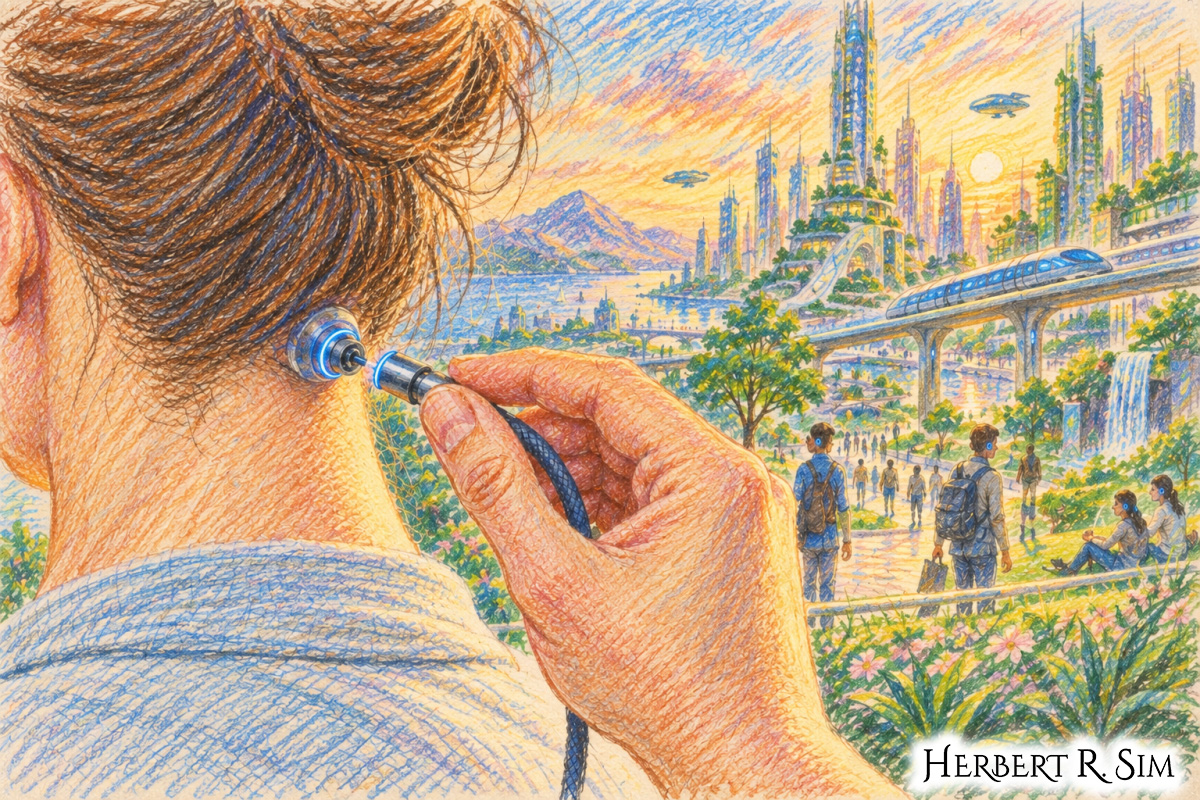
Above, my illustration entitled “The Right to Disconnect” — A close-up of a hand unplugging a sleek neural-interface cable, while a city of connected augmented citizens glows in the background.
Technology should widen the range of human possibilities, not narrow it. Yet every advance in enhancement—from cognitive implants and genetic intervention to prosthetic augmentation and life-extension medicine—creates a question that is too often treated as secondary: what happens to the person who says no?
In the coming decades, it may become increasingly easy to improve memory, attention, strength, perception and longevity. These developments can relieve suffering, restore function and expand human capability. They deserve serious research and responsible investment. But the freedom to enhance has meaning only when it is paired with an equally protected freedom not to enhance.
The right to remain human is not a rejection of progress. It is a defence of personal sovereignty in an age when the boundary between treatment, improvement and social expectation is beginning to blur.
Choice is the first condition of human progress
There is an important moral difference between making an enhancement available and making it necessary to participate in ordinary life. A neural interface chosen by an adult for personal reasons is one thing. An interface effectively required by an employer, school, insurer, military institution or government is another.
Coercion does not always arrive as a law. It can arrive as a condition of employment, a lower insurance premium, an admissions preference, a productivity target, or the quiet assumption that an unenhanced person has chosen to fall behind. When enhancement becomes the price of equal opportunity, consent is no longer fully voluntary.
Human-Sovereignty Transhumanism begins from a simpler premise: technology must serve the individual human being, not turn the individual into a resource for technological systems. The highest measure of a new capability is not merely what it can do, but whether people remain free to accept it, refuse it and live with dignity after either decision.
Therapy and enhancement must not be confused
Medicine has a powerful and humane purpose: to heal, reduce pain and restore lost function. A cochlear implant, artificial limb, insulin pump or life-saving genetic therapy may give someone access to a life that illness or injury would otherwise deny. These are profound achievements.
Enhancement is different. It seeks to move a person beyond an ordinary baseline of function—perhaps by extending attention, accelerating learning, increasing physical performance or altering mood. The distinction will not always be neat, but it matters because therapeutic access should never become an argument for compulsory optimisation.
We should champion the right to use technology to overcome disability and disease while refusing the idea that an unmodified body or mind is a defect. An individual who declines elective enhancement is not anti-science, irresponsible or less worthy of opportunity. They are exercising a fundamental liberty.
From permission to genuine consent
It is not enough for an institution to obtain a signature or click an agreement box. Genuine consent requires that a person understands the possible effects of an enhancement, can weigh alternatives, and can refuse without being punished indirectly. It must be informed, voluntary and reversible wherever the technology permits.
This matters especially where enhancement reaches into cognition, emotion or identity. A device may improve concentration, but it may also influence habits of attention. A biochemical intervention may improve mood, but it may also alter a person’s sense of self. We should not pretend that every new capability is merely another consumer product. The closer a technology moves toward the body and mind, the greater the duty to protect independent judgment.
Parents, teachers, doctors and employers will all face difficult decisions. Their role should be to inform and assist, not to transform a personal choice into an obligation. Children deserve particular care. They should not become early test cases for competitive parents, ambitious schools or industries seeking a future market. The desire to give a child every advantage must never eclipse the child’s future ability to define their own identity.

My illustration “The Right to Disconnect” work-in-progress. The art represents the sovereign right to choose one’s own limits: in a hyperconnected future, real progress means retaining the freedom to disconnect.
The danger of a two-tier humanity
Without safeguards, enhancement could create a new form of inequality. Those with wealth, institutional access or privileged data may acquire advantages that compound across education, work, health and political influence. The result would not simply be different tools in different hands; it could be a culture in which unenhanced people are treated as slower, less capable or less employable by default.
This is why the debate cannot be left to markets alone. Markets can offer choices, but they do not automatically protect people from discrimination or pressure. Public policy must ensure that a person is not denied work, education, insurance, housing, civic participation or legal standing because they choose to remain unenhanced.
We should also resist a social vocabulary that divides people into “upgraded” and “obsolete.” Human worth is not a performance metric. The value of a person cannot be reduced to processing speed, physical output, predicted productivity or compatibility with the latest device.
Freedom requires a real right to exit
A choice cannot be called free when it has no exit. For this reason, voluntary enhancement should include an expectation of discontinuation, removal or deactivation when this can be done safely. A person must not be trapped in a technology because leaving it would mean losing their livelihood, their access to public services or their standing among others.
The right to exit also guards against a more subtle danger: dependence engineered for profit or control. Systems that make people permanently reliant on a manufacturer, employer or state authority may offer capability while quietly transferring power away from the individual. The question is not only, “What can this enhancement do?” It is also, “Who retains authority once it is adopted?”
Human-Sovereignty Transhumanism therefore rejects both fear-driven prohibition and blind technological submission. It supports progress when progress expands a person’s capacity to act. It opposes progress when the price of greater capacity is the surrender of bodily, mental or moral independence. Technology must remain the servant of humanity; humanity must never become the property of technology.
Privacy protects the unenhanced as well as the enhanced
Enhancement technologies will generate new forms of intimate data: neural signals, genetic profiles, behavioural patterns and biometric records. If participation becomes expected, so may the surrender of this data. The right to refuse enhancement must therefore include the right to refuse unnecessary collection, monitoring and analysis of one’s body and mind.
No employer should be entitled to demand cognitive data to measure concentration. No school should require a student to adopt a device in order to prove attention. No institution should presume access to genetic information simply because a person seeks to participate in society. The more intimate the technology, the stronger the protection must be.
Answering the argument for compulsory progress
Some will argue that society has always expected people to learn, adapt and use new tools. That is true. But learning to use a public tool is not the same as modifying the body or mind to meet an institutional standard. The difference is not sentimentality; it is the difference between adapting one’s circumstances and surrendering authority over one’s own person.
Others may say that a nation, company or military cannot afford to let individuals decline enhancements that improve performance. This argument is dangerous precisely because it sounds practical. History shows that when efficiency becomes the only value, persons are quickly treated as instruments. A society that protects liberty only when liberty is convenient does not protect liberty at all.
Competition can encourage invention, but it cannot be allowed to define human dignity. The best long-term innovation culture is one that wins trust: one in which citizens know that new technologies will be offered honestly, governed responsibly and never used to make them strangers to their own bodies or minds.
A human-centred standard for innovation
Responsible innovation should be guided by several clear principles:
- Voluntary adoption: elective enhancement must rest on informed, revocable consent.
- Equal civic standing: people who decline enhancement must retain equal rights, opportunity and dignity.
- Protection from discrimination: no institution should penalise a person for remaining unenhanced.
- Privacy by design: biological, neural and genetic data must remain under meaningful individual control.
- Right to exit: where technologically possible, a person must be able to disconnect from or reverse an elective enhancement without losing their place in society.
These principles do not obstruct transhumanism. They make it worthy of human trust. A future built on forced adaptation would not be liberation; it would be a more sophisticated form of control. A future built on informed choice can allow people to explore new capabilities while preserving the authority each person has over their own life.
Progress must leave room for refusal
There will be people who choose enhancement enthusiastically, people who approach it cautiously and people who reject it entirely. A free society must make room for all three. It must never allow the excitement of invention to turn non-participation into exclusion.
The right to remain human is therefore not a nostalgic appeal to stop the future. It is a demand that the future recognise the person as its final authority. We may enhance. We may refuse. We may change our bodies and minds, or preserve them as they are. But the decision must remain ours.
That is the line that protects human freedom in the age of enhancement.