

My illustration entitled: “The Code-Controlled Mint” – A grand mint where streams of code program coins, while a few operators adjust the rules from a raised control room.
Money has always carried power. It determines whether people can save, exchange, invest, support a family, start an enterprise and plan beyond immediate survival.
As money becomes digital, that power becomes increasingly programmable.
A digital payment system can make transfers faster, reduce costs, improve record-keeping and widen access to commerce. It can help people transact across distance and allow businesses to operate with greater efficiency.
But programmability also creates a deeper political-economic question: if money can be programmed, who writes the rules?
Can a payment be limited by place, time, purpose or identity? Can savings be made conditional on compliance with changing rules? Can access to ordinary economic life be granted, monitored or withdrawn by institutions that sit between the individual and their own value?
These questions are not merely technical. They concern the relationship between money, power and human freedom.
Money Is More Than a Payment System
Money is often treated as a neutral instrument: a means of buying, selling and settling obligations. Yet money also connects present effort to future choice.
A person works, saves and preserves value so that they can make independent decisions later. They may use savings to pursue an education, move to a new place, begin a business, care for a family member or leave an arrangement that no longer serves them.
The ability to hold value securely is therefore an important part of economic liberty.
When money exists only as a permission granted through intermediaries, that liberty becomes more fragile. A person may possess funds in theory while lacking practical control over when, where and how they may use them.
Digital money does not automatically create this condition. But it can make the rules governing money more immediate, more detailed and easier to enforce at scale.
The Promise of Programmable Money
Programmable money can offer genuine benefits.
Payments may become faster, more transparent and more efficient. Contracts may be settled through clear digital rules. Individuals and businesses may gain new ways to manage obligations, exchange value and coordinate economic activity.
In a well-designed system, programmability can reduce friction without reducing freedom. It can allow people to transact more easily while retaining meaningful ownership over the value they hold.
The important distinction is between a tool that serves the user and a system that governs the user.
A useful financial tool helps people make their own decisions. A controlling financial system decides which decisions they are permitted to make.
The difference may appear subtle in software. Its consequences in ordinary life can be profound.
When Money Becomes Conditional
A programmable financial system may allow rules to be attached directly to money itself.
A payment could be restricted to specific merchants. A benefit could expire after a set time. A transfer could require approval. A person could be excluded from a network because of an administrative decision, an automated assessment or a policy they had no meaningful role in shaping.
Some restrictions may be proposed for legitimate reasons, such as reducing fraud or administering limited-purpose support. But any power that can be used for a narrow purpose can also become broader over time.
The question is not whether every rule is harmful. The question is whether the individual retains meaningful protection against arbitrary, excessive or permanent control.
When access to money becomes conditional, economic participation can become conditional as well. A person may be technically included in the system while losing the practical ability to act independently within it.
The Power to Monitor Is the Power to Influence
Digital systems can create detailed records of economic activity. Every purchase, transfer, subscription and payment pattern may reveal something about a person’s life: where they go, whom they support, what they prioritise and how they organise their time.
This information can be useful for accounting, security and voluntary financial management. It can also create opportunities for surveillance, profiling and influence.
A system that knows every transaction may gain a detailed map of an individual’s economic life. If that system also controls access to money, the boundary between observation and intervention becomes dangerously thin.
Privacy is therefore not an obstacle to economic progress. It is a condition of independence.
People should not have to expose every ordinary decision in order to participate in commerce. Nor should the accumulation of financial data create a permanent power imbalance between individuals and the institutions that process their lives.
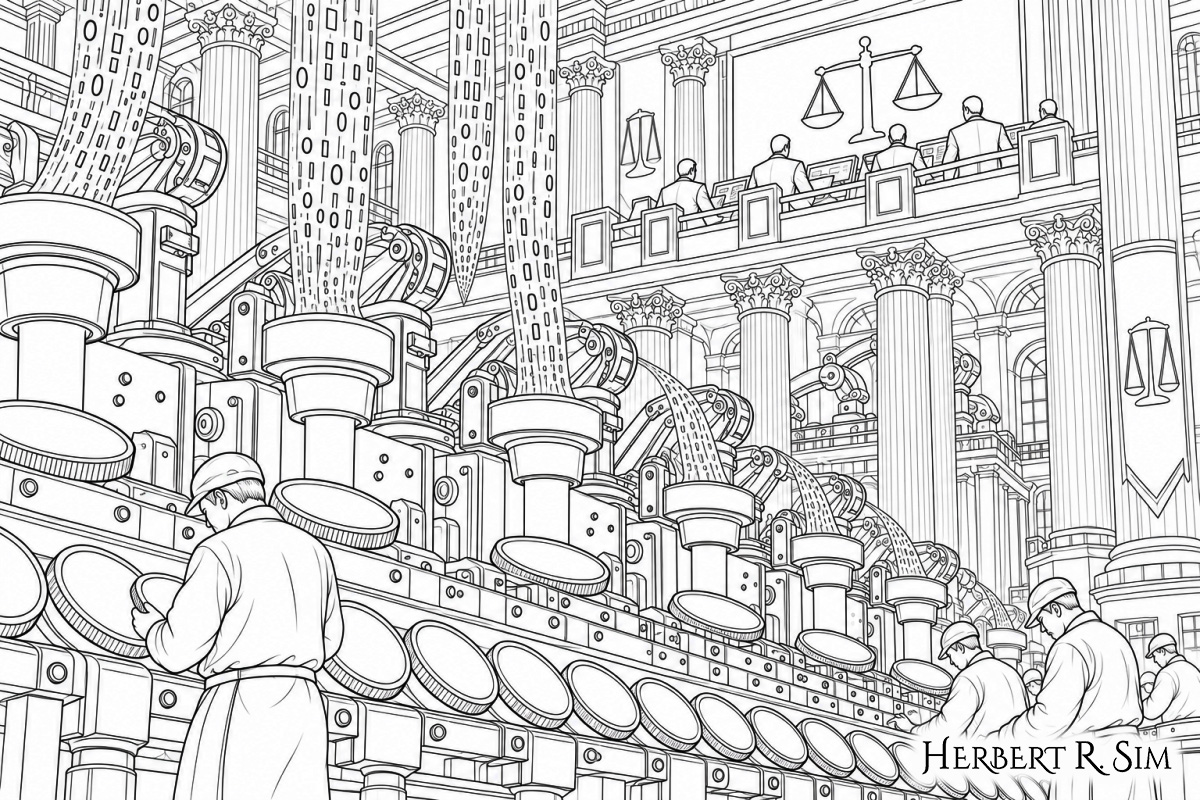
My illustration “The Code-Controlled Mint” work-in-progress. The art represents how programmable money can embed economic rules under the control of a small group of rule-makers.
Centralisation Creates a Single Point of Permission
A highly centralised monetary system can create efficiency, but it can also create dependency.
When one authority, platform or small group of institutions controls the essential channels of payment, its decisions can affect everyone at once. A technical failure, a policy change, an error or an abuse of power may become a problem not for one customer, but for an entire population.
The more essential a system becomes, the more carefully its power must be limited.
No institution should possess unnecessary authority over a person’s ability to hold value, receive payment, support a family or participate in ordinary economic life. Systems that become essential must remain accountable, contestable and subject to meaningful alternatives.
Economic resilience depends on avoiding a single point of permission.
Bitcoin and the Alternative Architecture of Money
Bitcoin offers a different model of monetary architecture.
It enables participants to verify and transfer value through a decentralised network rather than through a single central issuer. Its rules are enforced by cryptographic proof and distributed consensus, not by the discretionary approval of one institution.
Bitcoin does not eliminate responsibility. Users must still protect their keys, make informed decisions and accept the consequences of their choices. But it changes the structure of control.
It demonstrates that digital money can be built around direct ownership, open participation and the possibility of self-custody.
This does not mean that every person must reject every bank, payment provider or intermediary. Trusted services can offer convenience, security and support. The essential principle is that individuals should retain genuine choice.
A healthy monetary system gives people the ability to use trusted services without making those services the sole condition of economic participation.
Programmable Power Requires Limits
The issue is not whether technology should be used in money. Technology has always changed the way people exchange value. The issue is whether technological power remains subordinate to the individual.
Any programmable monetary system should be judged by clear questions:
- Can individuals hold and transfer value without unnecessary permission?
- Are restrictions transparent, proportionate and open to challenge?
- Can a person understand the rules that affect their money?
- Is financial privacy protected against unnecessary surveillance?
- Can people choose alternative providers or systems?
- Can an institution revoke access without due process or meaningful accountability?
These questions do not reject innovation. They establish the conditions under which innovation remains compatible with liberty.
The Right to Exit
The ability to exit is one of the strongest safeguards against economic control.
If individuals can move between providers, choose different forms of payment, self-custody value or build voluntary alternatives, institutions must compete for trust. If people have no practical alternative, institutions can impose conditions without earning confidence.
The right to exit does not mean freedom from law or responsibility. It means that responsibility remains connected to choice.
A person should not be trapped in a financial system because leaving means losing access to all money, commerce, work or social participation. Economic liberty requires more than a single approved channel.
It requires many paths through which individuals can act.
Money Must Serve Human Freedom
Programmable money may become one of the most consequential developments in the future of economic life. It can be designed to make exchange easier and institutions more efficient. It can also be designed to make control more immediate and dependence more complete.
The outcome will depend on the principles built into the system.
Sovereign Capability Economics holds that money should strengthen an individual’s capacity to choose, build, preserve value and direct their own future. It should not reduce people to accounts that can be managed according to changing institutional preferences.
The most important question is therefore not whether money becomes programmable. It is whether the individual remains sovereign when it does.
When money can be programmed, power can be programmed. Economic freedom survives only when individuals retain ownership, privacy, choice and the right to exit.