

My illustration entitled: “The Network Bridge” – Individuals from different trades and communities build a vast bridge together, each contribution strengthening the whole.
Capital is often understood as money: cash, savings, investment, land, machinery or other assets that can be used to create future value.
Money matters. It can provide security, mobility and the time needed to make independent decisions. But money alone does not determine whether an individual is capable of directing his or her own future.
A person may possess financial resources yet lack the knowledge to use them wisely. They may have talent yet lack access to trustworthy networks. They may possess an idea yet lack the freedom to develop it into productive work. They may be connected to many people while remaining dependent on systems that control every meaningful opportunity.
Sovereign Capability Economics therefore recognises a wider meaning of capital: the resources that increase an individual’s practical capacity to create value, build independently, cooperate voluntarily and retain meaningful choice.
Knowledge, networks and human capability are not secondary to economic life. They are among its most important forms of capital.
Capital Is the Capacity to Act
The purpose of capital is not simply accumulation. Its deeper purpose is capacity.
Capital gives an individual the ability to act beyond immediate necessity. Savings can provide time. Tools can improve productivity. Property can create stability. Knowledge can reveal opportunity. Networks can connect people who are able to exchange value and cooperate for mutual benefit.
An economy should therefore be judged not only by the capital held by institutions, but by the capability available to ordinary individuals. Can people acquire useful skills? Can they preserve some portion of what they earn? Can they access the tools needed to build? Can they form voluntary networks? Can they turn effort into a more independent future?
When the answer is yes, capital becomes widely productive. When the answer is no, wealth may grow in appearance while practical capability remains concentrated.
Knowledge Is Human Capital
Knowledge is one of the most durable forms of capital an individual can possess.
It includes education, technical skill, practical experience, creativity, judgment and the capacity to learn from changing conditions. Knowledge allows people to solve problems, recognise risk, produce useful work and make decisions that are not entirely determined by the authority of others.
Unlike many forms of property, knowledge can grow through use. It can be shared without being exhausted. It can create new value when applied to a new problem, a new market or a new form of cooperation.
This does not mean that knowledge alone guarantees prosperity. People need opportunity, tools and the freedom to act on what they know. But without knowledge, individuals are more vulnerable to dependency. They may be forced to accept conditions they cannot assess, trust systems they do not understand or rely on experts without the ability to question them.
Economic freedom therefore requires access to learning. It requires the ability to understand how money, contracts, technology and institutions shape the choices available in everyday life.
Networks Can Expand or Restrict Freedom
Human beings create value through cooperation. No individual builds entirely alone.
Networks connect people to customers, partners, employers, suppliers, mentors and communities. They allow ideas to travel, skills to be matched with opportunity and resources to be combined for productive purposes. A strong voluntary network can help an individual overcome the limitations of geography, background or limited capital.
But networks can also become systems of exclusion.
When access to opportunity depends on a small number of gatekeepers, networks cease to be open channels of cooperation and become instruments of control. The individual may be connected, but only on terms set by those who own the network. A platform may control access to customers. An institution may control access to credit. A closed professional system may control access to work.
The question is not whether networks should exist. The question is whether people can participate, leave and build alternatives when those networks become unfair or unaccountable.
Networks expand freedom when they are voluntary, open to competition and capable of connecting people without making them captive. They restrict freedom when participation becomes compulsory and exit becomes practically impossible.
Human Capability Is Productive Wealth
The most important economic resource is the capable individual.
Human capability includes the ability to learn, create, communicate, adapt, cooperate and direct one’s own effort toward useful ends. It is the capacity to transform opportunity into value and value into greater independence.
A society that develops human capability creates a stronger economic foundation than one that merely distributes temporary consumption. Individuals who possess knowledge, skills, productive tools and meaningful choices are better able to support themselves, contribute to others and recover from economic disruption.
This is why economic sovereignty is not isolation. It is not the belief that every person must become entirely self-sufficient. It is the ability to participate in society from a position of growing capability rather than permanent dependency.
The more capable the individual, the more voluntary cooperation becomes possible. People can choose partnerships, businesses and communities because they offer real value—not because they have no alternative.
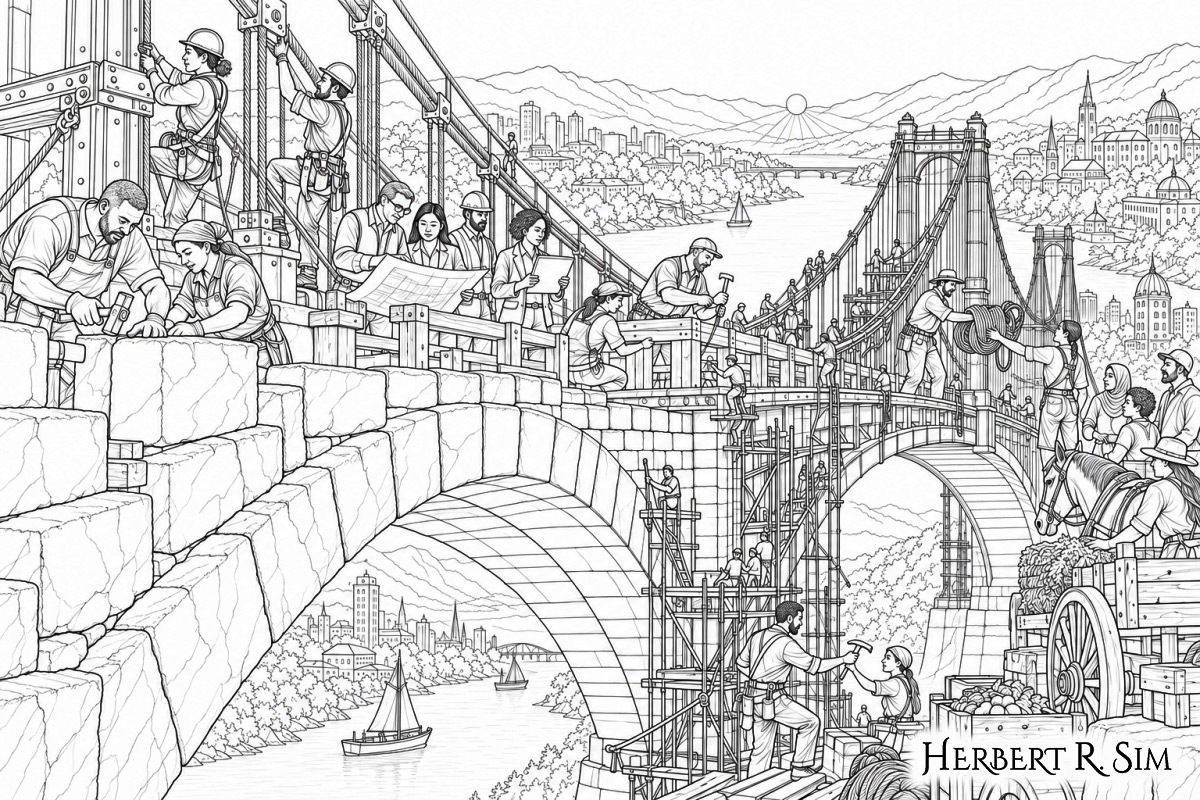
My illustration “The Network Bridge” – work-in-progress. The art represents how shared knowledge, skills and trust create durable economic strength by connecting independent people and communities.
Bitcoin as Knowledge, Network and Monetary Capital
Bitcoin illustrates how different forms of capital can converge.
It is a monetary network through which value can be held and transferred. It is also a body of knowledge: cryptography, decentralised consensus, open-source development and personal responsibility. Most importantly, it is an example of how a network can give individuals a new option for participation.
To use Bitcoin responsibly, an individual must learn. They must understand private keys, security, custody and the difference between holding an asset directly and relying on another institution to hold it on their behalf.
This learning process is itself a form of human capital. It gives people a clearer understanding of money, trust and ownership. It makes the individual less dependent on the assumption that essential systems must remain beyond public understanding or control.
Bitcoin does not make traditional institutions unnecessary. It demonstrates that monetary and network power can be structured differently. It expands the individual’s range of choices.
From Financial Wealth to Economic Capability
Financial wealth remains important, but it should not be mistaken for the full measure of prosperity.
A person with money but no knowledge may remain dependent on advisers, custodians and institutions. A person with knowledge but no opportunity may struggle to transform ability into value. A person with a strong network but no ownership may remain subject to the conditions set by others.
Economic capability emerges when these forms of capital reinforce one another:
- Financial capital provides time, security and productive resources.
- Knowledge capital develops judgment, skill and the ability to create value.
- Network capital connects individuals through voluntary exchange and cooperation.
- Ownership capital protects the individual’s ability to retain and direct what has been earned or created.
Together, they give individuals a stronger capacity to act independently and to participate in economic life without surrendering control over their future.
Institutions Should Develop Capability, Not Dependency
Institutions can play a positive role in economic life when they help people develop capability. Education systems can teach useful knowledge. Financial systems can support enterprise. Networks can connect people to opportunity. Governments can uphold fair rules and protect property.
But institutions fail when they treat people only as dependent recipients, consumers or users. A system that provides access while preventing ownership, learning, competition or exit may create short-term security at the cost of long-term independence.
The proper purpose of economic institutions should be to expand what people are capable of doing for themselves and with one another. They should make individuals more competent, more informed and more able to choose—not more permanently reliant on institutional permission.
The Wider Meaning of Prosperity
Prosperity should not be measured only by what people possess today. It should also be measured by what they are capable of creating tomorrow.
Can they learn new skills? Can they form productive relationships? Can they hold and transfer the value they earn? Can they build without unnecessary barriers? Can they leave systems that no longer serve them?
These are the questions that reveal whether an economy is developing human capability or merely managing dependency.
Sovereign Capability Economics holds that the most valuable form of capital is not simply money. It is the individual’s growing capacity to use knowledge, ownership and voluntary networks to direct his or her own future.
Money creates options. Knowledge creates judgment. Networks create opportunity. Human capability turns all three into economic freedom.
Reference: Satoshi Nakamoto, Bitcoin: A Peer-to-Peer Electronic Cash System, 31 October 2008.