
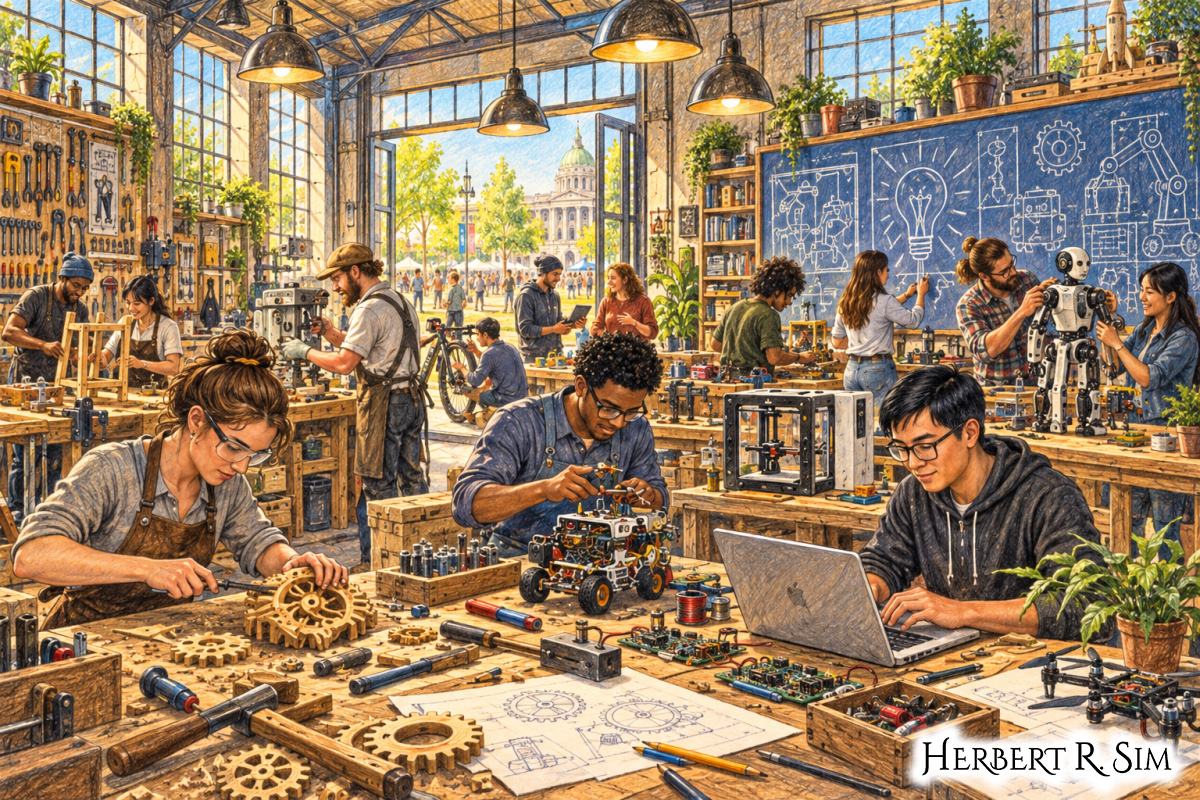
My illustration entitled: “The Open Workshop” – Inventors, craftsmen, and programmers freely building tools, machines, and ideas in a shared civic workshop.
Economic freedom is not only the right to choose between systems that already exist. It is also the right to build a better one.
Every important advance in economic life begins with someone identifying a problem and attempting to solve it. An entrepreneur creates a new service. A small business challenges an established provider. A technologist develops a new tool. A community forms a voluntary network when existing institutions no longer meet its needs.
This is the right to build: the practical freedom to create, compete, innovate and offer voluntary alternatives without being obstructed by unnecessary institutional power.
Sovereign Capability Economics holds that an individual’s economic freedom depends not only on ownership and choice, but on the ability to convert knowledge, effort and imagination into productive action.
Innovation Begins With the Individual
Institutions can organise large projects, but innovation often begins outside them.
It begins with the person who sees a need that has been ignored, a cost that can be reduced, a process that can be improved or a form of value that has not yet been recognised. The individual may begin with limited capital, limited influence and no place within an established system. Yet through knowledge, effort and voluntary cooperation, they may create something that changes the system itself.
A free economy must preserve space for this process.
When established institutions are allowed to determine who may innovate, which ideas may compete and what forms of enterprise are acceptable, progress becomes dependent on permission. The most powerful actors gain the ability to protect their position not through better service, but through the prevention of alternatives.
Economic freedom requires that individuals remain able to build before they are recognised, compete before they are powerful and create before they are approved by those most threatened by change.
Competition Is a Form of Accountability
Competition is often described as a contest for market share. It is more than that.
Competition is a form of accountability. It forces institutions to remain responsive because people can choose a better alternative. It rewards organisations that provide genuine value and challenges those that rely on habit, dependency or protected status.
Without competition, institutions can become indifferent to the people they serve. Prices may rise while service declines. Rules may become more restrictive because there is no viable alternative. Innovation may slow because existing providers no longer need to improve.
The right to build protects against this stagnation. It ensures that new participants can challenge established power through better ideas, better technology and more trustworthy methods of cooperation.
This does not mean that every new enterprise will succeed. Failure is part of economic learning. The important principle is that people should have a fair opportunity to try, learn and improve without facing barriers designed solely to preserve the advantage of those already inside the system.
Permission Can Become a Barrier to Progress
Rules are necessary in any functioning society. Fraud, coercion, theft and deception must be restrained. Contracts must be enforceable. Consumers and communities deserve reasonable protection from genuine harm.
But regulation can become harmful when it is excessive, opaque or structured in a way that only large and well-connected institutions can navigate.
A small enterprise may have a useful idea, a better service or a more efficient solution. Yet it may be unable to enter the market because compliance requires capital, legal resources, administrative time or political access far beyond its reach. The result is not greater safety. The result may be the protection of incumbency.
When rules prevent peaceful competition, they transform economic participation into a privilege. They make the ability to build dependent on approval from institutions that may have no incentive to welcome change.
The right to build does not demand the absence of standards. It demands standards that are clear, proportionate and directed toward preventing actual harm—not standards that make innovation impossible for everyone except those already powerful.
Ownership Gives Builders a Foundation
Building requires more than an idea. It requires the ability to retain the value created by that idea.
Entrepreneurs invest time, savings, knowledge and reputation. They take risks that established institutions may avoid. If the value they create can be taken, diluted or controlled by others without fair process, then the incentive and capacity to build are weakened.
Ownership gives builders a foundation from which to act. It allows a person to invest in tools, develop a service, form an enterprise and make decisions for the long term. It links effort to responsibility and responsibility to reward.
This is why property rights are not merely legal concerns. They are essential conditions of economic capability. Without a meaningful ability to own what one creates, economic life becomes a system in which individuals produce value while others retain control over its future.
The ability to hold value securely also matters. Savings provide time, and time provides independence. A person with some capacity to preserve value can take a risk, learn a new skill or begin a small venture without being entirely dependent on immediate institutional approval.
Bitcoin Demonstrates the Freedom to Build
Bitcoin is an important example of what the right to build can achieve.
Its creator did not seek permission from a central bank, payment network or financial institution to propose a different monetary architecture. Instead, Bitcoin was introduced through open code, cryptography and a voluntary network of participants.
Its success is not measured only by its market value. Its greater significance is that it proved an alternative could be built. It demonstrated that individuals can develop systems for holding and transferring value without relying exclusively on established monetary gatekeepers.
Bitcoin did not abolish conventional finance, nor did it need to. It expanded the range of possible choices. It gave people another path through which to store value, transact and participate in a global network.
This is the economic meaning of decentralised innovation: not the destruction of all institutions, but the creation of alternatives that make institutions accountable to the people they serve.
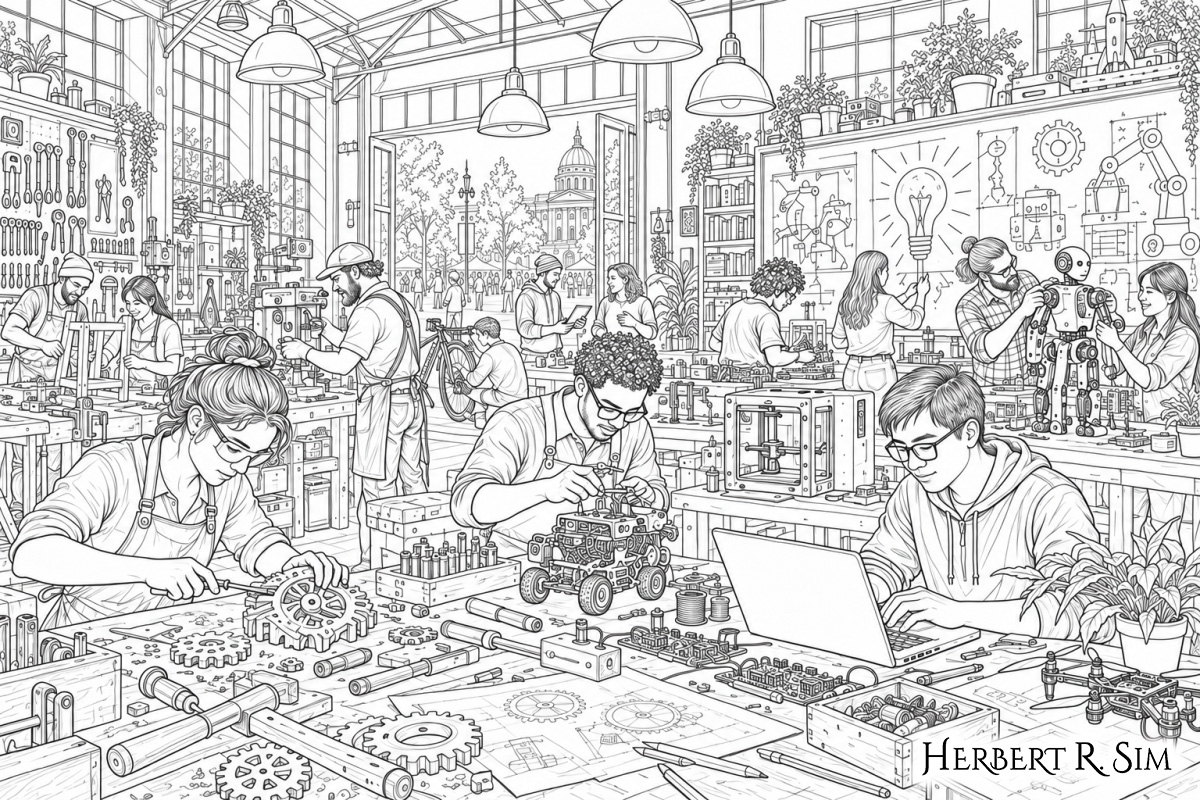
My illustration “The Open Workshop” work-in-progress. The art represents economic freedom as the shared right to invent, build, collaborate and turn ideas into independent value.
Open Systems Expand Opportunity
The ability to build is strongest in systems that remain open.
Open systems allow people to learn how they work, create compatible services and participate without requiring exclusive approval from a single operator. They reduce the cost of entry and enable smaller actors to compete through skill, effort and innovation rather than through political connection.
Closed systems may offer convenience, but they can also trap users and builders within rules they cannot influence. A developer may be unable to reach customers without accepting a platform’s terms. A merchant may be unable to receive payment without relying on one network. A person may be unable to move data, value or reputation when leaving an established provider.
Open systems are not perfect, but they create space for experimentation. They allow alternatives to emerge when existing systems fail. They make it more difficult for a single gatekeeper to control every path to participation.
The Right to Build Requires the Right to Exit
The freedom to build and the right to exit are inseparable.
An individual cannot meaningfully exit an unfair system if no alternatives are allowed to develop. Likewise, a new alternative cannot succeed if people are prevented from leaving an established system, moving their value or taking their business elsewhere.
Exit creates demand for better systems. Building creates the supply of those systems. Together, they prevent economic life from becoming permanently controlled by institutions that no longer need to earn trust.
The right to exit gives individuals the ability to refuse. The right to build gives them the ability to act after refusing. Both are necessary for economic sovereignty.
Responsibility Must Accompany Freedom
The right to build is not a right to cause harm, deceive others or evade legitimate responsibility.
Builders must honour contracts, respect property, communicate honestly and accept the consequences of their decisions. Innovation must be judged by whether it creates real value, not simply by whether it disrupts an existing system.
But responsibility should not be used as an excuse to prevent peaceful competition. A society that demands perfect certainty before allowing innovation will preserve old systems at the cost of future progress.
The appropriate balance is clear: protect people from genuine harm while preserving the freedom to experiment, compete and create alternatives.
Economic Freedom Is Productive Freedom
Sovereign Capability Economics does not define freedom as passive access to what others have built. It defines freedom as the capacity to become a productive participant in economic life.
That means having the opportunity to transform knowledge into value, value into ownership, ownership into independence and independence into meaningful choice.
A society becomes stronger when its people can build. It becomes more resilient when innovation is not confined to a small group of institutions. It becomes more just when opportunity depends less on permission and more on the ability to create genuine value for others.
The right to build is the right to turn capability into action. Innovation creates alternatives, competition disciplines power and economic freedom survives when individuals remain free to create the future rather than merely accept it.
Reference: Satoshi Nakamoto, Bitcoin: A Peer-to-Peer Electronic Cash System, 31 October 2008.