
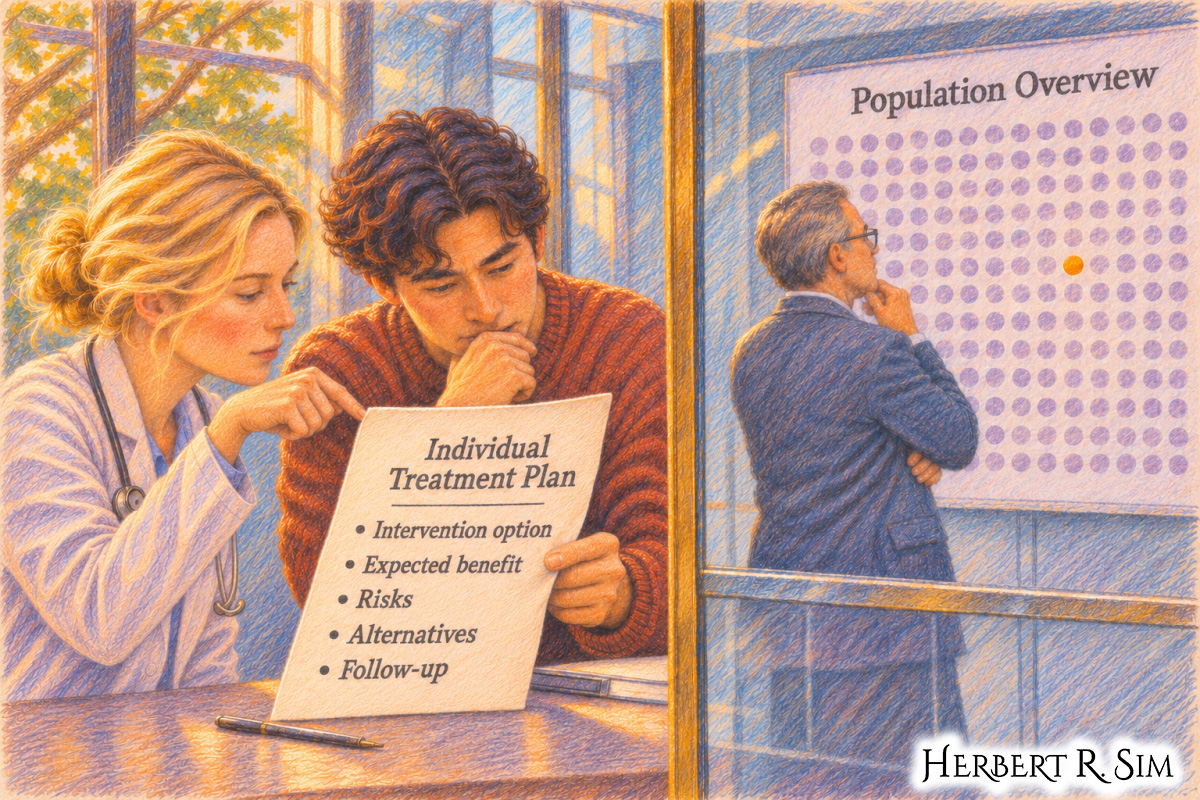
My illustration entitled: “The Clinic and the Census” – A physician and patient study an individual treatment plan at a sunlit desk. Behind the glass partition, a public official studies a wall-sized population chart where the patient’s case appears as a single colored dot.
A patient wants a genetic treatment. Her physician thinks the evidence is too weak. The manufacturer can supply it, a scientist wants to study its effects, and a regulator has yet to decide whether it may be offered. Each has a claim worth hearing. Yet each is answering a different question. The patient can decide whether she is willing to undergo the intervention. The physician must decide whether it can responsibly be offered. The regulator must consider what evidence and safeguards should govern its use. An answer to one question leaves the others open.
When claims conflict, which kind of authority should prevail, and why? Genomic Sovereigntism begins with the proposition that practical power over DNA does not confer authority over the person who will live with the change. That proposition establishes a limit. It leaves us with the harder task of deciding whose reasons should govern a particular decision, especially when the power to supply, perform, authorize or prevent an intervention is distributed among several actors.
Who has a claim, and to what?
The question “Whose genome is it?” can make the dispute sound like one about ownership. In practice, the conflict usually concerns several decisions at once. Who may consent? Who may act for a child? Who can refuse to perform a procedure? Who should answer for risks to people outside the clinic? A party may have a strong claim over one decision and little standing over another. The following table identifies the claims that recur in those disputes.
| Actor | Nature of the claim | What limits the claim |
|---|---|---|
| Affected person | First-person authority to accept, refuse or defer an intervention affecting their body. | Consent leaves the duties of clinicians and the interests of other affected people to be considered. |
| Parents or guardians | Custodial authority to make necessary decisions for someone who cannot decide. | The affected person’s welfare, developing agency and the burden of acting before they can decide. |
| Physicians | Clinical judgment about whether an intervention can responsibly be recommended or performed. | The patient’s consent, the evidence, and the physician’s obligations to the patient. |
| Scientists | Expertise to assess feasibility and uncertainty, and responsibility for the design and conduct of research. | Independent review, participant protections and the scope of any consent given. |
| Regulators | Authority within a defined mandate to set evidence and safety requirements and oversee access. | Decisions must be supported by reasons, proportionate to the risks and open to review. |
| States | Public responsibility to protect rights, address harms and establish fair conditions of access. | A public objective supplies no general mandate to select traits for the population. |
| Corporations | Commercial interests in developing and supplying an intervention, with responsibilities for its quality and terms of access. | Control of supply gives a company no authority to direct the patient’s biological choices. |
| Future descendants | Moral interests in their welfare and in the choices they will retain if they inherit a change. | Their interests must be considered despite uncertainty. No present actor can manufacture their consent. |
Adult gene therapy and the limits of consent
Suppose a competent adult with a progressive inherited disorder asks for a genetic treatment that would affect only her own body. Her parents urge her to accept it. Her physician believes it is a reasonable option. After learning about the risks and the demands of follow-up, she declines. Her refusal should prevail over the family’s wishes and the physician’s recommendation. The physician may correct a misunderstanding or revisit the decision if evidence changes, but the reasons for accepting a lasting change have to be reasons the patient can make her own. UNESCO’s declaration on the human genome treats informed consent and prior assessment of risks and benefits as distinct requirements. [1]
Now reverse the disagreement. The patient wants the intervention, but the physician judges that the evidence is too weak to justify offering it in clinical care. The patient remains the authority on what she is willing to undergo. The physician remains responsible for what they are willing to perform. A refusal should be grounded in identifiable concerns about the intervention, with room for a second opinion. An adult’s refusal can stop an intervention on her body. Her request, by itself, cannot settle whether the intervention is clinically defensible.
The scientist can clarify what earlier studies establish and where uncertainty remains. If the proposal belongs in research, its purpose should be explained to the patient, who may understandably hear the word trial as an offer of treatment. The researcher has an interest in obtaining knowledge, and the patient has an interest in receiving care. Those interests can coexist under independent ethical review and a consent process that makes the difference clear. Regulatory or ethics approval permits an offer under specified conditions. The patient still decides whether to take it up. [2]
Childhood treatment and conflicting duties of care
Consider a child with a serious inherited disorder for whom delaying treatment may lead to irreversible loss of function. Assume credible evidence supports a genetic intervention and that reasonable alternatives offer substantially less protection. The parents hesitate because the immediate risks are frightening. The clinician recommends proceeding because the likely harm of waiting is grave. The parents have authority to deliberate on the child’s behalf because they have a duty of care. Their authority carries room for judgment about uncertain outcomes. It becomes harder to defend a refusal when it would expose the child to serious, preventable harm and an independent assessment supports that conclusion.
The reverse case matters too. Parents may insist on an experimental intervention whose likely benefit is small and whose risks are substantial. Their willingness to try everything cannot make those risks reasonable for the child. A physician can decline to perform it and explain which evidence or safeguards are missing. In either direction, the case for overriding a decision must turn on the child’s circumstances, including the gravity of the harm, the quality of the evidence and what delay would cost. The mere fact that a physician would choose differently supplies too little reason to displace the parents.
The child also has a claim in the decision. An adolescent may be able to explain why years of follow-up would affect their life or why a particular risk matters more to them than it does to their parents. Their views deserve weight as their capacity develops. In a deferrable case, waiting may allow the child to make the decision. In an urgent case, adults may need to act sooner, while involving the child in the choices they can understand and make. [3]
My illustration “The Clinic and the Census” work-in-progress. The art represents that behind every dot on a population chart is a person whose voice matters in decisions about their own genome.
Embryo editing and parental purpose
Imagine prospective parents asking a clinic to edit an embryo intended for transfer. Their aim is to prevent a serious inherited condition. They have legitimate interests in forming a family and in avoiding a disease they know firsthand. The clinic has grounds to assess the proposal, and any person whose body would be involved must be free to consent or refuse. Those claims leave a further question. What justifies exposing a future child to the burdens of the intervention? The parents’ reasons for wanting it and the future child’s reasons for benefiting from it may overlap, but the clinic must examine both.
Now suppose the parents seek an edit intended to improve a future child’s prospects in competitive sport. Even if the clinic could demonstrate a plausible effect, the child’s interest in that advantage would remain uncertain. Its value would depend on a future the child has had no chance to choose. The distinction between the two cases concerns the strength of the reasons on the child’s behalf, as well as the evidence for the proposed change. Preventing serious disease may protect capacities the child can use across many lives. Choosing for a competitive pursuit makes a more particular claim about which life is worth preparing them for.
Enhancement, corporate leverage and public power
Consider a future employer that offers to pay for an adult enhancement expected to increase endurance. Participation is described as voluntary, but promotion begins to depend on accepting it. The employee may have a genuine interest in the enhancement. The employer has an interest in whether staff can perform the work. That interest gives it reason to specify relevant performance or safety requirements. It supplies a much weaker basis for insisting on a particular biological means of meeting them. Where an employee can do the job without modification, withholding advancement for refusing it turns workplace power into leverage over a bodily decision.
A manufacturer can exercise a different kind of leverage. Imagine that only one company supplies a follow-up service on which a previously treated patient depends. The company makes continued support conditional on agreeing to an additional intervention or joining a new study. The patient may sign because losing care would be intolerable. The company’s role in providing a service gives it a claim to fair payment and clear terms. Using that dependency to obtain agreement beyond the service crosses into a decision that belongs to the patient. The importance of the company’s technology increases its responsibilities to the patient.
A state may have good reason to prevent coercion or fund access to beneficial treatment. It may also claim that a genetic intervention would lower public expenditure or improve national competitiveness. Neither aim gives it authority to impose a preferred genome. The regulator’s narrower task is to apply defensible standards to the intervention and its provision. The state’s wider task is to establish fair rules and protect rights. When either restricts a choice, it should identify the harm or rights violation that justifies the restriction and explain why a narrower measure would be inadequate.
Germline intervention and descendants
Suppose an intervention offers a prospective child a substantial expected benefit and could also transmit a genetic change to descendants. The case for treating the immediate child may be strong on its own terms. It does not settle whether people in subsequent generations may be exposed to uncertain effects. Their lack of a present voice is a reason to scrutinize that exposure. If a less far-reaching intervention could offer comparable protection, the justification for accepting a heritable burden weakens. Where uncertainty is substantial and the effects could be serious, the case for deferral grows stronger.
Two contributions to the 2018 debate help clarify the issue. The Nuffield Council on Bioethics assessed possible heritable interventions against the welfare of the future person and their wider effects on social disadvantage and discrimination. Later that year, the organizing committee of the Second International Summit on Human Genome Editing concluded that clinical use of heritable editing would be irresponsible at that time. A framework for considering what might someday be defensible leaves open the question of what can be justified on the evidence and under the institutions we have today. [4, 5]
Which claim should prevail?
Start with the decision actually in dispute. If the question is whether a competent adult must undergo an intervention, their refusal should govern. If the question is whether a clinician can responsibly offer it, professional judgment and evidence set a separate threshold. If someone must decide for a child, the child’s welfare and present and future agency supply the reasons for acting. If a proposal creates serious risks beyond the person receiving it, those risks call for a justification that reaches the people who would bear them.
These judgments may lead to a decision that disappoints several parties at once. A scientist may have a worthwhile question and still lack permission to pursue it with a particular participant. Parents may have a serious reason to seek treatment and still be unable to justify a heritable route. A patient may be entitled to refuse even when every institution involved favours proceeding. The first step toward an account of genomic authority is to ask of every claimant what decision they are entitled to make, for whom, and on what grounds. The answer depends on the obligations that come with their role and on whose life will be changed by the decision.
References
- UNESCO. (1997). Universal Declaration on the Human Genome and Human Rights. Article 5.
- World Medical Association. (2013). Declaration of Helsinki: Ethical principles for medical research involving human subjects. JAMA, 310(20), 2191–2194.
- American Academy of Pediatrics, Committee on Bioethics. (2016). Informed consent in decision-making in pediatric practice. Pediatrics, 138(2), e20161484.
- Nuffield Council on Bioethics. (2018). Genome Editing and Human Reproduction: Social and Ethical Issues.
- Organizing Committee of the Second International Summit on Human Genome Editing. (2018). Statement by the Organizing Committee of the Second International Summit on Human Genome Editing.