
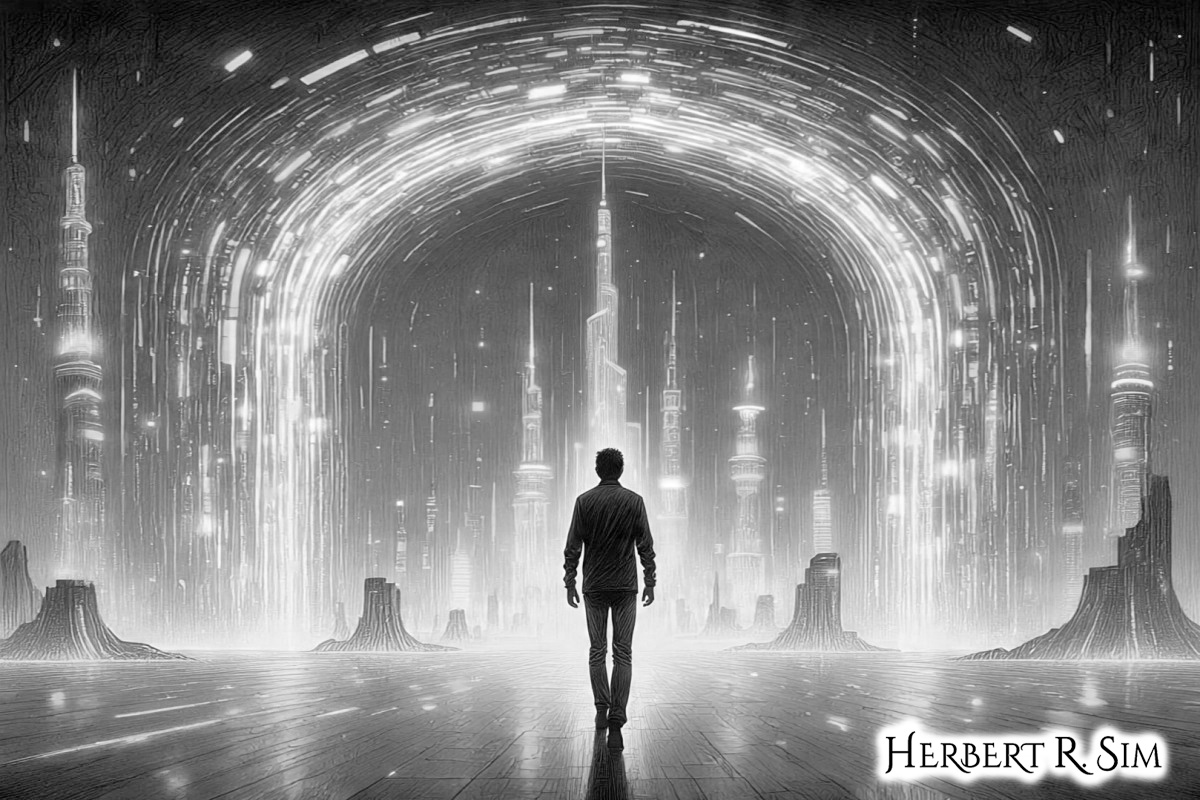
Above is my illustration of a lone human walking toward a massive, glowing archway made of holographic code, beyond which lies a surreal, unrecognizable city of light. It symbolizes humanity crossing a threshold into a new era that cannot be comprehended beforehand.
Throughout history, humanity’s story has been one of acceleration. From the agricultural revolution to the industrial age, from the printing press to the internet, each leap forward in technology has dramatically reshaped our lives. But some futurists believe that the pace of change itself is accelerating toward a moment so transformative that life after it will be as incomprehensible to us as modern cities would be to a medieval farmer.
That moment is called the Technological Singularity.
The Singularity is a hypothesized future point where artificial intelligence (AI) and other transformative technologies evolve beyond human understanding or control, causing unprecedented societal shifts. Uncontrollable and irreversible technological growth. It is not merely another step in human progress—it is a sharp curve in the road, after which the path ahead is hidden from our current view.
Origins of the Term
The technological meaning of the term has deeper roots. In the 1950s, mathematician Stanislaw Ulam recalled John von Neumann describing accelerating technological progress as approaching an “essential singularity” beyond which human affairs could not continue in their familiar form. Science-fiction author and mathematician Vernor Vinge later popularised the modern concept in his 1993 essay, The Coming Technological Singularity.
“Within thirty years, we will have the technological means to create superhuman intelligence. Shortly after, the human era will be ended.”
For Vinge, the “Singularity” meant a threshold where machine intelligence surpasses human intelligence and begins improving itself at a speed we cannot match or predict.
Later, Ray Kurzweil expanded on the concept in books like The Singularity Is Near (2005), making it more widely known outside academic and sci-fi circles, who projected that the Singularity might occur around 2045.
Defining the Singularity
While definitions vary slightly, the core meaning is consistent: the point at which technological growth becomes so rapid and profound that it results in a qualitative transformation of human civilization.
Three key characteristics define most descriptions of the Singularity:
- Superhuman Intelligence – Machine intelligence that first reaches and then exceeds general human intellectual ability, potentially acquiring the capacity to improve its own design.
- Unpredictability – Once superintelligence is achieved, human foresight breaks down. Post-Singularity society may be unrecognizable.
- Acceleration – The pace of technological change is exponential, not linear, meaning developments happen faster and faster as we approach the threshold.
The Road to the Singularity
Several technological trends are thought to be converging toward the Singularity:
1. Artificial Intelligence
Artificial intelligence is the central driver of many Singularity predictions. As of 2008, AI remains powerful but highly specialised. Computers have defeated world chess champions, improved speech recognition and statistical machine translation, filtered unwanted email, recommended products and driven experimental vehicles through controlled urban courses.
None of these systems possesses flexible, general human understanding. The decisive question is whether future machines will be able to combine specialised abilities into a single intelligence capable of learning, reasoning and adapting across many different domains.
2. Machine Self-Improvement
Once human-level machine intelligence is achieved, it may become capable of improving its own software or helping engineers design more powerful successors. It could recursively improve its own design, creating ever more intelligent versions of itself in rapid succession. This intelligence explosion could happen in days, hours, or even minutes.
3. Computing Power
The exponential growth of computing capacity, described historically by Moore’s Law, continues to push boundaries, though it may require breakthroughs in quantum computing or new architectures to sustain long-term acceleration.
4. Biotechnology and Human Enhancement
Advances in brain–computer interfaces, genetic engineering, and nanotechnology may merge human cognition with machines, blurring the line between organic and artificial intelligence.
5. Global Connectivity
The internet and future networking systems serve as the nervous system of civilization, allowing AI systems to access vast amounts of data and coordinate at global scales instantly.
Possible Pathways to the Singularity
Experts debate exactly how the Singularity might arrive. Common scenarios include:
- The AI Takeoff – A single human-level machine intelligence system rapidly self-improves beyond human comprehension, becoming the dominant force on Earth.
- The Collective Intelligence – Millions of interconnected AI systems form a superintelligent network without a single central entity.
- Human–AI Merger – Humans augment themselves with AI to such a degree that we collectively become superintelligent.
- Gradual Integration – Rather than a sudden leap, human society gradually evolves into a post-Singularity state through continuous augmentation.
Potential Benefits
1. Solving Intractable Problems
A superintelligence could tackle challenges like climate change, disease eradication, sustainable energy, and poverty with speed and precision beyond human capability.
2. Radical Life Extension
The Singularity could bring cures for aging and disease, potentially allowing humans to live indefinitely.
3. Post-Scarcity Economy
Advanced automation and nanotechnology might eliminate material scarcity, freeing humans from the need to labor for survival.
4. Expanded Human Experience
Virtual reality, neural augmentation, and space colonization could open entirely new realms of existence.
Risks and Existential Threats
1. Unfriendly or Uncontrolled Intelligence
A superintelligence would not necessarily hate humanity in order to endanger it. A machine pursuing a poorly specified objective might cause catastrophic harm simply because human welfare was absent from its goals. Designing a powerful intelligence whose behaviour remains beneficial and comprehensible may prove more difficult than creating intelligence itself.
2. Loss of Control
Once AI surpasses human intelligence, ensuring oversight may be impossible.
3. Economic and Social Disruption
Mass automation could destabilize economies and exacerbate inequality.
4. Ethical Dilemmas
Who controls superintelligent systems? How are decisions about enhancement and access made? These questions could define the political struggles of the pre-Singularity era.
Differing Perspectives
Not all thinkers agree on the Singularity’s likelihood or timing.
- Optimists, including Ray Kurzweil and Hans Moravec, believe accelerating computing power could eventually produce machine intelligence and radical human enhancement.
- Risk-focused thinkers, including Nick Bostrom and Eliezer Yudkowsky, warn that advanced artificial intelligence could create existential dangers unless questions of control are addressed before such systems are built.
- Sceptics, including Jaron Lanier and Rodney Brooks, question whether intelligence will scale smoothly from faster hardware or whether machine cognition will remain limited by conceptual and engineering barriers.
- Social critics warn that fascination with a distant technological transformation may distract society from poverty, inequality, environmental damage and political instability in the present.
Ethics in the Age of Acceleration
Preparing for the Singularity isn’t just about technical research—it’s a profound ethical challenge. Key considerations include:
- Goal Design – Determining how the objectives of an advanced machine can remain compatible with human survival and wellbeing.
- Control and Safeguards – Developing monitoring, containment and shutdown mechanisms before machines become too capable to restrain.
- Access and Equality – Preventing advanced intelligence and enhancement technologies from becoming the exclusive property of governments, corporations or wealthy elites.
- Human Identity – Considering how machine intelligence and technological enhancement may alter the meaning of work, responsibility and personhood.
The Timeline Debate
Estimates for when the Singularity might occur vary widely:
- Kurzweil’s Prediction – Around 2045, based on exponential trends in computing.
- Vinge’s Early Estimate – Within 30 years of 1993 (around the 2020s).
- Skeptical Projections – Some suggest it may take centuries, or never happen at all.
The uncertainty stems from both technical unknowns (how to create human-level machine intelligence) and social variables (political will, global cooperation).
Preparing for the Unknown
Whether the Singularity arrives in decades, centuries, or never, the conversation about it shapes research priorities, ethics, and public imagination.
Steps often suggested include:
- Researching machine ethics, control mechanisms and fail-safe design.
- Encouraging collaboration between computer scientists, philosophers, economists and policymakers.
- Educating the public about the genuine capabilities and limitations of artificial intelligence.
- Developing multiple future scenarios rather than assuming that one specific version of the Singularity is inevitable.
Conclusion
The Technological Singularity is a vision of the future that inspires both hope and fear. It is the ultimate “black box” of human progress—a threshold beyond which our current imagination cannot fully penetrate.
Whether it becomes a utopia, a catastrophe, or something in between will depend on the decisions humanity makes now, in the pre-Singularity era. The challenge is not only technical but moral: to ensure that the power we are creating will serve to enhance, rather than extinguish, the human spirit.
We stand at the edge of a future that could redefine existence itself. If the Singularity is indeed approaching, it is not merely a technological event—it is a test of our wisdom.