

My illustration entitled: “The Boundary in Red” – An adult patient and a physician study a treatment diagram laid across a light table. The patient has circled a preferred option. The physician marks a risk in blue, and a transparent regulatory overlay draws a red boundary around a different, impermissible option.
Problem. A genetic intervention may involve a willing patient, a guardian, a qualified clinician, a public regulator, and a patent holder. Each may have grounds to permit, refuse, or constrain some part of the intervention. Treating those grounds as interchangeable obscures who is entitled to decide what.
Approach. This article develops a normative taxonomy of five claims relevant to genetic intervention: sovereign, custodial, professional, regulatory, and proprietary. It distinguishes them by their source, object, scope, and limits, then tests the distinctions against five hypothetical conflicts.
Argument. These claims are non-fungible. Agreement from one actor cannot discharge a requirement that belongs to another kind of authority. The prospective interests of future persons warrant separate consideration, although those interests do not themselves supply an act of authorization.
Implication. The legitimacy of a genetic intervention depends on whether each applicable claim has been satisfied within its proper scope. A tally of approvals cannot establish legitimacy where a distinct requirement remains unmet.
1. Authority over which decision?
A competent adult asks for a genetic intervention. A clinician declines to perform it because the evidence is weak. A regulator permits the class of intervention under specified conditions, and a company has licensed the technology to the clinic. Who has authority? The question is incomplete. The adult can decide what they are willing to undergo. The clinician must decide what they can responsibly offer. The regulator sets conditions of practice. The company can grant permission under its intellectual-property rights. Each decision has an object, and changing that object changes the justification needed to make it.
The Genomic Power–Authority Distinction starts from a difference between practical power and legitimate standing. A person or institution may be able to bring about, block, or shape an intervention. Whether it is entitled to do so is a further question. Here, genomic authority means legitimate standing to make or constrain a specified decision concerning an intervention that would alter a human person’s genetic constitution. The relevant decision might concern consent, professional provision, public permission, or the use of a particular tool.
Wesley Newcomb Hohfeld’s distinction among legal claims, privileges, powers, and immunities offers a methodological lesson. The word right can obscure differences between legal relations that have different implications for other people. The present taxonomy applies that lesson to a specific field of decision-making. It includes legal and economic claims because they can shape what happens, and evaluates their moral significance separately. [1]
Each claim can be specified by five questions. Who holds it? What grounds it? What decision does it concern? Whose interests does it protect or affect? Where does it cease to apply? These questions make the unit of analysis a particular claim over a particular decision. A physician acting as a parent, for example, may bring clinical expertise to a conversation and have a custodial role in it. Each role needs its own justification, even when the same person occupies both.
2. The five categories and their limits
Sovereign authority
Sovereign authority is the authority exercised by a competent person regarding interventions affecting their own biological constitution. Its ground is the person’s standing to direct their own embodied life. It encompasses accepting, refusing, or deferring a specific intervention. Its exercise depends on decision-making capacity, adequate information, and voluntariness. A person who needs accessible information, translation, or help weighing alternatives may still be able to make their own decision.
Sovereign authority gives a person a presumptive veto over a non-emergency intervention on their own body. Agreement removes the barrier created by the absence of their permission. It creates no automatic claim to a clinician’s services, public funding, or the imposition of serious risks on others. A person can therefore have decisive authority to refuse a procedure while lacking unilateral authority to bring it about.
Custodial authority
Custodial authority is limited standing to decide on behalf of someone who cannot make the particular decision. It derives from responsibilities to the affected person and is directed to their interests. Those interests may include previously expressed wishes and values where the person once had capacity, their present welfare, or the preservation of choices they may later be able to exercise. A legal appointment or recognised relationship may identify the person entitled to act. The reasons for exercising that authority still need to fit the decision at hand. Buchanan and Brock’s account of surrogate decision-making helps explain why respect for self-determination and concern for welfare both matter here. [2]
Custodial authority is fiduciary in character because its holder exercises discretion for another person’s benefit. Its scope can narrow as that person’s ability to decide develops or returns. In paediatric care, the distinction between parental permission and the child’s assent makes room for the child’s participation before full decision-making authority is reached. The weight due to the child’s views depends on their understanding and on what is at stake. [3]
Professional authority
Professional authority is role-based standing to judge and act within the limits of clinical or scientific competence. It includes evaluating evidence, determining whether an intervention can responsibly be offered, and deciding how an authorized intervention should be carried out within its agreed scope. A scientist’s competence may establish what a procedure could achieve. A treating clinician must also consider whether offering it serves the particular patient’s interests under the circumstances.
Professional authority carries duties to explain reasons, acknowledge uncertainty, and disclose conflicts of interest. Expertise can justify declining to perform an intervention when credible evidence of safety or benefit is missing. It cannot make the patient’s willingness irrelevant. A professional who can explain how to do something still needs legitimate authorization to do it to someone.
Regulatory authority
Regulatory authority is the legitimate standing of public institutions to establish, administer, and enforce boundaries for practice. Its objects include safety standards, oversight of research, rules for clinical authorisation, and protection against serious harms. Its legitimacy depends on public justification, proportionate measures, and accountability. A rule that protects people from being offered an inadequately tested procedure has a different basis from an order directing a particular person to undergo it.
The Oviedo Convention illustrates how these questions can be separated. For its parties, it addresses consent and protection of persons unable to consent in Articles 5 and 6, and places separate limits on genome-modifying interventions in Article 13. Public permission and authorization for a particular person thus answer different questions. The moral justification of a restriction and its binding legal status also require separate inquiry. [4]
Proprietary claims
Proprietary claims are legal or economic rights over a resource used in an intervention, such as a patented invention, a tool, or a service supplied under contract. They are included in the taxonomy because they can affect which interventions are available and on what terms. In the United States, for example, a patent confers a right to exclude others from specified uses of the claimed invention. A licence can address that exclusion. Its subject remains the invention and the authorised uses of it. [5]
A proprietary claimant may therefore be entitled to refuse a licence while lacking standing to decide what should happen to a patient. Commercial control can nevertheless create considerable leverage when the patient depends on the technology or its supplier for continuing care. That leverage calls for scrutiny of the terms of access and their effects on the person’s choices. The World Health Organization’s 2021 recommendations treat equitable access and ethical licensing as concerns of genome-editing governance. [6]
3. Authority matrix
| Category | Holder and ground | Decision within scope | Limit |
|---|---|---|---|
| Sovereign authority | The affected person, by virtue of their standing over their own embodied life. | Accept, refuse, or defer a specified intervention on themselves. | Agreement does not compel professional provision or settle material risks to others. |
| Custodial authority | A guardian or other justified surrogate acting under duties to someone who cannot decide. | Make a justified decision on that person’s behalf, giving weight to their wishes, welfare, and developing agency. | Authority is limited by its purpose, the person’s capacity, and the costs of acting or waiting. |
| Professional authority | A clinician or scientist, grounded in relevant competence and role-specific duties. | Judge evidence, advise, determine what can responsibly be offered, and act within an authorized scope. | Expertise supplies a basis for professional judgment and leaves personal or surrogate authorization to its proper holder. |
| Regulatory authority | Public institutions acting within a legitimate, accountable mandate. | Set permissible practices, safety boundaries, and review requirements. | Jurisdiction establishes public constraints and supplies no proprietary claim over citizens’ bodies. |
| Proprietary claims | A holder of intellectual-property or contractual rights over an invention, tool, or service. | License, supply, exclude, or set terms within the scope of the relevant right. | Control of the resource supplies no authority over the person who depends on it. |
| Prospective claims of future persons | People who may bear the effects of a decision made before they can exercise agency. | Ground present duties to consider foreseeable burdens, welfare, and later agency. | Present decision-makers can represent interests imperfectly. They cannot supply those people’s consent. |
4. Non-fungibility and the status of future persons
Non-fungibility principle. A claim can discharge an authorization requirement only if its holder has legitimate standing over the decision to which that requirement applies. Expertise cannot substitute for consent. Ownership cannot substitute for moral authority over the person. Parenthood gives rise to responsibilities that can ground custodial authority, subject to limits. Regulation establishes public boundaries and does not make citizens’ biological constitutions the property of the state.
Non-fungibility does not imply that the categories operate in isolation. A clinician’s assessment can inform a patient’s consent. A regulator can require a credible consent process. A licence can make an intervention available for someone to consider. What matters is the difference between supporting the exercise of another authority and purporting to exercise it in the other party’s place. Several endorsements of the first kind cannot add up to an authorization of the second.
The proposed sixth category brings that distinction into focus. A future child’s welfare, or a descendant’s interest in avoiding a foreseeable burden, can give present actors reasons to act or refrain. Such interests deserve an explicit place in the analysis. I treat them as prospective claims rather than a sixth operative authority. The people affected cannot make a decision now. A parent, panel, or regulator may have duties to consider their interests, but taking those interests seriously cannot be represented as obtaining the future person’s consent.
The Nuffield Council on Bioethics’ 2018 report on genome editing and human reproduction makes the welfare of the future person and the avoidance of increased social disadvantage, discrimination, or division central to its account. The taxonomy adds a question about standing. Even if a proposed intervention could plausibly satisfy a welfare standard, who is entitled to make the choice, and how far does that entitlement extend? Grounds for protecting a first child’s interests may be stronger or more determinate than grounds for undertaking risks on behalf of unknown descendants. [7]
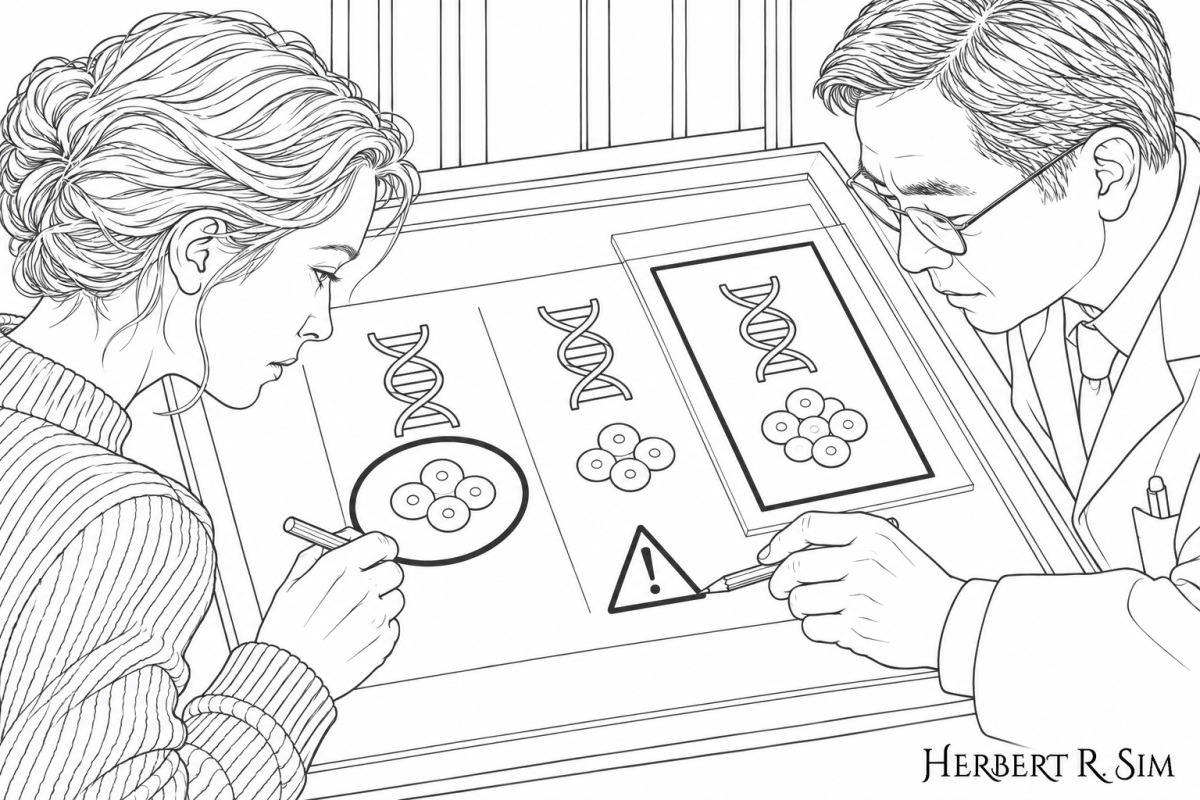
My illustration work-in-progress. The art represents that genomic authority has distinct limits: the patient chooses, the physician identifies risks, and the regulator sets the boundaries of what may proceed.
5. Cases in which claims conflict
Case 1. Adult request and professional refusal
An adult with an inherited condition requests a somatic genetic intervention. They understand the uncertainty and are willing to accept risks their clinician judges disproportionate to the likely benefit. A regulator permits the intervention in a defined setting, and the clinic can obtain a licence. The patient has settled their willingness to proceed. The clinician still has to defend a decision to offer it. Regulatory permission sets an outer boundary and does not resolve professional judgment in the individual case.
The clinician owes the patient reasons that can be explained and challenged. A second opinion may reveal a reasonable disagreement about the evidence. Reversing the example clarifies the allocation of authority. If the clinician recommends the procedure and the adult refuses, increasing the strength of the clinical recommendation cannot supply the adult’s permission. The patient’s control over acceptance and the clinician’s control over responsible provision can each block the proposed act for different reasons.
Case 2. Parental permission and a child’s developing agency
A fifteen-year-old has a progressive inherited disorder. A proposed genetic treatment might prevent serious harm if undertaken soon. The adolescent understands significant parts of the choice and objects because they fear a lasting adverse effect. Their parents favour treatment. Before treating this as a choice between parental and professional judgment, the team must assess what the young person understands, whether support would enable fuller participation, and what a delay would cost. The adolescent’s objection may be informed by concerns the adults have underestimated.
If the young person cannot make the decision and delay would lead to serious harm, a carefully justified custodial decision may still be possible within the applicable legal framework. Now suppose the same family seeks a permanent enhancement that can safely be deferred. The child’s ability to decide later counts strongly in favour of waiting. Parental standing remains relevant in both cases. Its legitimate exercise depends on the child’s interests, the urgency of the intervention, and the authority the child can exercise now or in the near future.
Case 3. Research approval and a change of purpose
A research team has approval for a genetic intervention intended to investigate a serious disease. An adult volunteers. During the study, the team proposes an additional intervention targeting an unrelated trait as an exploratory measure. The investigators consider the proposal scientifically informative and obtain an amendment to the study approval. The original consent applied to a defined intervention for a stated purpose. The amendment may settle whether the modified study is permissible to offer. The participant still needs a genuine opportunity to decide whether to undergo the additional intervention.
The reverse test is equally important. If the participant actively requests the additional intervention, willingness cannot repair an inadequate scientific or ethical basis for the amended study. Here the regulator or review body, the professional, and the participant answer distinct questions about the same proposal. Requiring each to answer its own question protects the participant’s agency and the integrity of the research simultaneously.
Case 4. Proprietary control and continuing care
A company supplies a genetic intervention through a network of licensed clinics. Two years after treatment, a patient moves. The nearest qualified clinic can provide the relevant follow-up, but the supplier controls access to essential treatment records and makes their release conditional on joining an optional commercial registry. The supplier offers this as a contractual choice. The patient faces a substantial loss if they decline.
The analysis begins by separating information clinically needed for safe care from information sought for a separate commercial purpose. The supplier can justify restrictions on access that are necessary to protect confidentiality or ensure competent use. A requirement to join an unrelated registry needs independently valid permission. The supplier’s control over records may explain why the patient agrees to the new term. The burden on refusal is also a reason to question how voluntary that agreement is. A viable transfer of care would change the conditions under which the patient decides.
Case 5. An embryo, a prospective child, and possible descendants
Prospective parents ask a clinic to consider a hypothetical heritable intervention aimed at preventing a severe inherited disease. Assume for argument that there is strong evidence of benefit for the prospective child. The person who would carry the pregnancy can consent to interventions on their own body. The parents can decide whether to pursue reproductive care. The clinician must assess the intervention and alternatives. Public institutions must determine whether the practice may be offered. Those decisions still leave the effects on the prospective child and possible descendants to be justified.
The strongest case for proceeding would have to explain the seriousness of the expected harm, the limitations of reasonable alternatives, and why the risk that extends beyond the first child is justified. An independent review could examine those reasons and require a credible plan for follow-up that respects later choices. It could also conclude that the uncertainty remains too great. The organizing committee of the Third International Summit on Human Genome Editing stated in 2023 that clinical heritable editing remained unacceptable at that time, citing unmet standards of safety and efficacy and deficiencies in governance. The hypothetical case isolates the authority question that would remain even if the evidence changed. [8]
6. Applying the taxonomy without a fixed hierarchy
In a disputed case, begin with the proposed act. Specify who would bear its effects, what decision is actually in dispute, and whether the dispute concerns permission to proceed, professional willingness, legal admissibility, or access to a resource. Then identify who holds the relevant claim and why. Test whether the decision stays within its scope. Finally, ask whether the affected person can exercise their authority in practice or whether dependency, coercion, or lack of support has made their apparent choice unreliable.
This approach gives priority to different claims at different points. A competent adult’s informed refusal is ordinarily decisive for a proposed intervention on their own body. A qualified clinician can decline to provide something professionally indefensible. A legitimate public restriction can block provision even when the patient and clinician agree. A patent holder can decline permission to use an invention within the scope of the patent, while a separate inquiry considers whether the resulting access terms are fair. Where several requirements apply, proceeding depends on satisfying them together. Where doing nothing would itself cause serious harm, that prospect also belongs in the justification.
7. Limitations
The taxonomy identifies the grounds and limits of claims. It cannot determine whether a particular intervention is sufficiently safe, whether a patient has capacity for a particular decision, or what a jurisdiction’s law requires. Those judgments need evidence and attention to local institutions. Decisions can also remain contested after the categories are clear, especially when people disagree reasonably about a child’s welfare or the distribution of scarce treatment.
Communities can have legitimate claims over research participation, the governance of samples and data, and the way findings about them are used. Those claims can shape whether a project is permissible. Their precise force depends on the proposed act and the community’s relation to it. The taxonomy also leaves open difficult questions about which future persons will exist under different reproductive choices. It can require present actors to account for foreseeable burdens without assuming that every alternative would have brought the same person into existence.
For Genomic Sovereigntism, the practical test is whether the reasons for proceeding can be stated at the level of the decision that affects a person. Who is entitled to decide? What gives them that standing? What must they leave to others? A complete answer requires more than identifying who has the means to act. It requires showing why that person or institution may exercise those means in the particular case.
References
- Hohfeld, Wesley Newcomb. “Some Fundamental Legal Conceptions as Applied in Judicial Reasoning.” Yale Law Journal 23, no. 1 (1913), 16–59. Full text
- Buchanan, Allen E., and Dan W. Brock. Deciding for Others: The Ethics of Surrogate Decision Making. Cambridge University Press, 1989. Chapter 2
- American Academy of Pediatrics, Committee on Bioethics. “Informed Consent in Decision-Making in Pediatric Practice.” Pediatrics 138, no. 2 (2016), e20161484. Article record
- Council of Europe. Convention on Human Rights and Biomedicine (Oviedo Convention). 1997, Articles 5, 6, and 13. Treaty text
- United States Code, Title 35, § 154(a)(1), “Contents and Term of Patent; Provisional Rights.” Statutory text
- World Health Organization. Human Genome Editing: Recommendations. 2021, recommendation 6. Report
- Nuffield Council on Bioethics. Genome Editing and Human Reproduction: Social and Ethical Issues. 2018. Report
- Organising Committee of the Third International Summit on Human Genome Editing. “Statement from the Organising Committee of the Third International Summit on Human Genome Editing.” 2023. Statement