

My illustration entitled: “The Insurance Threshold” — A patient faces an insurance AI that offers coverage only if they accept an enhancement, while an advocate stands beside them.
Medicine is becoming more capable of altering the conditions of human life. It can repair tissue, replace limbs, regulate mood, correct genetic errors, support cognition and restore functions once thought permanently lost. These advances should be welcomed where they relieve suffering and expand a person’s ability to live freely.
But the growing power of therapeutic technology makes one principle more important than ever: the patient must remain sovereign.
A patient is not merely a body to be repaired, a case to be managed, a stream of data to be analysed or a future market for upgrades. A patient is a person with a history, a conscience, relationships, fears, hopes and the authority to decide what happens to their own body and mind. Medicine is at its most humane when it recognises this fact. It becomes dangerous when it forgets it.
Human-Sovereignty Transhumanism supports the responsible use of technology to heal, restore and enhance human life. It is not anti-medicine, anti-science or anti-progress. It asks a more demanding question: does the new capability strengthen the person’s agency, or does it turn the person into an object of institutional, commercial or technological control?
In the age of therapeutic enhancement, patient rights must extend beyond the familiar right to receive information and sign a consent form. They must include the right to understand, to refuse, to withdraw, to protect intimate data, to seek human review and to remain a person rather than a product.
Healing and enhancement are not opposites
The line between therapy and enhancement is often presented as clear: therapy restores what illness or injury has taken away, while enhancement improves a healthy person beyond an ordinary baseline. In reality, the boundary is frequently uncertain. A neural device may help someone recover communication after injury and later improve attention. A genetic intervention may prevent a disease and also influence traits that affect performance. A prosthetic may restore mobility while giving its user new forms of strength or precision.
We should not use this uncertainty as an excuse to deny treatment. Nor should we use the moral authority of medicine to make every technological intervention compulsory. The central issue is not whether a technology sits perfectly in the category of therapy or enhancement. The issue is whether the person remains the author of the decision.
Therapeutic technology is most valuable when it gives a person more options: the ability to move, communicate, work, learn, feel less pain or live with greater independence. It becomes less humane when the new option is converted into a requirement by a hospital, insurer, employer, government or family member.
Consent must be more than a signature
Modern medicine rightly values informed consent. Yet informed consent can become a ritual when it is reduced to a long document, a hurried explanation and a signature obtained at a moment of fear. This is especially inadequate for interventions that may affect the brain, the genome, identity, memory, mood or long-term biological data.
For consent to be genuine, it must be specific, understandable, voluntary and renewed when the relevant circumstances change. The patient must know what the intervention is designed to do, what uncertainty remains, what data it will generate, who can access that data and what alternatives are available. They must have time to ask questions. They must be able to say no without being labelled irrational or denied unrelated care.
Consent must also be continuing. A person who agrees to an implanted device or an experimental therapy has not agreed forever to every future update, every secondary use of data or every change in commercial ownership. When technology changes its function, collection practices or risks, the patient’s decision must be sought again.
The patient is not a one-time source of permission. They are a continuing participant in decisions that affect their life.
The right to refuse treatment without punishment
Medical ethics recognises that competent adults may refuse treatment. In an age of increasingly powerful enhancement, this right must be protected against new forms of pressure. A patient may decline an intervention for religious, personal, medical, financial or simply private reasons. They may value continuity of identity over a projected gain in performance. They may distrust a device that requires intimate monitoring. These choices deserve respect.
Refusal is not meaningful when it leads to disproportionate punishment. An insurer should not use the refusal of an elective intervention to deny all reasonable coverage. An employer should not demand therapeutic technology as an undisclosed condition of retaining work. A public health system should not make access to ordinary services depend on accepting modifications that are not necessary for immediate safety or care.
There are difficult cases. Contagious disease, impaired capacity and emergencies may require special rules to protect others. But exceptions must remain narrow, transparent and subject to independent review. They must never become a general licence to treat bodily autonomy as an inconvenience.
The right to withdraw and to exit
Therapeutic enhancement may create dependencies that are physical, psychological, financial or digital. A device may need software updates. A treatment may require access to a proprietary network. A patient may depend on a manufacturer for maintenance, data access or a safe shutdown. These dependencies can turn a medical benefit into a relationship of vulnerability.
Whenever safely possible, the patient must have a right to withdraw from an elective intervention, to disconnect from an associated system and to obtain a clear path for continuing care. A person should not lose control because a company changes its terms, an insurer changes its policy or a provider changes its priorities.
This does not mean that every intervention can be reversed without risk. Medicine must be honest about that. But it does mean that the risks of removal, disconnection and long-term dependence should be explained before adoption—not concealed beneath the language of innovation. It also means that providers should design for safe exit and restoration wherever possible.
A patient who cannot leave an elective system without losing basic medical support is not fully empowered by that system. Their apparent capability may have been purchased at the cost of authority.
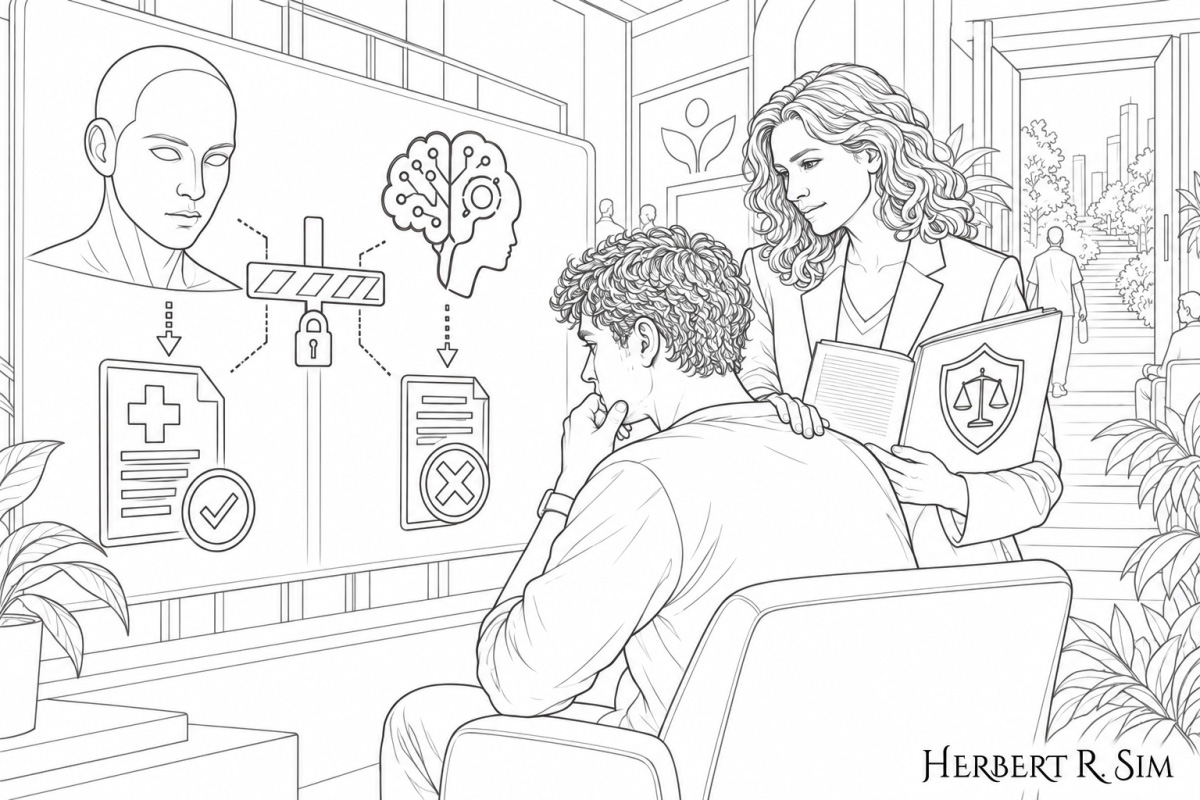
My illustration “The Insurance Threshold” work-in-progress. The art depicts the ethical threshold where healthcare coverage must never be used to pressure patients into enhancement, preserving genuine consent and human dignity.
Medical data is part of the person
Therapeutic technologies can produce unprecedented quantities of intimate information. Genetic tests may reveal risks shared with relatives. Cognitive devices may record attention, fatigue or behavioural patterns. Health monitors may track location, movement, sleep and emotional signals. This information can improve care, but it can also be used to classify, exclude and profit from the patient.
Data protection is therefore not a technical afterthought. It is a patient right. A person must know what is collected, why it is collected, where it is stored, how long it is retained and who may see it. Data should not be repurposed for marketing, insurance scoring, employment decisions or unrelated research without meaningful permission.
Most importantly, the patient must not be reduced to their data profile. A prediction of illness is not an illness. A neurological pattern is not a moral judgement. A genetic marker is not a person’s destiny. Medical institutions should use knowledge to serve the individual, not to create a permanent category by which others are allowed to judge them.
Human review must remain available
As medicine adopts more advanced software, automated monitoring and algorithmic decision support, patients may increasingly encounter decisions that appear objective but are difficult to question. A system may recommend a treatment, deny coverage, flag a risk or set a threshold for care. Such tools can be useful. They cannot become the final authority over a human life.
Every patient should have access to understandable reasons for a significant decision and a genuine opportunity for human review. A doctor, insurer or hospital should not be able to hide behind a system that cannot explain itself. Nor should a patient be expected to accept a life-altering recommendation without knowing who is accountable for it.
Technology may assist judgment. It must not erase responsibility. Where a decision affects the body, mind or future of a person, there must be someone who can listen, explain, reconsider and be held accountable.
Justice in access to therapeutic enhancement
There is another danger: a therapeutic future divided between those who can purchase restoration and those who must live without it. If innovation serves only the wealthy, technology may deepen the very inequalities it could have helped to overcome. Access matters because a treatment that restores basic function should not be treated merely as a luxury commodity.
At the same time, justice does not mean compulsory optimisation. Public institutions should expand fair access to life-improving therapies while preserving the right to decline them. A patient should not have to choose between medical abandonment and technological submission. They deserve care that respects their circumstances, values and judgment.
The goal is neither a world where every person is modified nor one where medical progress is feared. The goal is a world where beneficial treatment is available, authority remains personal and access does not depend on surrendering privacy or identity.
The sovereign patient standard
A human-centred medical future should be guided by a clear standard:
- Heal without owning: provide care without claiming authority over the patient’s body, mind or data.
- Inform without manipulating: explain benefits, risks, alternatives and dependencies in language a patient can understand.
- Offer without coercing: preserve the equal right to accept or refuse elective intervention.
- Protect without surveilling: secure health information without converting it into a tool of commercial or institutional control.
- Innovate with accountability: ensure human review, clear responsibility and meaningful redress when harm occurs.
- Restore agency: measure success not only by clinical performance, but by the patient’s ability to direct their own life.
These principles do not slow medicine down. They give medicine a moral direction. They ensure that the search for better treatment does not become a search for greater control over the treated person.
Enhance the human, never surrender the person
Therapeutic enhancement may become one of the defining humanitarian achievements of the coming century. It could reduce needless suffering and bring new independence to millions of people. That possibility should inspire serious work, careful investment and broad public support.
But no medical breakthrough is complete if it leaves the patient with less authority over their body, mind, data or future. The patient must never become the property of a device, a platform, a corporation or an institution. They remain the subject of care, not its raw material.
Human-Sovereignty Transhumanism therefore affirms a simple principle for the age of therapeutic enhancement: enhance the human, but never surrender the person.