

My illustration entitled: “The Closed Eye” — A giant camera lens closes like an eyelid as a citizen calmly raises a hand in refusal.
Human-Sovereignty Transhumanism supports technologies that empower people. It rejects the idea that a person must surrender their face, voice, body or behaviour to be allowed to participate in modern life.
The modern world is learning to measure the human being at extraordinary scale. A face can identify a traveller. A fingerprint can open a device. A voice can authenticate a customer. A gait can distinguish one body from another. Cameras, sensors and databases can turn ordinary movement through a street, workplace, school, shop or airport into a trail of biological identifiers.
These systems are often presented as practical conveniences: faster access, stronger security, reduced fraud, smoother services. Sometimes they may be. But convenience is not the same as consent, and identification is not the same as legitimacy. When measurement becomes routine, inescapable and linked across institutions, it changes the relationship between the individual and power.
A sovereign person is more than a reliable data point. A human being is not a faceprint to be sorted, a body to be scored, or a behavioural profile to be sold. The right to privacy is not simply the right to hide wrongdoing. It is the right to develop, move, associate, speak and change without having every moment converted into a permanent record.
Technology must remain the servant of humanity. Humanity must never become the property of technology.
Human-Sovereignty Transhumanism begins from this principle. Technology may expand human possibility, but it must not transfer ownership, authority or ultimate control over the person to governments, corporations or platforms. Biometric surveillance tests that commitment directly. It asks whether human beings will use technology to protect their freedom, or whether technology will make freedom conditional on being continuously measurable.
When the body becomes a password
Passwords can be changed. A card can be replaced. A person can choose not to share a username. Biometrics are different. A face, iris, voice, fingerprint and body pattern are bound closely to the person. They are not merely credentials; they are parts of embodied identity.
That difference raises the stakes. If a password database is compromised, the damage may be repaired by issuing a new password. If a biometric template is copied, linked, misused or permanently associated with a person, there may be no equivalent reset. The individual carries the identifier wherever they go.
This is why biometric information deserves protection proportionate to its intimacy and consequences. It should not be collected merely because it can be collected. The burden must fall on the institution that wants the data: what precise purpose requires it, why is a less intrusive alternative insufficient, how long will it be retained, who will access it, and what happens if the system fails or the organisation changes hands?
Without these questions, the language of security can become a blank cheque. A system built to verify entry to one building can gradually become a tool for tracking movement across many places. A database created for a limited service can be shared with partners, contractors, insurers or authorities. What begins as authentication can end as infrastructure for classification.
The difference between identification and surveillance
There are contexts in which identity verification may be justified. A person may choose to use a fingerprint to unlock a personal device. A hospital may need a reliable method to prevent dangerous mistakes. A secure facility may have a narrowly defined reason to verify who enters. These uses must still be safe, transparent and proportionate, but they are not identical to mass surveillance.
Surveillance begins when measurement is detached from a specific, understood and limited purpose. It begins when people are captured without meaningful notice, when data is retained indefinitely, when identities are linked across different domains of life, or when those measured have no practical way to question, correct or leave the system.
The danger is not only that someone knows where a person has been. Biometric systems can turn identity into a predictive profile: who is treated as suspicious, who is admitted more quickly, who is considered employable, who receives attention, who is excluded. Once these classifications become invisible and automated, people may never know why a door closed, a service changed or an opportunity disappeared.
A free society cannot accept permanent suspicion as the cost of participation. The presumption should be liberty, not continuous biometric inspection.
The right not to be measured
The right not to be measured does not mean that no data can ever be collected. It means that a person has a moral and civic claim against unnecessary, indiscriminate and coercive measurement. It means that bodies are not public property. It means that access to work, education, transport, commerce and public life should not routinely require people to expose their biological identity to systems they cannot understand or control.
This right contains several practical protections:
- Necessity: biometric data should be used only where it is genuinely needed for a clear purpose, not because it is fashionable or commercially valuable.
- Proportionality: the intrusion must match the risk. A low-stakes service should not demand a high-stakes biological identifier.
- Meaningful consent: people must understand what is being captured and have a real choice, especially outside narrowly defined legal obligations.
- Purpose limitation: data collected for one function must not silently migrate into profiling, advertising, policing or unrelated analytics.
- Data minimisation: collect the least information necessary, retain it for the shortest justified period and protect it against misuse.
- Access and correction: people must be able to know what record exists about them, challenge errors and seek remedy for harm.
- Non-discrimination: no one should be penalised for declining unnecessary biometric collection or for failing a system that misidentifies them.
These are not obstacles to responsible innovation. They are the conditions that distinguish responsible innovation from technological overreach.
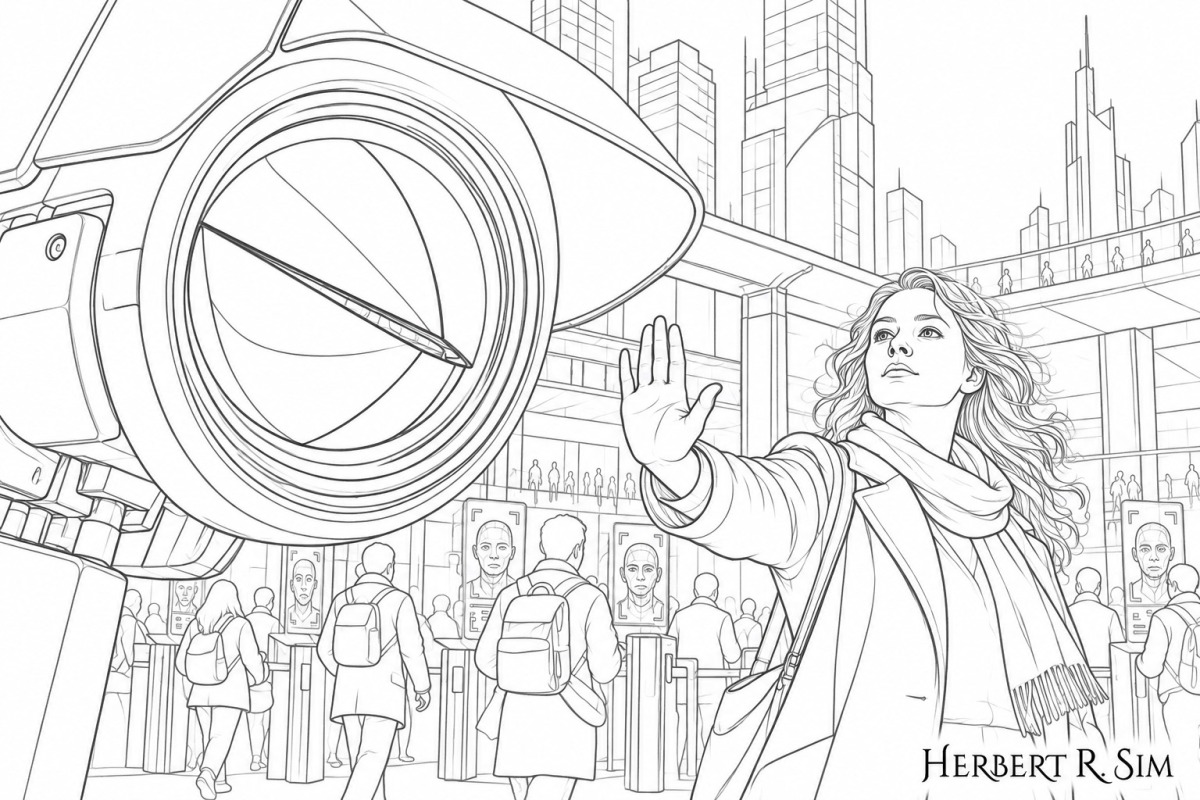
My illustration work-in-progress. The art represents the right to refuse being watched or profiled: human dignity begins where surveillance must close its eye.
Consent cannot be manufactured
Institutions often claim that biometric participation is voluntary. Yet a choice is not fully voluntary when refusal carries a serious penalty. If a worker must submit to continuous identification to keep a job, if a student must be scanned to access learning, or if a customer is denied a basic service without surrendering a faceprint, consent may be little more than compliance under pressure.
Human-Sovereignty Transhumanism calls for the Doctrine of Dual Freedom: the freedom to adopt technology and the equal freedom to refuse it. The same principle applies to biometric systems. A person may choose a convenient biometric tool. They must also be able to choose a reasonable alternative without being treated as suspicious, difficult or less entitled to participate.
This matters especially for vulnerable people. A person with a disability may not be recognised reliably by a system designed around narrow assumptions. A worker with little bargaining power may not be able to say no. A child may have no real understanding of how long a biometric record will follow them. Technology becomes unjust when its supposed neutrality conceals unequal capacity to refuse.
Biometric databases create a new form of dependency
Every centralised store of sensitive identifiers creates an attractive target for abuse, theft and political misuse. The risk is not limited to hackers. Data may be shared by contract, demanded by authorities, transferred during acquisition or repurposed by later management. A person who trusted one service can find their biological identity moving through an ecosystem they never agreed to enter.
The problem is compounded when access to ordinary life becomes dependent on a single identity architecture. If the system is wrong, unavailable or unjust, the person may be unable to correct the record quickly enough to live normally. They are reduced from a citizen or customer to a disputed entry in a database.
This is the sovereignty problem. A system becomes too powerful when it can decide, without accountable challenge, whether a person may enter, transact, travel, work or be believed. The answer is not to reject all identity technology. The answer is to design systems around decentralisation, limited retention, secure storage, independent oversight and practical alternatives.
A person must never need to surrender their biological identity simply to prove that they deserve ordinary freedom.
From biological data to behavioural control
Biometric surveillance also creates a subtler harm: self-censorship. People behave differently when they believe every movement is recorded, every face is recognised and every association may be interpreted later. They may avoid protests, difficult conversations, unpopular reading, private meetings or simply the freedom to move without explanation.
That is why privacy is a condition of autonomy. A person needs unobserved space to experiment with beliefs, relationships, ideas and identity. This is not an argument for isolation. It is an argument for the human interior: the right to become oneself without external systems constantly sorting and judging the process.
As biometric identification merges with behavioural analytics, artificial intelligence and networked sensors, the concern grows. The question is no longer only “Who can identify me?” It becomes “Who can infer what I will do, what I fear, what I value and what they can persuade me to accept?” The individual should not become transparent to institutions while institutions remain opaque to the individual.
Accountability must be human and visible
No biometric system should operate without a clear chain of responsibility. Someone must be answerable for why the system exists, how it is tested, what data it receives, how errors are handled, how long information is kept and what remedy is available when harm occurs.
“The system made a match” is not an explanation. A match can be wrong, incomplete, biased or wrongly interpreted. People must be able to obtain a human review, present context, correct a record and receive timely redress. The more serious the consequence, the stronger the duty of explanation and appeal.
Public institutions have a special obligation. Governments must not use the promise of efficiency to normalise indiscriminate biometric surveillance. They should establish strict legal limits, independent oversight, public reporting and meaningful remedies. Corporations, likewise, must not treat involuntary biological signals as assets simply because they have built the database capable of capturing them.
Technology should recognise dignity, not replace it
We will continue to build technologies that can identify, measure and analyse. Some will protect people from harm. Some will make services easier. The challenge is to keep the human being at the centre of their design.
A sovereign approach asks whether a system expands the user’s freedom or expands institutional power over the user. It asks whether people can understand what is happening, give or withdraw consent, choose an alternative, correct an error and leave without punishment. It asks whether data serves the person or whether the person has become raw material for data extraction.
Human-Sovereignty Transhumanism is pro-technology, but not technology without boundaries. Human progress cannot mean building a world in which every face is a tracking device and every body is an open file. The right not to be measured is the right to remain a person before becoming a profile.
Our bodies are not passports to a surveillance society. Our identities are not inventory. The human being must remain sovereign.