

My illustration entitled: “The Measure of a Child” – Two expectant parents stand in a tailor’s workshop. A tailor stretches a measuring tape around a child-sized silhouette woven from strands of DNA. Across the wall hang finished patterns for the lives the parents imagined.
Genetic intervention raises a question about who may decide that another person’s biological constitution should change. This essay introduces the Genomic Power–Authority Distinction, which separates the factual capacity to cause a genetic change from the legitimate standing to authorize it. It applies the distinction to research, clinical medicine, parenthood, reproductive practice, commercial provision, and public regulation. These cases show how technical competence, legal permission, financial control, and reasons to expect benefit can coexist with a disputed claim to authority. The problem is most acute for heritable interventions, where people who cannot participate in the decision may live with its consequences.
Two questions about the same act
Suppose a laboratory could make a lasting genetic change in a patient’s cells. Its researchers know how to make the change, the physician expects a benefit, and the hospital has cleared the procedure. The patient, having understood the risks, declines. There is no contradiction in saying that the intervention is technically feasible, medically defensible as an offer, and unauthorized as an act. Each judgment answers a different question.
Power is the factual or technological capacity to cause a genetic change. Evidence of power tells us whether an agent can bring about a result under specified conditions. Authority is the legitimate normative standing to decide that a change should occur. It concerns whose judgment or permission carries moral weight in a particular decision, and why. A researcher may acquire greater power by improving a technique while the grounds for intervening in a person’s body remain exactly as they were. A patient can have the standing to refuse a procedure they lack the skill to perform.
The Genomic Power–Authority Distinction
Possession of the technological power to alter a human genome does not, by itself, constitute legitimate authority to determine the genetic constitution of the person thereby affected.
The familiar saying “just because we can does not mean we should” invites us to examine the merits of a possible action. Genomic Sovereigntism asks a further question. Who possesses the normative standing to authorize genetic intervention? A favourable assessment of the outcome may explain why an intervention deserves to be offered. A separate argument is needed to establish who may accept that offer on the affected person’s behalf. We can agree that an intervention would probably help and still disagree about who may authorize it.
Scientists, physicians, and the scope of consent
A scientist’s competence gives others reason to take their account of a technique seriously. The scientist may be best placed to explain how uncertain its effects are, which findings can be reproduced, and what remains unknown. That competence can also warrant a leading role in deciding whether a study is scientifically sound. The participant’s decision concerns a different matter. They must determine whether the purpose of the study and the risks involved give them sufficient reason to take part. A scientist’s confidence in the design cannot supply that decision for them.
A physician has obligations to a particular patient as well as duties of professional judgment. An adult may authorize a specific intervention after understanding its purpose, material risks, and alternatives. The physician still has to judge whether offering and performing it is professionally defensible. Consider a patient who agrees to participate in a trial for an inherited blood disorder. If the investigators subsequently identify a separate opportunity to alter another trait, that opportunity falls outside the decision the patient made. The moral force of consent depends in part on its scope.
The 1997 UNESCO Universal Declaration on the Human Genome and Human Rights treats the assessment of risks and benefits and the obtaining of free and informed consent as distinct requirements. Its treatment of people unable to consent makes authorization a further question, guided by the interests of the person concerned. That structure is important. A competent adult’s refusal and a surrogate’s permission for a child have different grounds, even when both are recorded on the same kind of form. [1]
What parents may decide for children
Biological parenthood explains part of a child’s origin. The moral case for parental decision-making is better understood through the responsibilities adults undertake for a dependent child. Someone must often act before the child can understand the choice, and parents ordinarily know much about the child’s needs and circumstances. Their standing grows out of that relationship of care. Its scope depends on what the decision means for the child.
Imagine a genetic treatment with good evidence that it will prevent irreversible organ damage in a child. Waiting until the child can give legally effective consent might take away the opportunity to prevent that damage. The child’s need and the cost of delay supply reasons for an adult to authorize treatment. Now imagine an elective intervention aimed at a trait the parents prize, where it would be feasible to wait for the child’s own judgment. In the second case, the parents would need to explain why the decision belongs to them now. Affection for the child can explain their motive while leaving that question open.
Joel Feinberg’s account of a child’s right to an open future helps explain why the opportunity to decide later can matter now. No parent can preserve every option, and some decisions taken early are precisely what make later independence possible. The practical question is whether acting now protects a significant interest of the child, or settles a lasting question the child could otherwise answer for themselves. A child able to understand part of the decision has a perspective worth hearing even where adults must take final responsibility. [2]
Jurisdiction, ownership, and economic pressure
A government can establish conditions for research, require independent review, and restrict practices that expose people to serious harm. These are legitimate uses of public authority when justified by the interests they protect and exercised through accountable institutions. The power to regulate a class of interventions does not settle the authority to choose a particular intervention for an individual. A law that permits a physician to offer a procedure leaves room for a patient to decline it. A legislature that seeks to require genetic alteration owes a different and far more demanding justification than a legislature that sets standards for a voluntary procedure.
The Council of Europe’s Oviedo Convention illustrates the difference between setting public limits and deciding individual cases. For its parties, Article 13 confines interventions seeking to modify the human genome to preventive, diagnostic, or therapeutic purposes and excludes interventions aimed at introducing modifications into descendants’ genomes. This is a constraint on what may be undertaken. Within the range of permissible interventions, the Convention addresses consent separately. A statutory or treaty boundary and a person’s authorization do different work. [3]
A corporation may own equipment, finance a trial, or control access to a proprietary technique. Those positions confer considerable influence over which interventions are developed and which people are offered them. The patient’s genetic constitution lies outside the scope of what the corporation acquired by financing the work. Even access to genetic information under an agreement has a defined purpose. Permission to analyse a sample cannot be carried across to an intervention in the person from whom it came.
Consider an insurer that pays the full cost of a proposed intervention but makes continued coverage conditional on agreeing to it. A signed form would tell us that the patient accepted under those conditions. Assessing the validity of the authorization would also require asking what the patient stood to lose by refusing. In this case, finance matters because it can change the conditions in which another person exercises their authority.
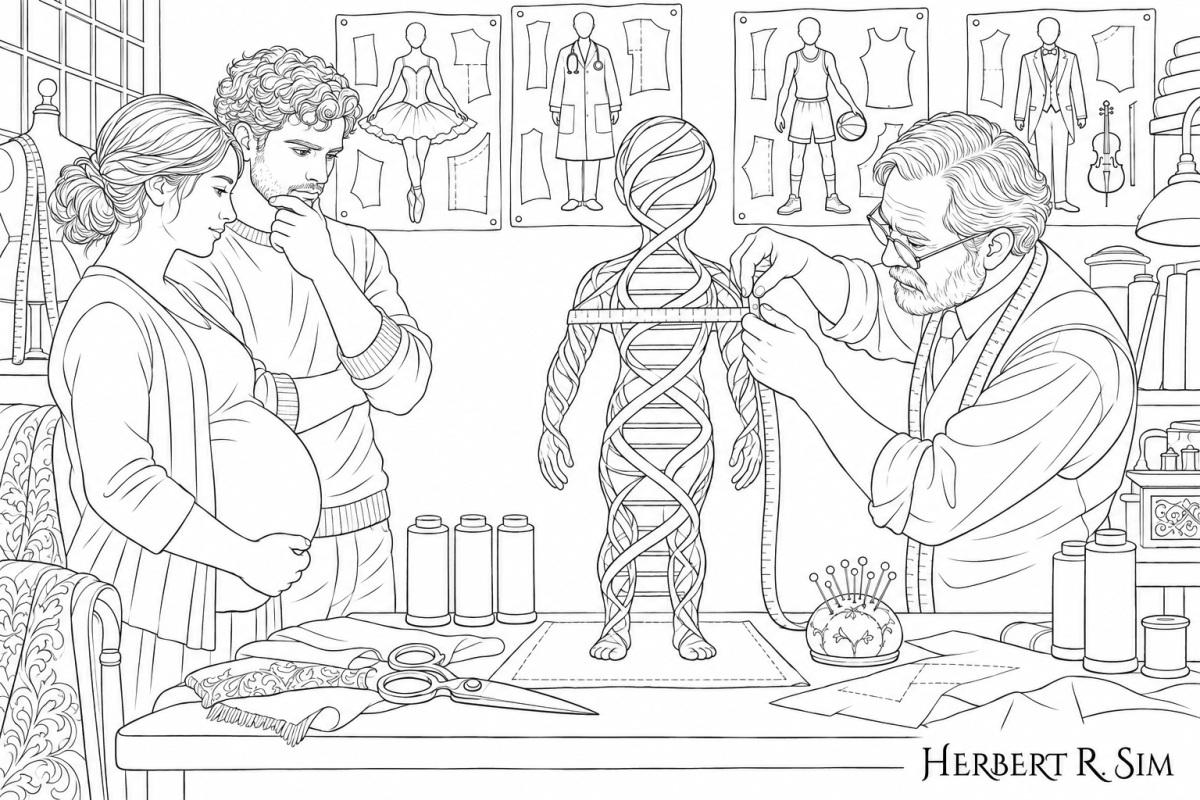
My illustration “The Measure of a Child” work-in-progress. The art represents that a child’s future should remain theirs to shape, even when others have the power to tailor their DNA.
Reproductive decisions and future persons
Reproductive specialists face decisions in which several people can have legitimate claims at once. Prospective parents can make decisions about seeking fertility treatment. A person undergoing a procedure or carrying a pregnancy has authority over interventions in their own body. A clinician has responsibilities for what they offer and perform. Where a prospective intervention could affect the constitution of a future child, the justification must also account for the interests of that child. Consent from each of the adults may settle what may be done to them and what they agree to undertake. It cannot function as consent given by the future child.
Reproductive cloning makes one aspect of the problem visible. A 2002 National Academies report concluded that, on the then-available evidence, human reproductive cloning would be unsafe. Imagine, for the sake of argument, that those safety objections could someday be answered. A clinician would still need to examine the proposed purpose. A request to reproduce the genetic resemblance of a deceased child, for example, involves an expectation the future child never agreed to carry. The parents’ grief deserves sympathy. The reasons for undertaking the procedure must also be defensible in relation to the independent person who might be born. [4]
There is a serious objection to requiring such justification. Every reproductive decision shapes a future over which the eventual child had no prior control. Julian Savulescu has argued that prospective parents have reason to select, among possible children, the one expected to have the best life given the available information. Selection among embryos and modification of an embryo raise different questions, since selection can determine which child comes to exist. Even so, the appeal to expected welfare carries over. If prospective parents have good reason to believe that an intervention would make a future life go better, why should they lack standing to authorize it? [5]
The answer depends on the kind of benefit and what an adult can reasonably claim to know. Preventing severe pain supplies a reason that a future person could recognize across many different conceptions of a good life. Giving a child a trait prized chiefly in a particular profession depends on a much narrower forecast of what that person will value. Expected benefit matters in both cases, but it needs to be assessed alongside the decision-maker’s relationship to the affected person, the availability of alternatives, and the consequences of acting before the person can speak. The argument for acting is strongest when delay would itself cost the person a substantial benefit.
Five propositions
- Capability requires a separate justification for its exercise. Evidence that an agent can produce a genetic change establishes feasibility. A claim to authority needs grounds that connect the particular decision to the person who will bear its consequences.
- Expertise warrants a voice within its scope. Scientists and physicians can assess evidence, advise, and determine what they can responsibly offer. A competent person’s informed and voluntary choice governs whether they accept a proposed intervention on their body.
- Surrogate authority is limited by its purpose. When another person must decide for a child or an adult unable to consent, the justification rests on responsibilities to that individual and the reasons for acting on that individual’s behalf.
- Institutional powers have defined limits. Public jurisdiction can justify oversight, and financial ownership can confer control over resources. Each claim must be justified in relation to the specific action it purports to authorize.
- Inability to consent leaves a duty of justification. Where a decision cannot be deferred, those who act must explain why action is warranted for the person affected. Heritable consequences extend that responsibility beyond the adults able to agree today.
The unresolved problem
The distinction is easiest to apply where an adult can understand the proposed intervention and decide whether to accept it. It is harder where the person cannot decide yet, and hardest where the effects of a present decision may pass to descendants. In these cases, several people may have standing over some part of the decision, while none can speak with the authority of every person who will live with the result. Independent review can expose weak evidence, conflicts of interest, or unjustifiable risks. That scrutiny can improve a decision without answering who ultimately has standing to make it.
Genomic Sovereigntism therefore leaves an unresolved problem. The means to alter an inherited condition may become available before there is a defensible way to authorize their use on behalf of those affected. Refusing to act can carry serious costs, just as acting can impose consequences no future person could decline. The question is what could confer sufficient authority to make a particular decision under those conditions, and who could legitimately exercise it.
References
- UNESCO. Universal Declaration on the Human Genome and Human Rights. 1997, Article 5. Declaration
- Feinberg, Joel. “The Child’s Right to an Open Future.” In Freedom and Fulfillment: Philosophical Essays, 76–89. Princeton University Press, 1992. Originally published in 1980. DOI
- Council of Europe. Convention on Human Rights and Biomedicine (Oviedo Convention). 1997, Articles 5, 6, and 13. Treaty text
- National Research Council. Scientific and Medical Aspects of Human Reproductive Cloning. National Academy Press, 2002. DOI
- Savulescu, Julian. “Procreative Beneficence: Why We Should Select the Best Children.” Bioethics 15, nos. 5–6 (2001): 413–426. DOI