

My illustration entitled: “The Two Measures of a Civilization” – Two colossal instruments rise above a flourishing city. One overflows with symbols of wealth—homes, food, inventions and gold. The other measures freedom through open doors, independent voices and usable choices, yet its mechanism stands nearly empty. Citizens examine both from below.
Imagine an economy with impressive buildings, reliable transport, rising production and well-stocked shops. Its businesses earn substantial revenues, its infrastructure attracts investment and many households enjoy comfortable lives.
Yet a worker struggles to change employers without losing essential benefits. A merchant depends on one institution to reach customers. A new entrepreneur faces requirements that established competitors can absorb but newcomers cannot.
These conditions can coexist.
Prosperity describes important achievements in production and material wellbeing. Economic freedom concerns people’s authority over the conditions through which they work, own, exchange and pursue alternatives.
An economy can perform well on the first dimension while leaving serious weaknesses on the second.
This distinction connects the central questions of the Economics collection: who exercises power, what obstructs practical agency, which alternatives are usable and what individuals are actually capable of doing.
Prosperity Deserves Recognition
Material improvements matter. Adequate housing, dependable energy, nutritious food and access to useful services expand the possibilities of human life.
Poverty can constrain choice severely. Someone facing immediate deprivation may accept conditions they would otherwise reject. Greater resources can provide time, mobility and security.
A philosophy concerned with economic sovereignty should therefore take production and prosperity seriously.
The argument is that these achievements do not answer every question about freedom. A comfortable life may still depend on permissions that another party can withdraw arbitrarily.
Assessment should recognise material benefits while examining their conditions. Doing so provides a more complete account of economic success and the vulnerabilities that favourable averages can conceal.
Output and Authority Measure Different Things
An economy’s total production cannot reveal by itself who controls productive resources or how decisions are challenged.
Two hypothetical societies might produce similar quantities of goods and services. In one, people can establish enterprises, change providers and question restrictions through accessible procedures. In the other, comparable opportunities depend heavily on personal approval from a narrow group.
The output may look alike while the distribution of authority differs.
Even detailed income information leaves questions unanswered. A high earner may have little control over accumulated savings held under restrictive conditions. A household with modest income may possess secure property and several workable routes to employment.
Income remains important, but its relationship with independence requires further investigation.
Comfort Can Depend on Continuing Compliance
Consider a worker receiving good pay, housing and medical support through one employer.
The arrangement may be beneficial and freely chosen. It may also become difficult to question if leaving employment simultaneously threatens several essential aspects of life.
The employer’s authority then extends beyond ordinary supervision of work.
Whether this dependence becomes abusive depends on conduct, commitments and available protections. Integration alone does not establish wrongdoing.
Nevertheless, an assessment of freedom should ask what happens when interests diverge. Can the worker raise a complaint? Are benefits transferable? Is there time to find another position?
Comfort demonstrates one aspect of the relationship. The practical consequences of disagreement reveal another, particularly when security depends on remaining acceptable to one decision maker.
Formal Rights Can Remain Difficult to Exercise
A person may possess a recognised right to start a business, challenge a decision or move resources while encountering substantial obstacles in practice.
Application fees, delays, complex procedures and inaccessible information can accumulate between permission and action.
Some obstacles serve legitimate purposes. Safety assessments and protection against fraud require evidence and administrative work.
The question is whether the burdens are necessary, proportionate and realistically manageable.
An appeal process may be formally available yet take longer than a small enterprise can survive. A transfer right may exist while records arrive in an unusable format.
Sovereignty Friction Theory directs attention to this gap. Economic evaluation should examine what people must overcome to exercise a right, alongside whether the right appears in an official description.
Ownership Has Several Practical Dimensions
Ownership can support independence by giving people resources that remain available when other relationships change.
A home, productive tools or savings may provide continuity and negotiating room.
Yet ownership should be examined through the powers it actually confers. Can the owner use the resource, obtain its benefits, transfer it and defend their claim against interference?
A business may own equipment while depending on a single supplier for essential maintenance. A customer may possess a record of funds while facing unexplained obstacles to accessing them.
These relationships do not make every indirect claim worthless. They require clarity about commitments, dependencies and remedies.
Secure ownership combines recognised claims with practical means of exercising and protecting them. A document alone cannot establish the full economic position.
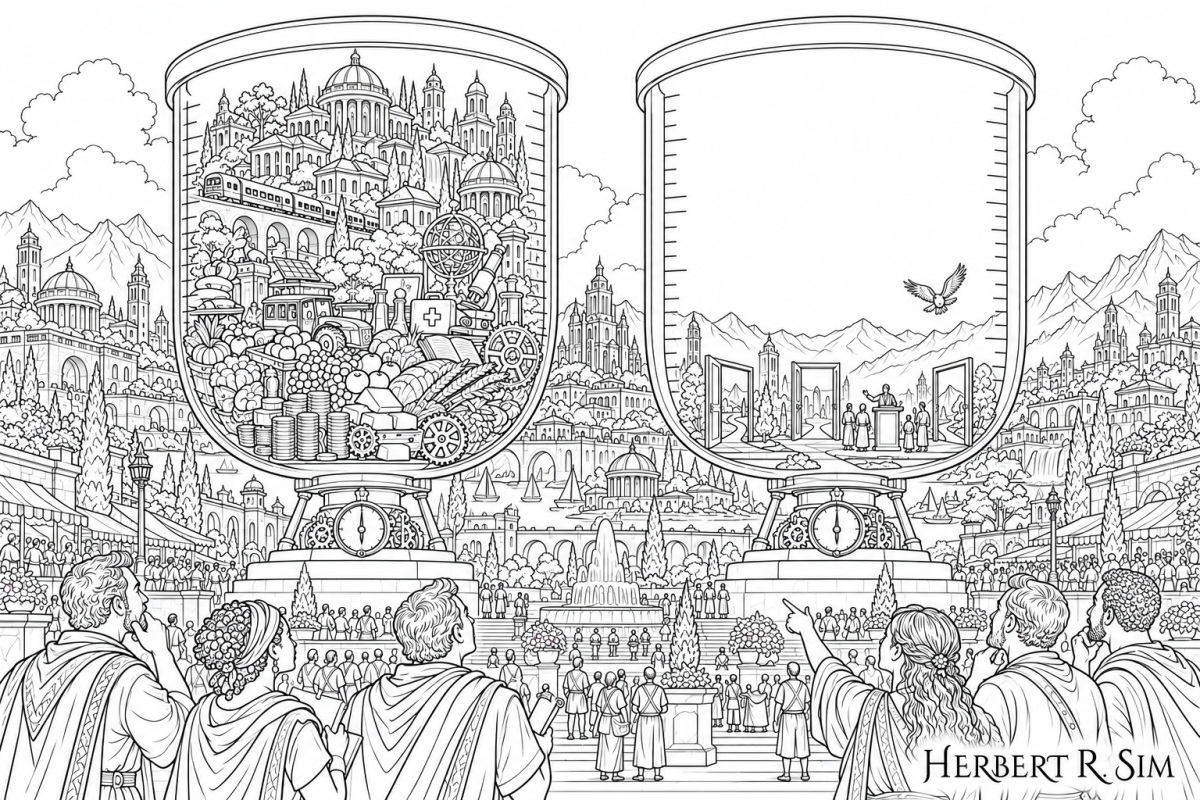
My illustration “The Two Measures of a Civilization” work-in-progress. The art represents that economic success and human freedom require separate assessment.
Alternatives Change the Meaning of Consent
Agreement becomes more secure when people can realistically choose another arrangement.
A customer dissatisfied with one supplier has greater negotiating power when competitors are accessible. A producer can challenge an intermediary more confidently when another route to customers exists.
This is one reason Counter Economics examines peaceful and voluntary alternatives to concentrated dependence.
Counting organisations is insufficient. Several providers may impose similar restrictions or rely on the same indispensable institution.
Constructive Counter-Economics adds the practical question: what infrastructure allows another route to work?
Records must transfer, payments must settle and people must possess enough knowledge to participate. Alternatives strengthen freedom when they can be used under the circumstances that make departure necessary.
Collective Prosperity Can Conceal Unequal Agency
People experience the same economy differently.
A large business can retain advisers, finance a lengthy dispute and operate through several suppliers. A sole trader may possess none of these protections.
Identical procedures can therefore impose radically different practical burdens.
Likewise, household wealth may offer one person extensive opportunities while another household member lacks meaningful control over it.
Assessment should examine who can make decisions, obtain assistance and absorb the costs of disagreement.
This is not a demand that everyone possess identical resources. It is a reason to investigate whether prosperity translates into usable agency across different circumstances.
Aggregate success becomes less reassuring when important groups remain dependent on inaccessible institutions or relationships they cannot reasonably reconsider.
Economic Capability Extends Beyond Income
Sovereign Capability Economics asks what individuals can actually do with the resources and opportunities around them.
Knowledge, health, time, productive tools and secure access can affect whether money becomes practical independence.
A person may afford training but lack time to attend. Another may own equipment without the knowledge needed to use it safely. Someone may have substantial savings but be unable to understand the conditions governing their access.
These examples show why capability requires attention to combinations of resources.
Useful responses may include accessible education, clearer information, transferable qualifications and opportunities to obtain assistance.
The purpose is to expand people’s ability to direct their own activities. Support should leave meaningful room for different judgments about work, risk and the kind of life worth pursuing.
Freedom Also Depends on Shared Institutions
Economic sovereignty does not require individuals to provide everything for themselves.
Courts, infrastructure, professional knowledge and shared standards can protect people against powers they could not resist alone. Their quality influences whether ownership and voluntary exchange remain dependable.
Institutions can also become sources of arbitrary control.
Legitimacy requires defensible purposes, understandable rules and opportunities to correct mistakes. Restrictions should connect to identifiable interests, including protection against harm imposed on others.
An institution may contribute substantially to prosperity while still needing reform in how it exercises authority.
Evaluating these dimensions separately makes improvement more precise. Reliable service deserves recognition; opaque exclusion deserves scrutiny. Neither observation needs to erase the other.
Examine the Economy Under Disagreement
Ordinary operation can conceal weaknesses that become visible during conflict.
A useful assessment asks what happens when a worker objects, a customer changes providers or a small enterprise challenges an exclusion.
Can the person obtain reasons? Does review have authority to change the outcome? What resources remain accessible while the dispute continues?
We should also examine foreseeable disruption. If one provider fails, can people preserve records, receive payments and continue essential activities?
These questions connect power, friction, alternatives and capability in a single practical inquiry.
Prosperity can make systems appear resilient because activity continues smoothly. Their treatment of disagreement and failure reveals whether that resilience extends to the people who depend on them.
Prosperity and Freedom Should Strengthen Each Other
Economic assessment should include production, income and material security alongside the practical distribution of authority.
Useful evidence includes barriers to entry, switching costs, access to remedies, security of ownership and the feasibility of building another route. It should account for differences between people rather than assume that average gains benefit everyone equally.
Measures require context. More providers do not necessarily create independent alternatives, and fewer complaints do not necessarily establish fair treatment.
The central question remains whether people gain dependable means to shape their economic futures.
An economy can be prosperous while leaving individuals insufficiently free. A stronger achievement is prosperity that gives people usable resources, accountable institutions and realistic opportunities to choose, challenge, build and leave.