
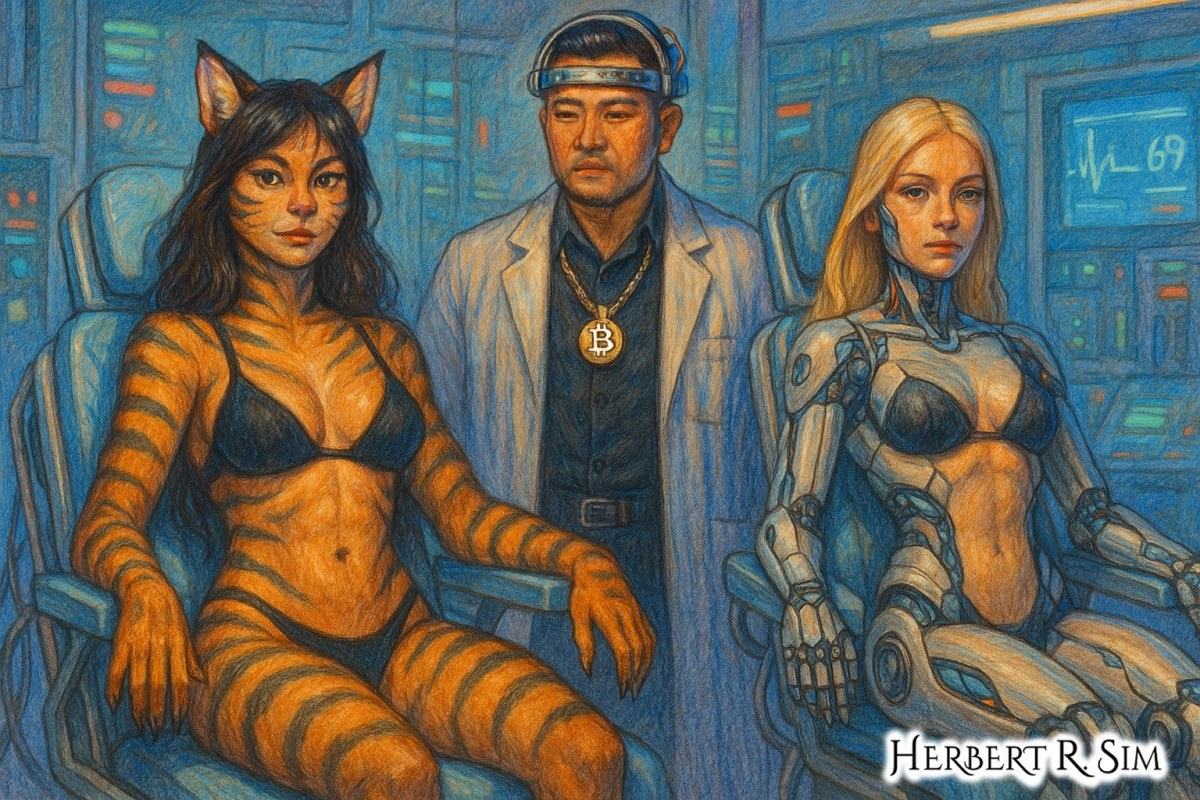
Above is my illustration featuring a scientist wearing a brain-computer interface (Neurochip); he is behind an animal-human hybrid spliced with tiger DNA, and a bionic woman with robotic mechanical parts.
In recent years, debates around individual autonomy have expanded far beyond political, social, and economic arenas. One of the most compelling and controversial discussions now centers on the idea of morphological freedom—the right of every person to upgrade, enhance, alter, or redesign their own bodies using science and technology. Far from science fiction, this concept is increasingly grounded in real-world technological breakthroughs such as genetic engineering, neurochips, bionics, regenerative medicine, robotics, and pharmacological enhancement. Morphological freedom asserts that the human body is not a sacred, untouchable vessel but a system that can—and arguably should—be reconfigured according to one’s desires, goals, and identities.
The Philosophical Foundation of Morphological Freedom
Morphological freedom stems from a broader philosophy of transhumanism, the belief that human beings can and should transcend biological limitations by using technology. This freedom is not only about extending lifespan, eliminating disease, or improving strength—it is about self-determination. Every individual, according to this principle, has the right to determine what form their body will take, what sensory capacities they possess, how they experience cognition, and how they present themselves.
From a moral perspective, morphological freedom challenges the assumption that the current human form is optimal or sacred. Instead, it positions bodily evolution as a personal decision, similar to religious belief, political affiliation, or lifestyle choices. It also confronts the long-standing social pressures that demand conformity to normative standards of gender, appearance, or ability. In this view, using technologies to radically transform ourselves is not unnatural, but rather an extension of a deeply human impulse: to create tools that improve our lives.
Genetic Upgrades and the Power to Rewrite Biology
One of the most powerful potential vectors of morphological transformation lies in genetics. Researchers are developing increasingly targeted methods of altering DNA, including zinc-finger nucleases and a newly adapted bacterial defence mechanism known as CRISPR-Cas9. Early laboratory experiments suggest that CRISPR may allow scientists to cut selected locations in the genomes of human cells with unprecedented ease.
These experiments remain at a very early stage. They do not yet constitute safe treatments, and researchers are still investigating inaccurate cuts and unintended mutations. Nevertheless, the possibility of targeted genetic alteration raises an important question: if scientists eventually learn to repair mutations that cause hereditary disease, will people also seek to alter non-medical characteristics?
The enhancement of intelligence, strength, appearance or sensory abilities remains speculative. Such traits are generally influenced by many genes as well as environmental factors. Yet morphological freedom asks us to consider who should possess the authority to make such changes if genetic modification eventually becomes sufficiently accurate and safe: governments, physicians, parents—or the individual whose body is being altered?
Neurochips and Cognitive Reinvention
The human brain is not exempt from modification. Experimental brain–computer interfaces have already demonstrated that electrical activity recorded from the brain can be translated into commands for computers and mechanical devices. Researchers working with systems such as BrainGate have enabled people with severe paralysis to control cursors and other equipment through recorded neural activity.
Other neural technologies operate in the opposite direction. Cochlear implants deliver electrical information to the auditory nervous system, while retinal prostheses are being developed to provide limited visual perception to some people with blindness. In February 2013, the United States approved the Argus II retinal prosthesis for a restricted group of patients.
These systems remain medically focused, invasive and limited in capability. They do not yet provide seamless communication between the brain and the internet, nor do they allow people to download knowledge or upgrade intelligence. Nevertheless, they establish an important principle: information can travel between neural tissue and electronic devices.
From the standpoint of morphological freedom, the future question is whether people should eventually be permitted to use neural technology not only to restore lost functions but also to enhance memory, concentration, communication or perception. Such freedom would have to be balanced against surgical risks, coercion and the protection of mental privacy.
Pharmacological Enhancement and Designer Drugs
Drugs and medicines have long been used for healing and treatment, but a growing field of research focuses on enhancement. Cognitive enhancing drugs, or “smart drugs”, are increasingly popular among students and professionals. Morphological freedom supports the use of pharmacology not merely to restore normal function, but to create optimized or even non-human states of consciousness and performance.
Future pharmacological enhancers might seek to improve focus, prolong wakefulness or alter mood, but no such intervention is free from side effects, dependency risks or individual variation.
Combined with genetic knowledge, pharmaceutical formulas might be uniquely designed for an individual’s DNA, targeting specific biochemical pathways to reshape personality, mood, or sensory perception. In the broader sense of autonomy, the individual has the right to choose their mental state and emotional profile, just as one might choose their career or relationships.
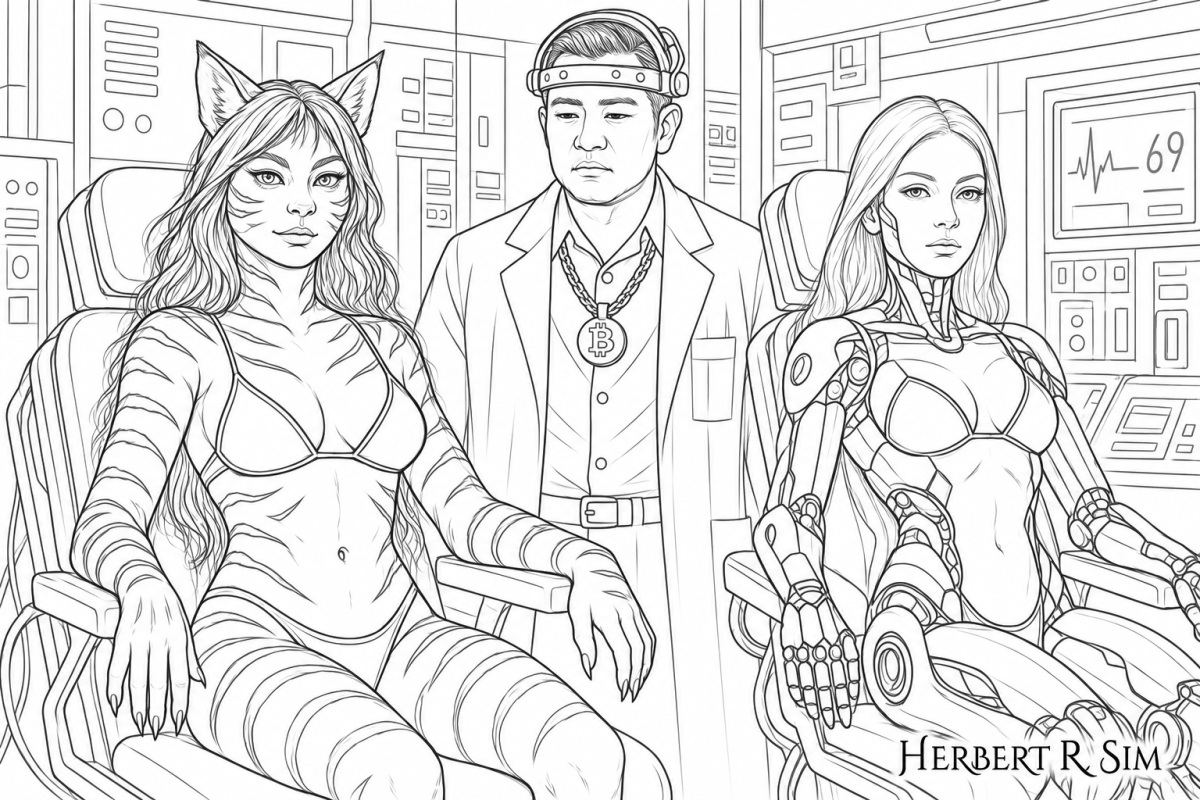
My illustration work-in-progress above.
Robotics and Bionics: Augmenting the Physical Form
Another pillar of morphological freedom lies in robotics and bionics. The boundary between human flesh and machinery is beginning to change through prosthetic limbs, experimental exoskeletons and artificial organs. Some advanced prostheses can interpret electrical signals from muscles or nerves, while laboratory brain–machine interfaces have allowed users to control robotic devices through neural activity.
These devices do not yet equal the speed, sensitivity or versatility of healthy biological limbs. Powered exoskeletons are also being tested for rehabilitation, mobility assistance and military applications, but they remain constrained by batteries, weight, balance and cost. Their importance lies not in having surpassed the human body, but in demonstrating that selected biological functions can increasingly be restored or supplemented by machines.
From an enhancement perspective, some transhumanists imagine that future individuals may voluntarily replace or supplement healthy biological structures if mechanical alternatives eventually provide capabilities that the natural body cannot match – with bionic ones to gain superior strength or endurance. This is not simply about restoring lost function—it is about upgrading. Future bionics may include telescopic eyes, extendable arms, or entirely new locomotion systems (e.g., mechanical wings or aquatic fins). The core idea is that one’s physical form becomes modular, reconfigurable, and tailored.
Plastic Surgery and Sex Modification: The Precedent of Bodily Sovereignty
While much of morphological freedom looks to the future, we already see its practice in everyday reality: plastic surgery and gender reassignment. People routinely reshape their noses, augment their body size or shape, and undergo procedures that alter fundamental characteristics such as gender. These practices are socially contentious, but they represent expressions of bodily autonomy—the right to choose how one presents and experiences their own body.
Morphological freedom extends this logic to an even more radical horizon. If an individual can change from one biological sex to another, why not change to an entirely new or hybrid morphology? Why not adopt androgynous structures, animal-inspired forms, or entirely invented anatomical configurations?
Social and Ethical Implications
With such far-reaching possibilities come crucial ethical and societal questions. Will morphological freedom be available to all, or only to the wealthy? As human morphology diversifies, will new forms of discrimination arise—against those who choose not to upgrade, or those with unconventional configurations? What regulations are appropriate to ensure informed consent while preserving autonomy?
Another concern centers on the potential erosion of the concept of “humanity.” If individuals diverge too far from the biological norm, do legal definitions of human rights still apply? Advocates of morphological freedom argue that the answer lies in focusing on sentience and personhood rather than outdated biological categories.
The Future Landscape of Human Diversity
As a significant thread in the broader tapestry of transhumanism, morphological freedom envisions a future in which humanity is not defined by a single biological blueprint, but by a spectrum of self-created forms. Some may choose to remain unaltered; others may selectively enhance cognitive and physical functions; still others might radically redesign themselves into entirely new kinds of beings.
Research fields such as 3D bioprinting, stem cell organ generation, synthetic biology, nanorobotics, and immersive virtual reality will further blur the boundaries between physical, biological, and digital self. Freedom will no longer be limited to location, speech, or belief—but will include the full customization of physical and mental experience.
Conclusion
Morphological freedom challenges us to rethink our understanding of the human body. Rather than seeing it as a given, it becomes a canvas—a platform for expression, improvement, and reinvention. Whether through genetics, neurochips, designer drugs, bionics, or surgical modification, individuals will increasingly have the power to shape themselves according to deeply personal desires. At its heart, morphological freedom is the next expansion of personal liberty: the right not only to be, but to become.