

My illustration entitled: “The Corridor of Possible Outcomes” – Two expectant parents face three translucent panels in a clinic. One shows a child spared a serious inherited illness. Another shows an unforeseen complication. The third is still unpainted.
Suppose a family carries an inherited condition that has caused severe illness in successive generations. An intervention might prevent the condition in a future child, and the resulting genetic change could be passed on to that child’s descendants. The parents have a strong reason to want the illness to end with them. A physician can assess the evidence for the proposed intervention. Neither can know which descendants will inherit the change, what other care may be available to them, or what choices they would make if given the opportunity.
What legitimate authority does one generation possess to make irreversible biological decisions that descendants may inherit? Genomic Sovereigntism begins by separating the power to change a genome from the authority to determine that a change should occur. With a heritable intervention, the people who make the decision and the people who may eventually bear its consequences are separated by time as well as by role. Any adequate justification must explain why acting now is warranted for those who may inherit the result.
One patient, one future child, and descendants
Consider first an adult offered a genetic intervention intended to affect only their own body. A permanent change can have serious consequences, but the patient can weigh those consequences against their own aims. If the intervention can responsibly be offered, the patient’s informed decision governs whether it proceeds. In this case, Genomic Self-Authorship includes the freedom to accept a lasting change for reasons that another person might weigh differently.
A decision for a future child has a different basis. A prospective parent may have a good reason to prevent severe disease that would affect the child from birth. The justification rests on a credible benefit to the child and on what can fairly be decided on their behalf. Parental willingness to proceed matters, as does the consent of anyone whose body is directly involved in the procedure. Each permission answers for that person’s participation. The prospect of benefit to the child requires its own defence.
A germline intervention capable of transmission introduces a third question. A decision intended to benefit one child may establish a biological condition that some of that child’s descendants also inherit. The first child’s welfare remains central, yet an assessment that ends there leaves part of the decision unexamined. Those who authorize it must consider how far the effects could reach, how well they can be anticipated, and what means later people would have to respond.
What the absence of consent requires
Future people cannot give consent. That fact matters because no present person can volunteer them for a risk in the way a competent adult can volunteer themselves. It leaves open whether there are grounds to act for them. Parents routinely make decisions whose benefits reach beyond the years in which a child can participate. Sometimes an opportunity to prevent serious harm will be lost before a person can decide for themselves. Requiring their prior consent in every such case would leave a duty of care impossible to discharge.
The principle that allows adults to act in those circumstances also limits their authority. Parents may act for a child because they owe that child care. Their ability to prevent a specific harm may give them reason to decide before the child can. Later descendants stand in a different relationship to those parents. A present generation owes them consideration, but it cannot claim the same knowledge of their circumstances or the same authority to judge which risks they would accept. The further a decision reaches, the harder it is to justify by appealing only to the intentions of the people making it.
I use intergenerational authority to mean the constrained moral standing to act now where a decision will shape the biological conditions later people may inherit. It arises from responsibility for foreseeable consequences. A family can bring knowledge of what a condition has meant in their lives. Clinicians can assess the evidence. Public institutions can require independent scrutiny and arrangements for responding to harm. Each contributes something to the justification. Taken together, they can make a decision more accountable, while the descendants’ interests remain their own.
When a future benefit can justify acting now
Imagine a serious inherited disease that causes progressive suffering from early childhood. Assume, for the sake of the argument, that reliable evidence supports an intervention and that no reasonably available alternative offers comparable protection. Preventing the disease could give the child years of life and activity that would otherwise be lost. If the benefit extends to descendants, that might strengthen the case. The benefit would consist in something those people could use in many different lives, whatever work, relationships or commitments they eventually choose.
The comparison with alternatives matters. In some cases, a treatment after birth might protect the child comparably without introducing a change that descendants could inherit. In others, reproductive options may allow prospective parents to avoid transmitting a condition, though those options can have burdens and limitations of their own. Calling an alternative reasonable requires attention to those burdens and to whether it is genuinely available. A route on paper may offer little to a family that cannot access it. Equally, a preference for one route needs to be weighed against the additional consequences it would impose on others.
There is also a difference between expecting a benefit for those who undergo or inherit a change and expecting an aggregate benefit for a population. A proposal to reduce disease across many generations sounds impressive when expressed as a total. The total can conceal who must bear the greatest uncertainty. A strong case for intervention must explain why the proposed benefit justifies the risks to the people exposed, including the first child. Speculative benefits to distant descendants do little to justify a substantial, poorly understood burden on a child who would be born now.
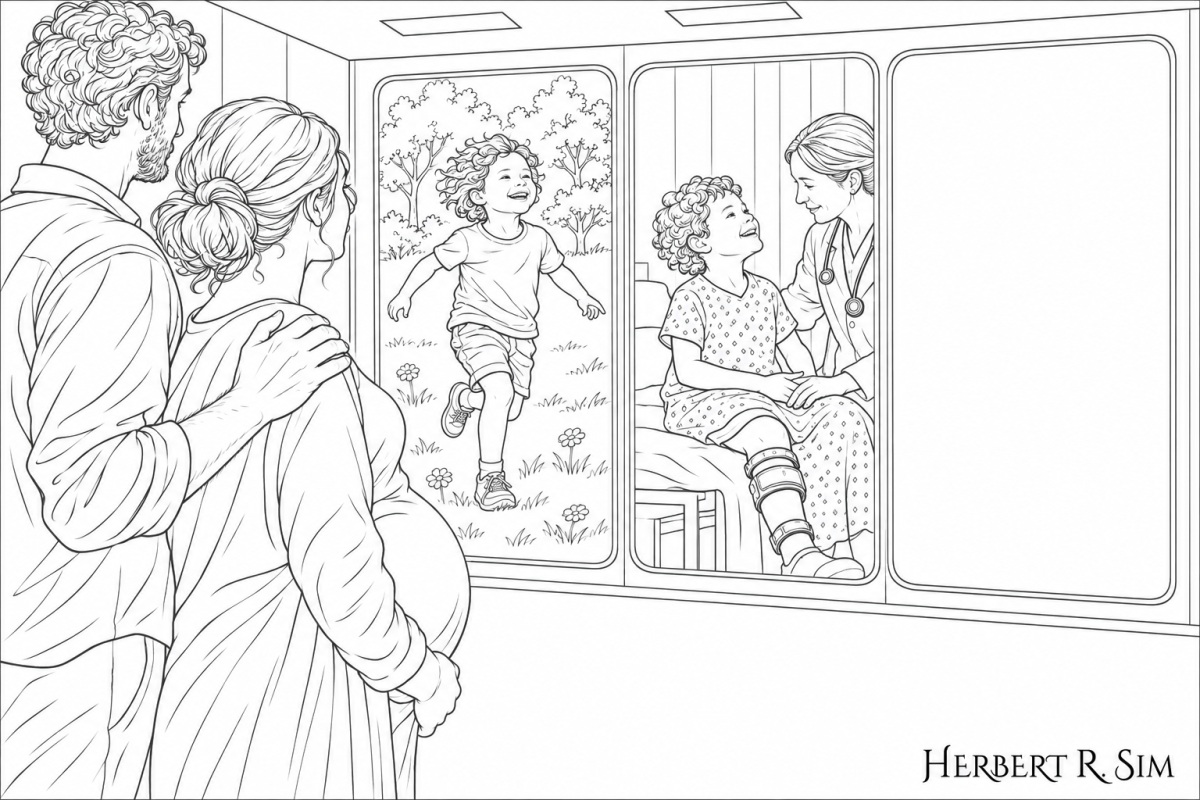
My illustration “The Corridor of Possible Outcomes” work-in-progress. The art represents that a heritable decision can spare a child from illness or bring unforeseen harm, while the blank panel reminds us how much of their future remains unknowable.
Enhancement and changing ideas of advantage
Consider a proposal to give a future child and some of their descendants greater physical endurance. The improvement might be valuable in sport, work or ordinary life. Its value may also depend on a particular environment or set of expectations. A family might imagine that descendants will prize the same abilities it prizes today. Their descendants may measure the advantage differently, especially if it comes with a trade-off the family never anticipated. The more the proposed benefit depends on a preferred way of life, the weaker the grounds for committing others to it before they can decide.
A further risk arises when a freely sought advantage becomes an expectation. If schools or employers begin to reward people for carrying a particular enhancement, families may feel obliged to pursue it to maintain opportunities their children previously had. The Nuffield Council on Bioethics identified the welfare of the future person and the effects on disadvantage, discrimination and social division as central considerations in assessing heritable interventions. Those considerations belong together. A benefit to some individuals can coexist with conditions that make it harder for others to decline. [1]
The distinction between treatment and enhancement helps identify the purpose of a proposal. Its label cannot settle the matter. A treatment can be disproportionate, and an enhancement can offer a genuine benefit. The case for a heritable change depends on how substantial and well supported that benefit is, how broadly it serves the affected people’s own purposes, and what burdens they would inherit with it.
The burden of justification under uncertainty
Heritability changes what decision-makers must be able to justify. Evidence about an immediate outcome cannot answer every question about later effects. A change may have consequences that only become apparent as a person ages or under circumstances different from those anticipated at the time. Nor can one assume that a later generation will have the means to reverse a change simply because the present generation can introduce it. A promise of future repair has little weight when the people making it cannot deliver that repair.
The stronger the possibility of serious, lasting or widely transmitted effects, the stronger the reasons required to act. That includes better evidence of benefit and a more searching assessment of alternatives. It also means stating plainly what remains unknown and asking whether later people would have any practical means to respond. Waiting carries moral costs of its own when a person faces serious preventable illness. The appropriate comparison is between the consequences of acting and the consequences of waiting, including what each choice would leave later generations able to do.
The 2020 International Commission on the Clinical Use of Human Germline Genome Editing drew a distinction between a possible future justification and a present basis for proceeding. It concluded that the scientific conditions it set for attempting a pregnancy with an edited embryo had yet to be met. Its discussion of possible initial uses focused on serious single-gene diseases and narrowly limited reproductive circumstances. The report helps locate two distinct judgments. Evidence may eventually establish that an intervention can be performed with adequate reliability. The people proposing it would still owe an ethical justification for making that decision for others. [2]
What later generations should be able to decide
Future agency matters even when the biological change itself cannot be undone. A person who inherits a change may still decide whether to seek follow-up care, take part in research, share information, or make particular reproductive choices. They should be able to obtain medically relevant information when they want it and to consult someone independent of the institution that originally authorized the intervention. A plan that depends on every descendant agreeing to lifelong observation assumes authority over choices that will belong to those descendants.
Institutions should also consider who would remain answerable if harms appear after a clinic closes or a company changes ownership. A credible plan calls for arrangements that can outlast the people who made the original decision. Oversight should be capable of responding to new evidence, and access to necessary care should not depend on a person’s willingness to provide data for research. The World Health Organization’s July 2021 recommendations place international cooperation and registries among the governance tools for human genome editing. Those tools can support accountability. Their design should preserve the ability of affected people to make informed choices about their own involvement. [3]
We owe unknown descendants reasons that take their circumstances seriously without pretending to know what they will value. Prevention of severe harm can sometimes supply those reasons. A desire for them to resemble us, fulfil our plans or secure an advantage we happen to prize seldom can. Where we may legitimately make an enduring decision, our responsibility includes ensuring that later people have room and means to make decisions of their own.
Intergenerational Authority Principle
One generation may authorize a heritable genetic intervention only when it can justify the decision to those who may inherit its effects. The expected benefit must be substantial and supported by evidence, the foreseeable risks and uncertainties proportionate, and less enduring alternatives seriously considered. The more irreversible the change and the further its effects may reach, the stronger the justification required. Any decision must preserve later people’s agency wherever possible and establish lasting responsibility for the consequences they may bear.
References
- Nuffield Council on Bioethics. (2018). Genome Editing and Human Reproduction: Social and Ethical Issues.
- National Academy of Medicine, National Academy of Sciences, and the Royal Society. (2020). Heritable Human Genome Editing. The National Academies Press.
- World Health Organization. (2021). Human Genome Editing: Recommendations.