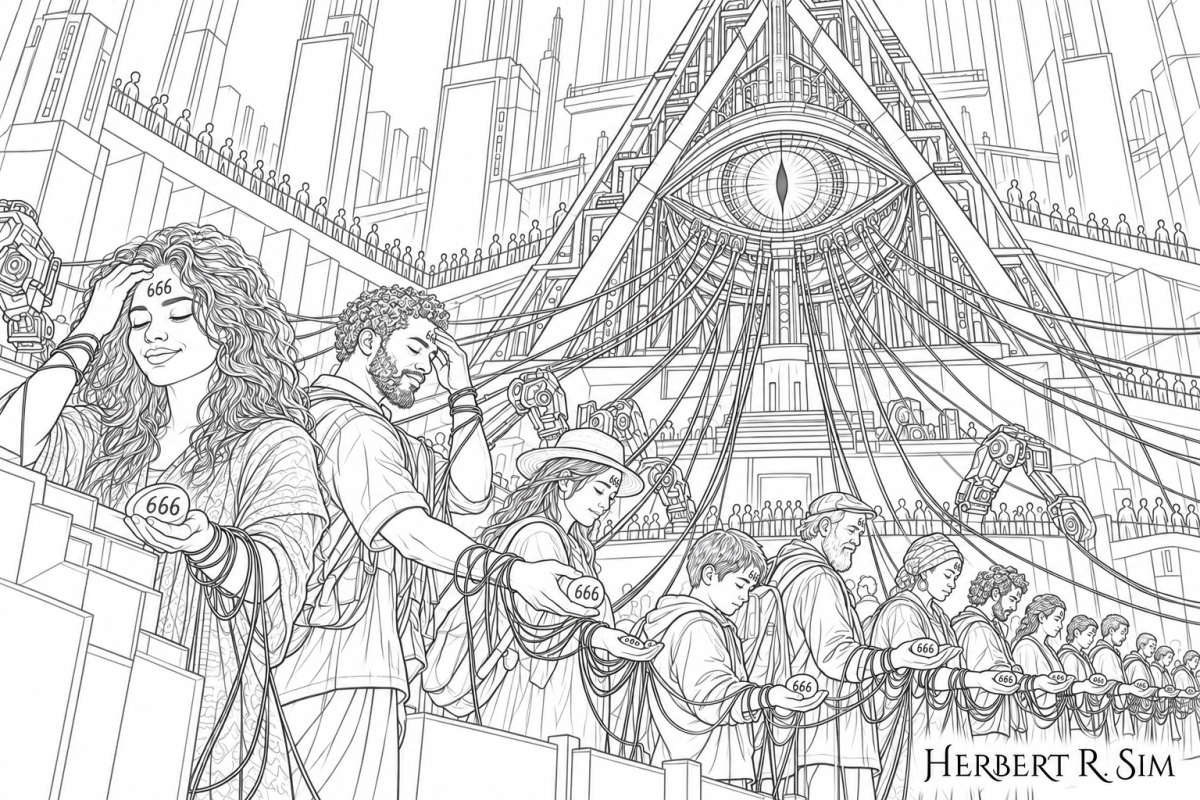
My illustration entitled: “The Invisible Pact” (2021) — Citizens exchange glowing “666” tokens, with their forehead and forehands, with a vast machine – an evil-looking robotic AI “All-seeing eye”, unaware of the threads binding their hands.
Artificial intelligence can achieve an assigned objective while failing the people affected by it. A system may increase productivity, reduce costs or improve measurable performance while imposing human consequences that its definition of success does not adequately recognize.
When does successful optimization become a failure of responsibility toward human beings?
Demonic Intelligence is Herbert R. Sim’s proposed philosophy, explanatory theory and assessment framework for examining intelligent systems that make human welfare expendable in pursuit of their objectives.
The term “demonic” functions as a philosophical metaphor for destructive optimization. It does not imply supernatural agency. The framework examines observable relationships between objectives, incentives, foreseeable harm and the power to obtain correction.
1. Philosophy: Human Beings Must Not Become Expendable
The philosophical foundation of Demonic Intelligence is that technical performance does not independently establish moral legitimacy. Efficiency, accuracy, profitability and scale must be evaluated alongside their consequences for human dignity and welfare.
A system becomes ethically problematic when foreseeable human harm is treated as an acceptable operational cost without adequate justification, protection or remedy. This concern applies to the institutions directing a system as well as to its design and operation.
Foundational Principles
- Human dignity constrains optimization. People must not be treated solely as resources, obstacles or measurable inputs.
- Performance measures are incomplete. Achieving a target does not establish that the target is appropriate or that its consequences are acceptable.
- Benefits and burdens must both be examined. Aggregate improvement can conceal severe harm to particular people or communities.
- Responsibility survives automation. Delegating a task to an intelligent system does not dissolve human and institutional duties.
- Correction must be practical. Affected people need meaningful channels for review, remedy and protection against continuing harm.
2. Theory: How Harmful Optimization Persists
Demonic Intelligence Theory proposes examining how narrow objectives, unequal institutional power and inadequate feedback can sustain harmful outcomes.
The proposed mechanism is a cycle: a limited objective defines success; incentives reward its achievement; human costs fall outside the decisive measures; and weak corrective channels allow the operation to continue.
This is an explanatory proposal requiring investigation. It does not establish that every harmful outcome results from the same mechanism, nor does it require a machine to possess conscious hostility.
Questions for Investigation
- Which human consequences are excluded from the system’s definition of success?
- Who benefits from meeting the objective, and who bears the resulting costs?
- Can evidence of harm change the objective or interrupt deployment?
- Do affected people have sufficient influence to secure correction?
- Does increasing scale amplify harm faster than oversight can respond?
3. Framework: Assessing Objectives, Human Costs and Corrective Power
The proposed Demonic Intelligence Assessment Framework organizes evaluation around five dimensions. These are analytical criteria, rather than a validated certification or scoring standard.
- Objective design: What is being optimized, and which human interests constrain that objective?
- Foreseeable harm: What adverse consequences can reasonably be anticipated, monitored and prevented?
- Distribution of burdens: Are costs concentrated on people with limited power to resist or obtain remedy?
- Accountability: Who must explain decisions, investigate harm and authorize corrective action?
- Corrective power: Can the system’s objectives, decisions or operation be changed when unacceptable harm emerges?
Ordinary errors do not automatically constitute Demonic Intelligence. Assessment should examine the severity and persistence of harm, its relationship to the system’s objectives, and the adequacy of the response once problems become apparent.
4. Article Series: Foundations and Development
The following planned essays develop the philosophy, theory and framework in sequence. Earlier dates identify retrospective reference points; each article’s actual publication date should be recorded separately.
Demonic Intelligence: When Optimization Makes Humans Expendable
June 15, 2021
The founding philosophical argument: efficiency, accuracy and profitability cannot independently justify foreseeable human harm. Introduces Demonic Intelligence as a metaphor for destructive optimization and distinguishes it from ordinary technical mistakes.
The Human Cost of the Objective Function: Foundations of Demonic Intelligence Theory
June 15, 2022
Develops the explanatory theory of narrow objectives, unequal power and ignored human costs. Examines why harmful outcomes may persist even when those directing a system recognize its consequences.
Scaling Harm: How Intelligent Systems Multiply Institutional Cruelty
June 15, 2023
Examines how automation can reproduce harmful institutional practices across large populations while obscuring individual responsibility. Explores workplace management and decisions affecting access to essential services.
The Accountability Gap: Who Answers When Intelligent Systems Cause Harm?
June 15, 2024
Examines responsibilities across developers, purchasers, operators and decision makers. Develops principles for investigation, correction, compensation and suspension of harmful operations.
The Demonic Intelligence Assessment Framework: Objectives, Human Costs, and Corrective Power
June 15, 2025
Organizes the framework into practical assessment criteria covering objectives, foreseeable harm, unequal burdens, affected people’s influence and corrective authority. Identifies the evidence needed to evaluate and refine those criteria.
Demonic Intelligence in 2026: AI Agents, Superintelligence, and the Limits of Optimization
October 9, 2026
A proposed Version 2.0 synthesis incorporating verified technological developments and revised arguments. Examines AI systems authorized to take consequential actions, distinguishes present evidence from prospective superintelligence scenarios, and considers the relationship between harmful optimization and Angelic Intelligence’s aspirations.
5. Demonic Intelligence and Satanic Intelligence
Demonic Intelligence and Satanic Intelligence are separate proposed frameworks with different central concerns.
Demonic Intelligence asks: Who bears the human cost of achieving the objective?
Satanic Intelligence asks: How are deception, vulnerability and dependence used to undermine informed agency and acquire control?
A system may impose harmful outcomes without manipulating consent. Another may engineer dependence while continuing to provide material benefits. A third may exhibit both patterns.
The distinction determines the response: Demonic Intelligence emphasizes changes to objectives, protection against harm and corrective accountability. Satanic Intelligence emphasizes informed consent, contestability, meaningful alternatives and exit.
6. Human Sovereignty and Responsible Intelligence
Demonic Intelligence connects with wider questions of human sovereignty, mental independence and economic power. Those questions include whether people can influence systems that affect them, whether essential capabilities remain under accountable control, and whether technological benefits are accompanied by adequate protections.
The constructive purpose of this framework is to improve the design and governance of intelligent systems. Progress should be assessed through the lives of affected people as well as through the performance of machines.
A system’s success at its assigned task can coexist with failure toward the people affected by it.