

My illustration entitled: “The Fine-Print City” — A city’s streets are formed from dense contracts, with corporations moving freely while people navigate restrictive clauses.
Economic freedom weakens when one side of society can set the terms, revise the rules and withhold approval, while the other must repeatedly ask for permission to live, work and build.
Modern societies commonly describe themselves as free because citizens may own property, sign contracts, seek employment, form businesses and make personal choices. These protections are important. But freedom cannot be understood only by looking at what the law permits in principle. It must also be examined through the distribution of decision-making power in practice.
Who gets to say yes without asking? Who must wait for approval? Who may revise the terms after an agreement has begun? Who has alternatives when a relationship becomes unfair, and who must simply accept the conditions offered?
These questions reveal a problem that is often hidden by the language of formal rights. It may be called permission asymmetry: a condition in which institutions possess broad discretion over economic life while individuals possess only narrow, conditional choices.
An institution may decide whom to employ, lend to, insure, supply, certify, admit or serve. It may change its internal policy, raise a fee, require new documents or withdraw access. An individual, by contrast, may be told that he is free to pursue opportunity but must first satisfy conditions he did not create and cannot meaningfully negotiate.
This does not mean every institution is unjust, or that all rules are forms of tyranny. Organisations must make decisions. Banks must assess risk. Employers must hire carefully. Governments must protect the public from fraud and danger. The problem emerges when the power to grant or deny access becomes so concentrated that ordinary people have no realistic way to challenge it, escape it or replace it.
At that point, permission is no longer a simple administrative matter. It becomes an economic power.
The Difference Between Choice and Approval
Choice belongs to the individual when he can select among genuine alternatives. Approval belongs to the institution when it decides whether an individual may enter a particular system at all. These are not the same thing.
A person may choose between several shops because sellers compete for his business. But if a worker depends on a single large employer in a town, the employer’s approval has far greater weight. A family may technically choose among financial services, but if every provider uses similar terms and each can deny access without explanation, the family’s choice is mostly theoretical.
In a free society, approval should not become the universal condition for ordinary life. When people must seek permission from powerful organisations to work, save, travel, communicate, trade or obtain basic services, their independence becomes fragile. They may hold rights, but their ability to exercise them rests on continuing acceptance by people they do not know and cannot influence.
Permission asymmetry is therefore not simply about the existence of rules. It is about whether rules apply evenly. The ordinary citizen is expected to comply with forms, deadlines, fees, inspections and conditions. The institution that creates these procedures may operate with far greater flexibility. It can interpret a rule, alter a policy or hide behind a committee. The citizen faces a final decision; the institution often has a process.
When institutions possess discretion and individuals possess only compliance, the language of choice conceals a relationship of dependence.
The Fine Print Economy
One of the most common sources of permission asymmetry is the agreement that no ordinary person can reasonably negotiate. A contract is supposed to be a meeting of willing parties. In reality, many contracts are presented on a take-it-or-leave-it basis.
The individual must accept the terms to obtain employment, credit, insurance, accommodation, communication services or access to a marketplace. The institution’s terms may be long, technical and subject to change. The individual may sign not because he truly agrees, but because he has no practical alternative.
This is not always malicious. Standard agreements can reduce costs and make large-scale services possible. Yet efficiency should not become a justification for unfairness. A system may be convenient for the organisation while silently transferring all uncertainty to the person with the least power.
Consider the difference in position. An institution can employ legal departments, specialists and administrators. It can spread risk across thousands or millions of customers. An individual usually confronts the agreement alone. He may not understand every clause. He may not have the time, money or expertise to dispute it. If he refuses, he may lose access to something necessary.
When this pattern becomes normal, consent loses substance. The person is not choosing among arrangements; he is being processed through one.
A fair economic system should not eliminate contracts. It should make them more honest, understandable and contestable. Terms that govern ordinary life should be clear. Material changes should be communicated plainly. Disputes should be heard without forcing individuals into burdens they cannot afford. Most importantly, institutions should not use complexity as a substitute for consent.
When Bureaucracy Becomes a Barrier to Entry
Permission asymmetry is also visible in the gap between large institutions and small participants. A major company may have dedicated staff for legal compliance, licensing, taxation, accounting and regulation. A small trader, self-employed worker or family enterprise must often face the same system with far fewer resources.
Rules intended to protect consumers or ensure order can therefore have an unintended effect: they may shield established organisations from competition. The large firm absorbs a new requirement as an ordinary cost of business. The small firm postpones, abandons or never begins.
This is not an argument against public safeguards. Unsafe products, fraud, exploitation and corruption require a response. But regulations should be judged by more than their stated purpose. We should ask who can comply, who is excluded, and whether the burden is proportionate to the harm it prevents.
An economy in which only the well-capitalised can navigate the law is not truly open. It becomes a managed space where opportunity depends on prior access to advisers, licences, connections and capital. In such a system, enterprise may be praised in speeches while quietly restricted in practice.
There is a human cost to this. Every unnecessary barrier prevents someone from trying an idea, developing a skill, serving a community or becoming less dependent on a single employer. It reduces not only economic activity but also the confidence people gain from building something of their own.
Institutions Need Accountability, Not Immunity
Institutions are necessary. They allow large numbers of people to cooperate. They pool resources, manage risk and perform functions no individual could easily carry out alone. The question is not whether institutions should exist. It is whether they remain accountable to the people whose lives they shape.
An institution becomes dangerous when it is insulated from the consequences of its decisions. If it can deny access without explanation, alter terms without challenge and impose costs without meaningful competition, it begins to act as an authority rather than a service provider.
The language of customer service can obscure this fact. A person may be called a customer, client, account holder, applicant or member, but these labels do not guarantee equal standing. What matters is whether the person can obtain an explanation, appeal a decision, compare alternatives and leave without losing the foundations of ordinary life.
Accountability does not mean that every request must be granted. It means that power should be visible, limited and answerable. Decisions affecting someone’s livelihood or property should not be buried in anonymous procedures. Rules should not be so vague that they can be used selectively. A person should not be treated as guilty of inconvenience merely because he asks how a decision was made.
The greater the economic power of an institution, the greater its duty to act transparently and fairly.
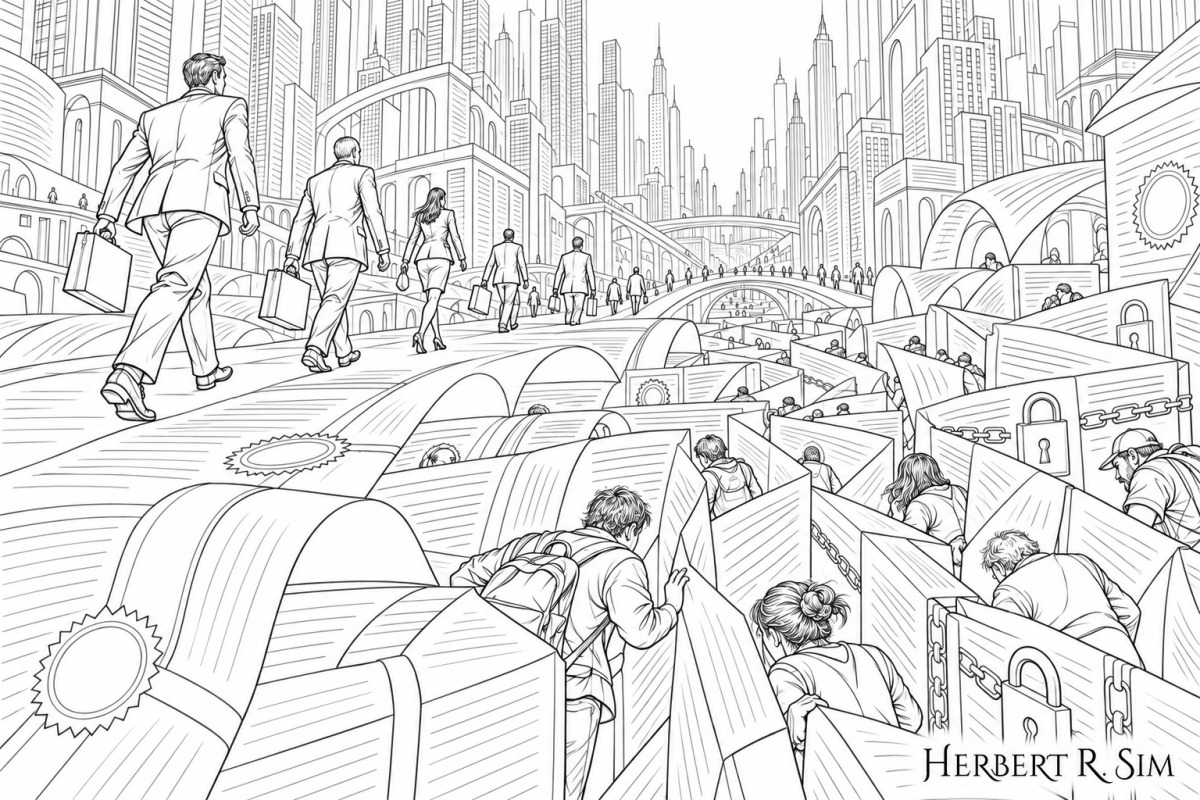
My illustration “The Fine-Print City” work-in-progress. The art shows how systems that grant institutions broad freedom can trap individuals in economic complexity, making formal rights meaningless without real power to choose.
The Weakness of One-Sided Risk
Permission asymmetry often produces another imbalance: the institution keeps discretion while the individual bears risk.
A company may change its pricing, service or employment policy. A lender may tighten conditions. A landlord may revise an arrangement within the bounds of a lease. A government office may introduce a new requirement. Each action may be lawful. But the person affected by it may have planned his life around the previous conditions.
For the institution, the change is one decision among many. For the individual, it may determine whether rent is paid, a business survives or a family can meet its obligations. This is why economic power must be evaluated not only by intention but by impact. A rule that appears minor from an office may be devastating when it reaches the person with no margin for error.
Risk should not be hidden behind formality. If an institution gains the benefit of changing terms, it should also bear responsibilities: adequate notice, clear reasons, fair transition periods and a process for resolving genuine hardship. The more a person depends on an arrangement, the less acceptable it is to treat that arrangement as disposable.
Society often expects individuals to plan responsibly. That expectation is reasonable. But planning becomes impossible when powerful institutions reserve the right to rewrite the conditions upon which planning depends.
Why Alternatives Matter
The best protection against permission asymmetry is not endless supervision of every institution. It is the existence of alternatives.
When people have several employers, suppliers, lenders, customers and places to trade, each institution must take their choices seriously. When there is only one practical option, the institution can treat the individual as captive. Competition is therefore more than an economic mechanism; it is a safeguard for personal dignity.
Alternatives can take many forms. They may be small businesses, cooperatives, professional associations, mutual-aid groups, local markets or new methods of communication and exchange. Their importance lies in the space they create. They give individuals another path when the first path becomes closed, unaffordable or unfair.
A society should welcome peaceful experimentation in how people work and cooperate. Not every alternative will succeed. Some will fail. But the ability to try is itself a form of liberty. It prevents the existing order from claiming that it is the only order possible.
Of course, alternatives must be honest and lawful. Freedom to build does not include freedom to defraud or exploit. Yet a system that treats every new form of voluntary cooperation with suspicion will protect established power at the expense of ordinary initiative.
The Cultural Cost of Constant Permission
There is a cultural cost to living in a permission-heavy society. People gradually learn that their future is not something they shape but something they apply for. They become cautious about creating, investing and speaking independently because every step appears to require validation from a gatekeeper.
This mentality weakens responsibility as well as freedom. A person who never owns a meaningful decision may also lose the habit of accepting the consequences of one. He learns to obey procedures rather than exercise judgment. He waits for institutions to tell him which path is legitimate, which risk is acceptable and which ambition is permitted.
Such a culture may appear orderly, but it can become stagnant. Innovation requires room for error. Enterprise requires the ability to begin before every outcome is guaranteed. Communities become stronger when people can solve problems directly rather than always waiting for a remote authority to act on their behalf.
The goal should not be a society without standards. It should be a society in which standards protect people without depriving them of agency.
A Fairer Balance of Power
Permission asymmetry cannot be solved by a single law or institution. It is a pattern that appears wherever one side holds concentrated discretion and the other lacks practical alternatives. But several principles can help restore balance:
- Rules that govern ordinary economic participation should be clear, stable and understandable to non-specialists.
- Small enterprises should not be burdened with requirements designed only for large organisations unless the risk clearly demands it.
- Institutions making consequential decisions should provide reasons and accessible avenues for review.
- Contracts should not hide essential conditions in language that ordinary participants cannot reasonably understand.
- Economic policy should encourage competition, local enterprise and multiple paths to work and exchange.
- People should be able to develop savings, skills and property that reduce their dependence on any single gatekeeper.
These principles do not abolish institutions. They civilise their power. They recognise that institutions exist to serve human life, not to make human life permanently conditional on institutional approval.
Freedom Requires Symmetry
Economic liberty is not achieved merely because the individual is told that he may act. It requires a reasonable symmetry between the individual and the institutions that shape his opportunities.
If an institution can choose, revise, deny and withdraw while the individual can only comply or suffer, then power has become one-sided. If the individual can understand the rules, seek alternatives, keep the fruits of his effort and challenge unfair treatment, then freedom becomes more real.
Permission will always have a place in complex societies. We need trust, standards and safeguards. But permission should never become the hidden constitution of economic life. The individual must remain more than an applicant in a world run by gatekeepers.
A free economy is one in which institutions are strong enough to serve, but not so strong that ordinary people must surrender their independence in order to participate. The right balance is not the absence of organisation. It is the presence of genuine choice—on both sides of the relationship.
Download the PDF on Zenodo
Official Publication Record
Permission Asymmetry: When Institutions Hold More Economic Choice Than Individuals has been archived on Zenodo with a permanent DOI for citation, preservation and scholarly reference.
| Title | Permission Asymmetry: When Institutions Hold More Economic Choice Than Individuals |
|---|---|
| Author | Herbert R. Sim |
| ORCID | 0009-0008-6500-5749 |
| Publication date | 18 August 2007 |
| Canonical webpage | https://herbertrsim.com/permission-asymmetry-institutional-economic-choice/ |
| DOI | 10.5281/zenodo.23057602 |
| Zenodo record | View and download the publication |
| Licence | Creative Commons Attribution 4.0 International (CC BY 4.0) |
Preferred citation:
Sim, Herbert R. (2007). Permission Asymmetry: When Institutions Hold More Economic Choice Than Individuals. Zenodo.
https://doi.org/10.5281/zenodo.23057602
Copyright and licence:
© 2007 Herbert R. Sim. Licensed under Creative Commons Attribution 4.0 International (CC BY 4.0).
Zenodo submission note:
Archived on Zenodo for permanent preservation and citation.