
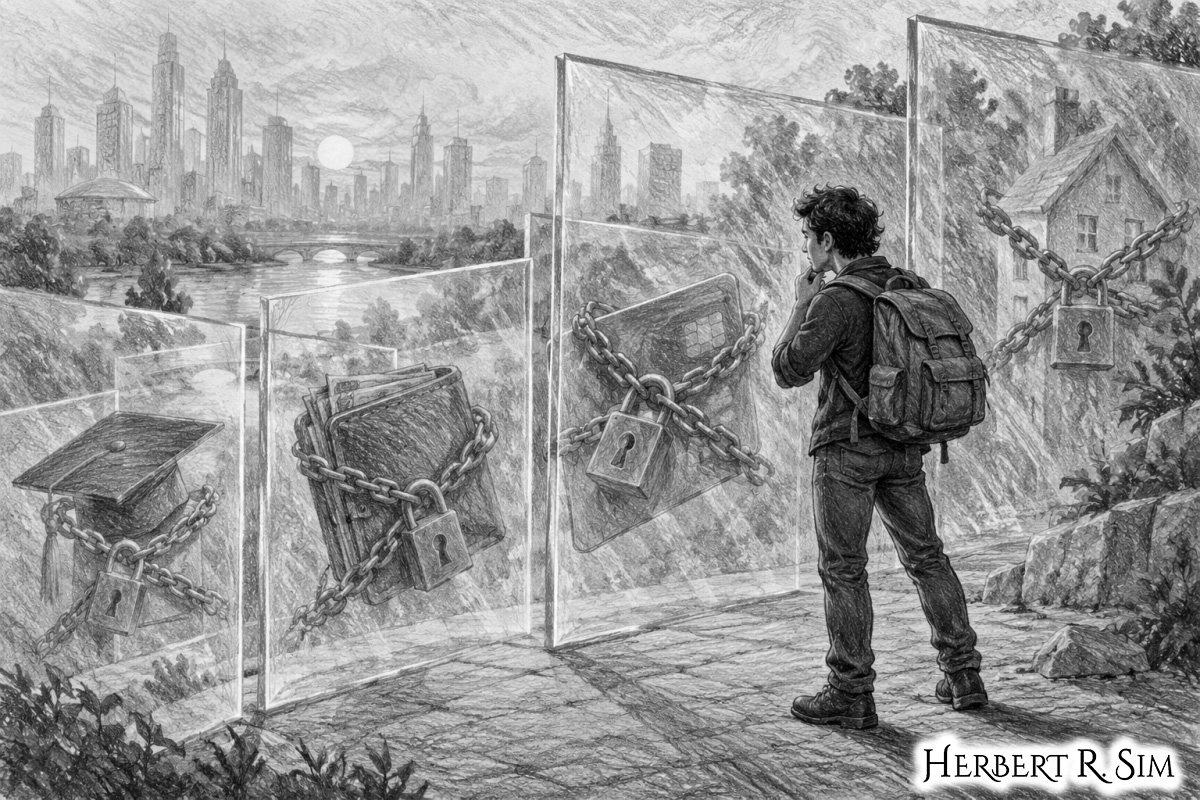
My illustration entitled: “The Invisible Wall” — A person walks freely through a city but is stopped by transparent walls labelled by debt, dependency, and lack of access.
A person may be legally free to act and still lack the practical power to do so. Economic liberty begins where this difference is taken seriously.
Freedom is often discussed as though it were a document. A constitution names rights. A legislature passes protections. A court recognises a claim. These things matter. A society without legal safeguards can quickly become a society in which property, speech, work and conscience depend on the whim of the powerful.
But legal rights are not the whole of liberty. They are only one part of it.
A person may have the legal right to start a business and still be unable to obtain the tools, credit, information or permission needed to do so. A worker may be legally free to leave an employer and yet lack savings, alternatives or bargaining power. A family may be told that it is free to choose its future while every serious choice is narrowed by debt, bureaucracy, monopoly or dependence on institutions beyond its control.
There is a profound difference between being allowed to do something and being able to do it.
This difference is the starting point for economic liberty. Political rights protect the individual against overt coercion. Economic liberty asks a further question: does the individual possess enough real independence to make choices meaningful? Can he own, save, exchange, create, invest, work and plan without every important decision being subject to someone else’s approval?
When the answer is no, legal freedom may remain intact on paper while practical freedom steadily disappears in life.
Permission Is Not Power
Consider the simplest example. A person is legally permitted to open a shop. Yet opening a shop may require licences, permits, inspections, registrations, leases, insurance, capital and access to suppliers. None of these requirements is necessarily unreasonable. A society has legitimate concerns about safety, fraud and public order. But each requirement creates a gate through which the individual must pass.
When the gates are few, clear and fairly administered, they may protect trust without strangling initiative. When they become numerous, costly, uncertain or dependent on personal connections, the legal right to trade becomes a privilege available mainly to those who already possess wealth, influence or specialist knowledge.
The same pattern appears in many areas of life. A person may be free to work, but only in occupations for which expensive credentials are required. He may be free to buy property, but only if access to finance is concentrated in a few institutions. He may be free to save, but find that inflation, fees or financial instability steadily erode what he has set aside. He may be free to speak, but unable to be heard outside channels controlled by larger organisations.
None of this means that every difficulty is oppression. Life involves risk, effort and unequal talent. Economic liberty does not promise that every person will achieve the same result. It means that access to peaceful work, ownership and exchange should not be unnecessarily placed behind systems of permission controlled by others.
Freedom without the means to act is often only a polite name for dependence.
The Hidden Architecture of Dependence
Dependence is not always visible. It can be mistaken for normality because it is built into the ordinary arrangements of society.
A worker who lives from one pay packet to the next may not be formally compelled to remain in an unfair job. Yet the threat of losing income, housing or access to basic necessities can make departure impossible in practice. A small business may not be forbidden from competing with a large corporation, yet the cost of compliance, distribution and advertising can make competition little more than a theoretical possibility. A farmer may own land and still be dependent on suppliers, lenders and buyers whose terms he cannot influence.
Economic dependence grows whenever one institution becomes the unavoidable gatekeeper between a person and the necessities of life. If a person cannot earn, save, buy, sell or move without passing through a narrow set of authorities, then his formal rights are conditional. He is free only so long as permission continues.
This is why concentration of economic power deserves the same scrutiny that concentration of political power receives. A monopoly may not carry a flag or wear a uniform, but it can still exercise decisive control over people’s choices. An institution that controls access to credit, employment, communications or markets can shape human behaviour as surely as a government office can.
Economic liberty does not require hostility to all large institutions. Large organisations can create useful services, jobs and infrastructure. The concern begins when size becomes unaccountable power—when individuals have no meaningful alternative, no negotiating strength and no realistic way to refuse terms imposed upon them.
Property and the Space to Decide
Private property is sometimes described only as a matter of possession: who owns a house, a field, a machine or an account. But property has a deeper significance. It gives a person a protected space in which to make decisions.
A person who owns tools can work without first asking for access. A person who owns savings can survive a period of uncertainty without immediately submitting to the first available demand. A family that owns a home has more security than one permanently exposed to the decisions of a landlord. A small producer with his own equipment has more freedom than one whose livelihood depends entirely on a single employer.
Property does not guarantee wisdom or virtue. It can be abused, hoarded or inherited unfairly. Yet without some secure claim to the fruits of one’s labour, independence becomes difficult to sustain. A society that makes ownership inaccessible to ordinary people is not merely unequal in wealth; it is unequal in the capacity to choose.
This point applies to small ownership as much as great fortunes. Economic liberty is not served only by protecting the wealthiest. It is served when ordinary people can accumulate savings, own productive tools, preserve the value of their labour and pass a measure of security to their children.
The ability to own is closely tied to the ability to say no. Without it, a person must often accept terms he considers unjust because the alternative is immediate hardship. With it, he can negotiate, wait, build, relocate or begin again.
Work Must Be More Than Submission
Work is one of the central facts of adult life. It is how most people support themselves, contribute to others and develop practical skill. Yet work can become a site of profound dependence when individuals are treated merely as inputs in someone else’s system.
Economic liberty does not mean that every person must become an entrepreneur. Many people rightly choose stable employment, collaborative work and professional organisations. The issue is whether that choice remains voluntary.
A healthy economy should make room for different forms of work: employment, independent trade, family enterprise, partnership, cooperative effort and self-employment. The more varied the paths to earning a living, the less any single employer or institution can dictate the conditions of participation.
This is particularly important for people whose skills do not fit neatly into formal categories. A society that demands excessive certification for every kind of work may protect established professions while excluding capable newcomers. A system that punishes small-scale commerce with burdens designed for large corporations can prevent ordinary people from starting modestly and growing gradually.
Work should give people the opportunity to develop competence and responsibility, not simply train them to seek approval from increasingly distant authorities.
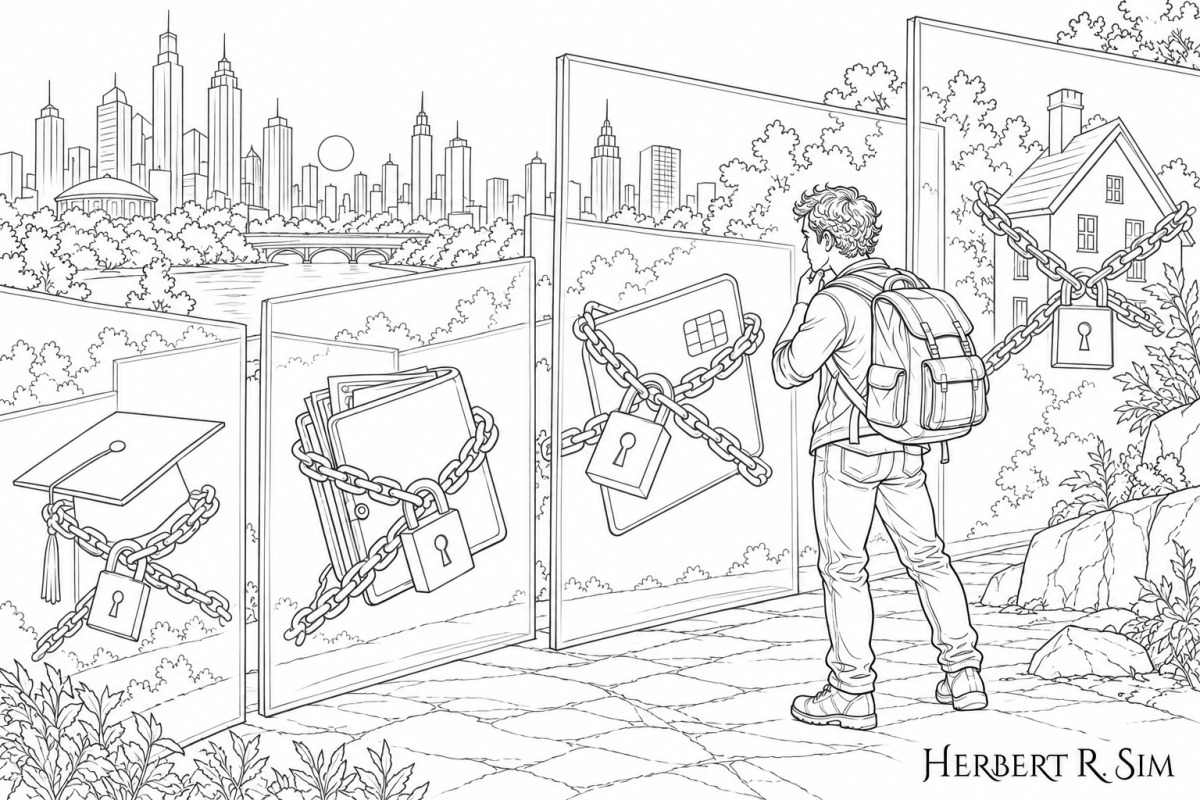
My illustration “The Invisible Wall” work-in-progress. The art represents how debt, dependency, and unequal access can become invisible barriers that deny people real economic freedom.
Money and the Right to Preserve Effort
Money is often treated as a technical matter, best left to governments, banks and specialists. But money is deeply connected to liberty because it allows people to carry the value of their work into the future.
When someone saves, he is not simply storing coins or figures in an account. He is preserving time. He has worked today in the hope that the result will remain available tomorrow—for education, illness, a new venture, family needs or retirement. If that stored value is unreliable, then long-term independence becomes harder to achieve.
Economic liberty therefore requires monetary responsibility. People need confidence that honest work will not be quietly diminished through instability, arbitrary policy or institutional failure. They need access to savings and exchange that is not reserved only for the well-connected. They need financial arrangements that serve the public rather than merely protect the interests of those closest to the source of money and credit.
This does not mean that money should be beyond all public oversight. Fraud, theft and reckless speculation harm real people. It means that monetary power must be treated as a public trust because it affects every person’s ability to plan, save and act independently.
Where money is unstable, the poor suffer first. The wealthy may have assets, advisers and opportunities across many markets. The ordinary worker has wages, modest savings and little margin for error. To protect the value of ordinary effort is therefore not a luxury; it is a basic condition of economic dignity.
The Dignity of Voluntary Exchange
Voluntary exchange is one of the most peaceful ways human beings cooperate. A buyer values a good or service more than the money exchanged for it. A seller values the money more than the good or service provided. When neither party is deceived or coerced, both can benefit.
This simple principle is often overlooked because commerce can seem impersonal. Yet markets allow strangers to cooperate across distance, culture and status. They enable a craftsman to offer skill, a farmer to sell produce, a writer to reach readers and a small business to serve a community.
For this reason, the freedom to exchange should be protected. Excessive restrictions on peaceful trade usually fall hardest on people with the least influence. Large firms can hire lawyers and navigate complex rules. Small traders cannot. The result is often a market that appears regulated in the public interest but is, in practice, insulated from competition by those already inside it.
This is not an argument for removing every rule. Markets require trust, honest weights, enforceable contracts and remedies for fraud. But rules should protect voluntary exchange, not become a substitute for it. They should be understandable to ordinary citizens and proportionate to the real harm they are intended to prevent.
Economic Liberty Is Not the Same as Wealth
It would be a mistake to define economic liberty as wealth alone. A rich person may possess many assets and still be trapped by debt, political favour or dependence on privileged access. A person of modest means may possess meaningful liberty if he has skills, savings, a secure home, strong community ties and the ability to choose among several paths.
Nor does economic liberty mean that society has no duty to those who cannot provide for themselves. Children, the elderly, the sick and people facing sudden hardship should not be abandoned in the name of an abstract freedom. A humane society recognises mutual obligation.
But assistance should strengthen a person’s ability to stand, not turn temporary need into permanent dependence. The best social arrangements provide protection against catastrophe while preserving incentives, responsibility and the possibility of self-direction. They should help people regain their footing rather than make their future conditional on obedience to remote institutions.
The goal is not a society without support. It is a society in which support opens paths to independence.
From Legal Liberty to Practical Liberty
If economic liberty is more than legal permission, what should a free society seek to protect?
- The ability to own the lawful fruits of one’s work and preserve them over time.
- The freedom to start, join or leave peaceful economic activity without unreasonable barriers.
- Open competition that gives individuals real alternatives to dominant employers, lenders and suppliers.
- Clear, limited and accountable rules rather than arbitrary permission.
- Stable conditions for saving, planning and building for the future.
- Access to knowledge, skills and productive tools that allows people to participate meaningfully in economic life.
These principles do not guarantee equal outcomes, nor should they. People differ in ambition, ability, circumstance and willingness to take risks. But they create a fairer starting point: one in which the individual is treated as an active participant in the economy rather than a dependent subject of institutions he cannot influence.
The Real Measure of Freedom
The real measure of liberty is not how many rights a society can list. It is whether ordinary people can use those rights to shape their lives.
Can a worker acquire enough security to refuse exploitation? Can a family save without watching its effort disappear? Can a small business begin without being overwhelmed by rules designed for larger rivals? Can an individual own property, exchange value and pursue a livelihood without permanent dependence on permission?
These are economic questions, but they are also moral questions. They concern dignity, responsibility and the proper relationship between the individual and power.
A society should be judged not only by the freedoms it announces, but by the freedoms it makes practical. Legal rights are indispensable. Yet they are the beginning of economic liberty, not its completion. The person who is merely permitted to act is still waiting for freedom. The person who can truly own, choose, create and walk away has begun to possess it.