
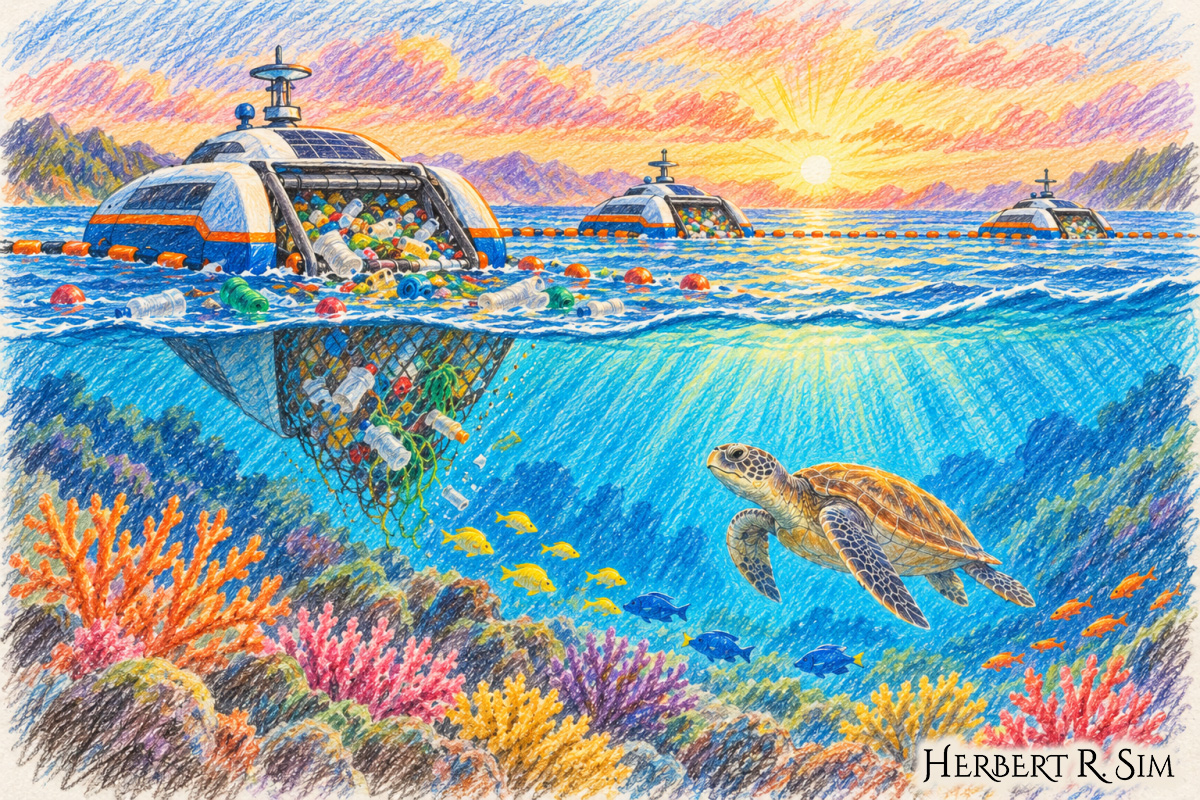
My illustration entitled: “The Healing Ocean” — Autonomous vessels remove plastic from a glowing ocean as coral reefs revive below.
Technogaianism is the belief that technological progress and ecological responsibility need not be enemies. The real question is whether humanity has the wisdom to make its tools restorative rather than merely powerful.
For much of the modern age, the environmental argument has been framed as a conflict between two futures. On one side stands nature: forests, rivers, animals, stable climates and the slow systems that make human life possible. On the other stands technology: factories, engines, extraction, consumption and a civilisation apparently unable to grow without leaving damage behind it.
This framing is understandable. Industrial society has given us extraordinary comforts, longer lives, rapid communication and immense productive power. It has also polluted air and water, reduced wilderness, weakened ecosystems and placed a growing burden on the atmosphere. To look at that record and conclude that technology is inherently hostile to the Earth is tempting.
But it is incomplete.
Technology is not an independent moral force. It does not choose whether to clear a forest, poison a river, waste energy or preserve a habitat. Human beings make those choices through markets, governments, institutions and habits. The machine amplifies intention. A careless civilisation can use advanced tools to cause damage at unprecedented scale. A responsible civilisation can use equally advanced tools to repair damage that previous generations lacked the means even to measure.
This is the promise of Technogaianism: not the naïve belief that every new invention will save us, and not the romantic belief that humanity must reject technology in order to belong to nature. It is the conviction that human intelligence, science and engineering can become active partners in ecological restoration.
The challenge is not simply to invent better machines. It is to redefine progress itself.
The Earth Does Not Need Our Nostalgia
There is a valid longing for a world that seems less artificial: cleaner skies, quieter cities, abundant wildlife, landscapes not cut into fragments by roads and development. Yet nostalgia is a poor environmental strategy. Humanity cannot return to a pre-industrial past. There are billions of people alive today, many still seeking reliable food, shelter, medicine, education and electricity. Asking them to remain poor in the name of ecological purity is neither humane nor realistic.
The answer cannot be a philosophy of deprivation for the poor and indulgence for the wealthy. Nor can it be endless consumption disguised as freedom. The better path is to make prosperity less destructive: to produce more value with less waste, use energy without treating the atmosphere as a dumping ground, build cities that work efficiently, and design products that can be repaired, reused and eventually recovered.
Technogaianism begins with a simple observation: human beings are already changing the planet. The question is not whether we intervene. We intervene when we mine, farm, build, transport, fish, breed animals, drain wetlands and burn fuel. The moral question is whether our intervention is blind and extractive, or informed and restorative.
A forest left intact is not the same as a forest clear-cut and replanted with one commercial species. A river restored after pollution is not identical to a river never polluted. We should not use technological optimism as an excuse for preventable destruction. Prevention remains better than repair. But where damage already exists, refusing the tools of restoration would be as irrational as refusing medicine because illness should never have occurred.
Technology becomes ecological when it is judged not only by what it produces for us, but by what it preserves, renews and returns to the living world.
From Extraction to Restoration
The industrial economy has largely been organised around a one-way model: take resources, manufacture goods, use them briefly, discard the remainder. This model treats the natural world as an inexhaustible source at one end and an invisible sink at the other. It is efficient only when the real costs are ignored.
A Technogaian economy would be designed differently. It would aim to imitate, where possible, the cyclical logic of natural systems. In a healthy ecosystem, waste from one process becomes nourishment for another. Materials circulate. Energy comes primarily from a continuing source: the sun. Diversity makes the whole system more resilient.
Human civilisation cannot copy nature perfectly, nor should we pretend that a city is a forest. But we can learn from the principle. Products should be designed for long service, repair and recovery. Buildings should use less energy and generate some of their own. Industrial processes should minimise toxic by-products. Water should be treated as a resource to be cleaned and reused rather than casually discarded.
This is not merely an ethical preference. It is an engineering challenge. Sensors can identify leaks in water systems. Smarter electricity networks can reduce waste and better accommodate variable renewable energy. Efficient materials can lower energy demand before a new power station is ever needed. Better batteries, improved public transport and decentralised power generation can reduce dependence on the most damaging fuels.
None of these developments is magical. Each has costs, limitations and trade-offs. Solar panels require materials. Wind turbines require land and infrastructure. Batteries depend on mining and manufacturing. Yet the existence of trade-offs is not an argument for paralysis. It is an argument for honest accounting and continual improvement.
Energy: The First Ecological Test
Energy is at the centre of the environmental question because energy powers almost everything else. It lights homes, moves goods, grows food, operates hospitals and connects people across continents. A future without adequate energy is not a green future; it is a future of scarcity and inequality.
The problem is not energy itself. The problem is an energy system that treats pollution as an acceptable side effect of development.
Technogaianism therefore supports a broad search for cleaner, more reliable and more efficient energy. Solar power, wind power, geothermal systems, hydroelectricity, improved storage, conservation, advanced nuclear research and smarter grids should not be treated as rival political tribes. The task is too important for that. Every technology should be assessed according to its real environmental costs, its reliability, its safety, its ability to scale and its effect on human well-being.
Conservation is often the most immediate source of clean energy. A building that needs half as much heating or cooling is effectively drawing less power from every source. Efficient appliances, better insulation, more intelligent transport planning and improved industrial processes may sound less glamorous than a breakthrough reactor, but their cumulative effect can be enormous.
At the same time, efficiency must not become an excuse for complacency. History shows that when technology makes a resource cheaper or easier to use, people often use more of it. This is why ecological progress requires cultural and political responsibility as well as technical invention. A more efficient machine is valuable; a society that understands limits is indispensable.
Biotechnology and the Living World
Biotechnology will be one of the most controversial fields in any Technogaian future. It touches food, health, reproduction and the genetic fabric of life. It therefore deserves caution, public scrutiny and clear ethical boundaries. But controversy should not prevent serious thought about its potential.
Agriculture already transforms nature on a massive scale. The food on our tables is the result of thousands of years of human selection, cultivation and intervention. The question is whether modern biotechnology can help produce food with fewer pesticides, less water, less land and less environmental damage—or whether it will reinforce dependency, monoculture and corporate control.
The answer depends on governance, ownership and design. A crop that resists disease could reduce chemical use. A plant that needs less water could help farmers in drought-prone regions. Biological processes might one day help clean contaminated soils or treat industrial waste. These possibilities should be investigated carefully rather than accepted or rejected on ideological grounds.
Yet we should remain alert to the dangers of narrow thinking. A genetically uniform crop may be productive in the short term and vulnerable in the long term. A technology controlled by a small number of corporations may increase yields while reducing the independence of farmers. A laboratory success may have consequences that become visible only after it enters a complex ecosystem.
Technogaianism is not a license to redesign the living world carelessly. It is a demand that power over life be matched by humility before life.
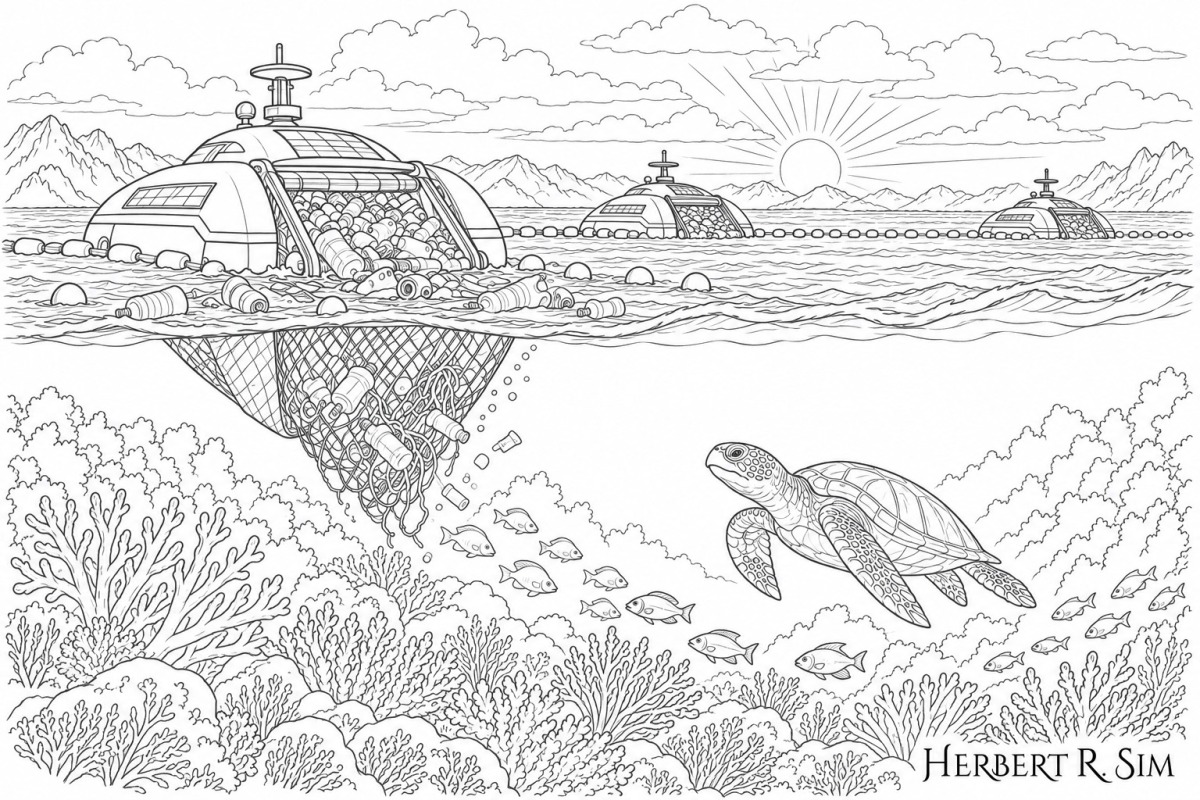
My illustration “The Healing Ocean” work-in-progress. The art represents technology as a tool for ecological repair—showing that innovation can help restore nature when guided by stewardship rather than exploitation.
Information as an Ecological Tool
One of the most promising developments of our age is the growing ability to see environmental systems more clearly. Satellites can observe deforestation, shrinking ice cover and changes in land use. Networks of sensors can monitor air quality, water pollution and energy consumption. Computing can help researchers model weather patterns, track wildlife populations and identify inefficiencies that would otherwise remain invisible.
Information does not restore a forest by itself. A graph does not clean a river. But what cannot be seen is easily ignored, and what can be measured can at least enter public debate.
This creates an important democratic opportunity. Environmental knowledge should not be locked behind government agencies or corporate databases. Communities affected by pollution should have access to credible information about their air, water and land. Citizens should be able to examine the claims made by industries and public authorities. Transparency does not solve every dispute, but secrecy almost always makes responsible decision-making harder.
There is also a danger here. A world of ubiquitous sensors can become a world of ubiquitous surveillance. The environmental value of information must not become an excuse to erase privacy or place every individual under permanent observation. Technogaianism should seek intelligent systems that help protect common resources while respecting the dignity and freedom of the people who live among them.
Why Technology Alone Will Not Save Us
The weakness of crude technological optimism is its assumption that invention automatically creates wisdom. It does not. The same engineering skill that can build a cleaner factory can build a more efficient system of extraction. The same information network that can expose illegal logging can be used to manipulate consumers into buying more disposable goods.
Technology changes what is possible. It does not decide what is desirable.
That decision belongs to human beings. It belongs to citizens who demand accountability, to scientists who communicate uncertainty honestly, to entrepreneurs who accept responsibility for long-term effects, and to governments willing to protect shared resources from short-term exploitation. It also belongs to individuals, because daily choices about consumption, transport, food and waste are multiplied across society.
Environmental responsibility should not become an excuse for authoritarian control. A healthy ecological future cannot be built by treating people as obstacles to be managed. It must give people practical alternatives: affordable clean energy, efficient transport, durable products, accessible information and a real voice in decisions affecting their communities.
Freedom matters because sustainable societies require participation. People protect what they understand, what they help shape and what they believe they have a stake in preserving.
The Technogaian Standard
Technogaianism should ask more of technology than novelty, profit or raw efficiency. A useful invention should be examined through a wider set of questions:
- Does it reduce ecological damage over its full life cycle, rather than shifting harm elsewhere?
- Does it help restore natural systems, or only make extraction more efficient?
- Who controls it, and who bears its risks?
- Does it strengthen the independence of communities, or create new forms of dependency?
- Can its benefits be shared broadly, rather than reserved for those already privileged?
- Does it leave future generations with greater capacity and a healthier world?
These questions do not lead to simple answers. But they make the right kind of complexity visible. A technology is not truly progressive merely because it is advanced. It is progressive when it expands human possibility without narrowing the future of the Earth itself.
This is where Technogaianism differs from both anti-technology environmentalism and careless industrial optimism. It refuses the idea that humanity must choose between intelligence and nature. It argues that intelligence becomes mature only when it understands its dependence on the systems that sustain life.
A Civilization Worth Advancing
The deepest environmental question is not whether human beings are natural. We are. Our cities, machines, languages and sciences are expressions of a species capable of reflection and choice. The question is whether we will use that capacity to become a force of permanent degradation or a force of repair.
Advanced technology could deepen our distance from nature if it encourages us to believe that everything living is replaceable. But it could also bring us closer to an intelligent appreciation of interdependence. The more we learn about ecosystems, climate, genetics and the delicate cycles of life, the harder it becomes to claim that humanity stands outside the world it alters.
Technogaianism is therefore not a promise that technology will save the planet for us. It is a challenge to use our tools as if the planet matters. It asks engineers to think beyond the next product cycle, politicians beyond the next election, businesses beyond the next quarter and citizens beyond the next convenience.
The future should not be measured by the number of machines we possess. It should be measured by whether our knowledge has made the world more livable, more abundant and more secure for both humanity and the countless other forms of life with which we share it.
That is the Technogaian ambition: not to conquer the Earth, and not to retreat from it, but to become capable of restoring what power without wisdom has damaged.