

My illustration entitled: “The Data Harvest” – Citizens’ ideas and digital traces flow into a giant central processor controlled by distant owners.
Artificial intelligence is becoming a form of productive capital.
Like machinery, energy, software and specialised knowledge, AI can increase the output of human effort. It can analyse information, assist decision-making, automate tasks, generate content and enable individuals or organisations to create value at a speed that was previously unavailable.
But this development raises a fundamental economic question: who owns productive intelligence, and who captures the value it creates?
If AI becomes controlled only by a small number of governments, corporations and platforms, it may widen the gap between those who own the productive tools of the future and those who must depend on them. If individuals can access, understand, direct and benefit from AI, it can become a powerful instrument of human capability.
The future of AI is therefore not only a technological question. It is a question of ownership, economic power and individual sovereignty.
Productive Intelligence Is Capital
Capital is anything that increases the capacity to create future value.
Traditionally, this has included land, machinery, financial savings, tools and infrastructure. In the digital economy, knowledge, networks, data and software have also become important forms of capital. Artificial intelligence adds a new dimension: productive intelligence that can be applied repeatedly across many forms of work.
An AI system can assist a small enterprise with research, communication, design, analysis and administration. It can help an individual learn a new skill, solve a technical problem or compete more effectively with larger organisations. Used responsibly, it can lower the cost of creating and distributing value.
This makes AI a potentially powerful force for economic decentralisation.
But potential is not the same as outcome. The economic effect of AI will depend on whether productive intelligence remains widely accessible and whether individuals can retain meaningful control over the value created through its use.
Ownership Determines Who Benefits
Every major technological change creates new forms of ownership.
Those who own the infrastructure, data, models, distribution channels and commercial platforms can determine who has access, under what conditions and at what cost. They may capture most of the value even when the underlying technology depends on the labour, creativity and information of millions of people.
This is the central ownership question of artificial intelligence.
Will AI be structured only as a service rented from powerful institutions? Will individuals become dependent users of systems whose rules can be changed remotely? Or will people possess the practical capacity to choose tools, develop skills, protect their data and retain a share of the value their work creates?
Economic freedom requires more than access to AI. It requires the ability to make informed choices about how AI is used, what information is contributed, who controls the outputs and whether alternatives remain available.
Access Without Control Creates Dependency
Access can be useful, but access is not ownership.
A person may use an AI system every day while having little control over its rules, its data practices, its availability or the future cost of participation. A business may build essential workflows around a platform only to discover that its ability to operate depends on terms it cannot negotiate.
This is a familiar pattern in the digital economy. Individuals and smaller enterprises receive powerful tools, but the tools are controlled by institutions that may also control the channels through which value, customers, information and reputation move.
The result can be a new form of dependence: people become more productive while becoming less independent.
Sovereign Capability Economics rejects this false choice. Productivity should not require permanent surrender of ownership, privacy or the right to exit. The purpose of technology should be to expand an individual’s capacity to act—not to make that capacity conditional upon a single provider’s approval.
Human Capability Must Remain Central
Artificial intelligence should strengthen human capability, not replace human agency.
AI can assist people in learning, creating and making decisions. But the individual must remain responsible for the goals, judgments and consequences involved. Productive intelligence should be understood as an extension of human capability, not as a reason to reduce people to passive recipients of machine-generated outcomes.
This distinction is essential.
A society that uses AI to educate, empower and expand opportunity can increase the number of people capable of creating value independently. A society that uses AI only to concentrate knowledge, automate dependency and narrow access to work risks producing greater inequality of power.
The value of AI should therefore be measured not only by efficiency. It should also be measured by whether it improves the individual’s practical capacity to learn, own, build and choose.
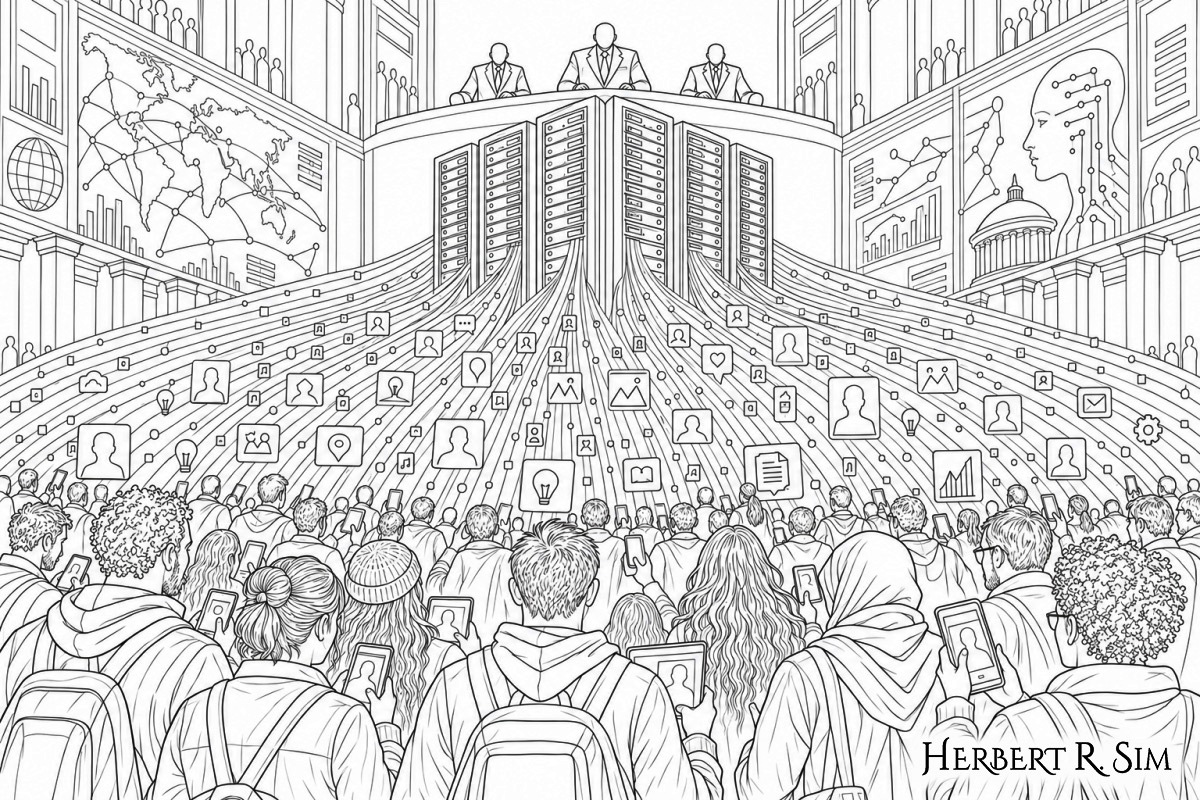
My illustration “The Data Harvest” work-in-progress. The art represents how citizens’ ideas, identities, and digital lives can be extracted into concentrated AI power controlled by a distant few.
Data Is Part of the Economic Relationship
Artificial intelligence depends on information.
Data can improve systems, train models and create commercial value. Yet much of this data originates from individuals, communities, workers and creators who may not understand how their information is being used or who ultimately benefits from it.
This raises a basic question of fairness: when an individual’s work, knowledge, behaviour or creative output contributes to productive intelligence, should that individual have meaningful transparency, choice and protection?
The answer should not be that every piece of information is treated as private property in the same way. Data is complex, and the public interest may sometimes require responsible sharing and research. But individuals should not be treated merely as raw material for systems they cannot understand, influence or leave.
Economic sovereignty requires a clearer relationship between the people who generate value and the institutions that capture it.
Open Alternatives Protect Innovation
The development of AI should not be restricted to a small number of closed systems.
Open research, interoperable tools, independent development and competition can help prevent productive intelligence from becoming permanently concentrated. They allow smaller enterprises, researchers and individuals to contribute new ideas and build alternatives to dominant models.
This does not mean that every AI system must be public or unrestricted. Some technologies require safeguards, responsible deployment and careful assessment of risk. But safety must not become an excuse for permanent institutional monopoly.
The right to build remains essential. Individuals should be able to develop lawful, beneficial and accountable AI tools without being excluded simply because they lack the scale, political access or capital of established technology powers.
Bitcoin and AI: Two Questions of Ownership
Bitcoin and artificial intelligence appear to address different problems, but they raise a similar economic question: who controls the productive infrastructure of the future?
Bitcoin creates a monetary network where individuals can hold and transfer value through cryptographic keys rather than relying exclusively on a central issuer. AI creates new forms of productive capacity that may assist people in creating and organising value.
Both technologies can either decentralise capability or reinforce dependency, depending on how they are designed and governed.
Bitcoin demonstrates the importance of direct ownership, open participation and the right to exit. These same principles should guide the development of AI. Individuals should retain meaningful choices over the tools they use, the data they contribute and the economic value they create.
The Right to Exit From Productive Dependence
The right to exit is one of the strongest protections against concentrated power.
If an individual or business becomes dependent on a single AI provider for essential work, they should retain the ability to move, adapt or choose another path. If all productive intelligence is controlled through a handful of institutions, then access to opportunity may become conditional upon compliance with those institutions’ terms.
Competition, interoperability and alternative tools reduce this risk. They make it possible for people to choose services based on value rather than accept them because departure is too costly.
A future in which AI is widely available but impossible to leave is not a fully free future. Economic agency requires more than powerful tools. It requires meaningful control over the conditions under which those tools are used.
Artificial Intelligence Must Serve Economic Sovereignty
The purpose of technology should be to expand human capability.
Artificial intelligence can help individuals learn faster, create more effectively, solve complex problems and participate in new forms of economic life. It can become productive capital available to many rather than privilege reserved for a few.
But this outcome is not guaranteed. It depends on whether ownership remains distributed, whether data practices remain accountable, whether alternatives can be built and whether individuals retain the right to exit systems that no longer serve them.
Sovereign Capability Economics provides a standard for evaluating this future: does artificial intelligence increase the individual’s practical capacity to create value, retain ownership, develop knowledge and choose an independent path?
Artificial intelligence is becoming capital. The economic question is whether it will become capital for the many—or power over the many.