

My illustration entitled: “The Unlocked Ledger” – A towering ledger-book opens into a landscape of workshops, farms, trade routes and independent digital networks. Broken chains fall away from its pages, while private agreements replace imposed dependency.
A person cannot be considered economically free if every important decision depends on permission from a system they cannot leave.
The freedom to work, save, trade, own property and build an enterprise has little practical value when an individual is locked into a single authority, provider or institutional arrangement. A choice is not fully meaningful if refusing it means exclusion from ordinary economic life.
This is the economic right to exit: the practical ability to leave an unfair arrangement, choose an alternative, preserve ownership and continue participating in economic life without surrendering one’s independence.
Political Economics examines how money, regulation and institutions shape individual liberty. The right to exit is one of its central tests. It reveals whether an economic system serves the individual—or whether the individual has become dependent on the system.
Choice Requires an Alternative
Choice is often presented as a simple matter of preference. A person chooses one product over another, one employer over another or one financial service over another. But genuine choice requires more than a selection between options presented by the same concentrated structure.
It requires the ability to reject a harmful arrangement without losing the means to live, work, exchange or preserve value.
When individuals can move freely between providers, enterprises and methods of exchange, institutions must compete for trust. They must offer better service, clearer terms and stronger protection for those who depend on them. When individuals cannot leave, that discipline disappears.
A monopoly does not always announce itself through a single company. It can exist wherever one system becomes so essential that refusal is no longer realistic. It can exist where the same rules, intermediaries or authorities determine access to every meaningful path.
The economic right to exit protects against this condition. It keeps power contestable.
Ownership Makes Exit Possible
The ability to exit depends upon ownership.
A person who owns nothing directly may be permitted to use many services, yet remain dependent on the terms set by others. Their savings may exist only as entries in another institution’s records. Their access to trade may depend upon an intermediary. Their livelihood may be tied to a system whose rules they cannot influence and whose decisions they cannot challenge.
Ownership provides a measure of independence. It gives individuals something they can preserve, transfer, improve or use as the basis for a new beginning. It allows them to make decisions beyond immediate dependence on wages, gatekeepers or changing permissions.
This does not mean that every individual must avoid all institutions or conduct every activity alone. Institutions can offer convenience, expertise and useful protection. The essential question is whether individuals retain meaningful control over what is theirs—and whether they have alternatives when trust is lost.
Where ownership is weak, exit becomes difficult. Where ownership is secure, choice becomes more real.
Institutional Power Must Remain Accountable
Institutions are necessary parts of modern economic life. Governments establish laws. Courts enforce contracts. Banks facilitate payments. Companies organise production. Markets connect buyers and sellers.
Their existence is not the problem. The problem begins when institutions become so powerful that people cannot question, refuse or leave them without disproportionate harm.
An institution should be judged not only by its intentions, but by the power it exercises over those affected by its decisions. Can it change the terms of participation without consent? Can it transfer risk to ordinary people while preserving advantage for itself? Can it prevent competition through rules that only the already powerful can meet? Can it withdraw access without offering a meaningful process of appeal or alternative?
The greater the power of an institution, the greater its responsibility to remain transparent, accountable and open to competition.
The right to exit is one of the strongest forms of accountability because it does not depend solely on promises. It gives individuals the ability to act when confidence has been broken.
Economic Dependency Is a Form of Vulnerability
Dependence becomes dangerous when it is absolute.
A person who relies on one employer, one financial channel, one source of credit or one approved method of exchange may become vulnerable to decisions made far beyond their control. A change in policy, a withdrawal of service or an institutional failure can place their security at risk.
This vulnerability is not distributed equally. Those with capital, connections and multiple options can often adapt. Those with limited savings, fewer opportunities or no alternative channels bear the consequences most severely.
Economic freedom should therefore be measured not only by whether people are included in a system, but by whether they possess the capacity to survive and adapt outside a single system.
A resilient economy is one in which people can build alternatives, transfer skills, preserve value, form voluntary associations and create new paths when old ones fail.
The Freedom to Build
The right to exit must be accompanied by the freedom to build.
Leaving an unfair arrangement has limited value if every possible alternative is prevented from emerging. A free economy must allow individuals to create enterprises, form networks, exchange knowledge and develop new methods of cooperation.
Innovation does not emerge only from established institutions. It often begins with individuals who see that an existing system has failed to meet a need. They create a better service, a more efficient tool or a more trustworthy way for people to exchange value.
This process should not be treated as a threat merely because it challenges established power. Competition is one of the means through which institutions remain responsive. It gives people more than the right to complain; it gives them the capacity to choose differently.
A society that protects the freedom to build is better able to renew itself. A society that protects only established systems risks turning economic life into a closed structure in which participation depends on approval from those already in control.
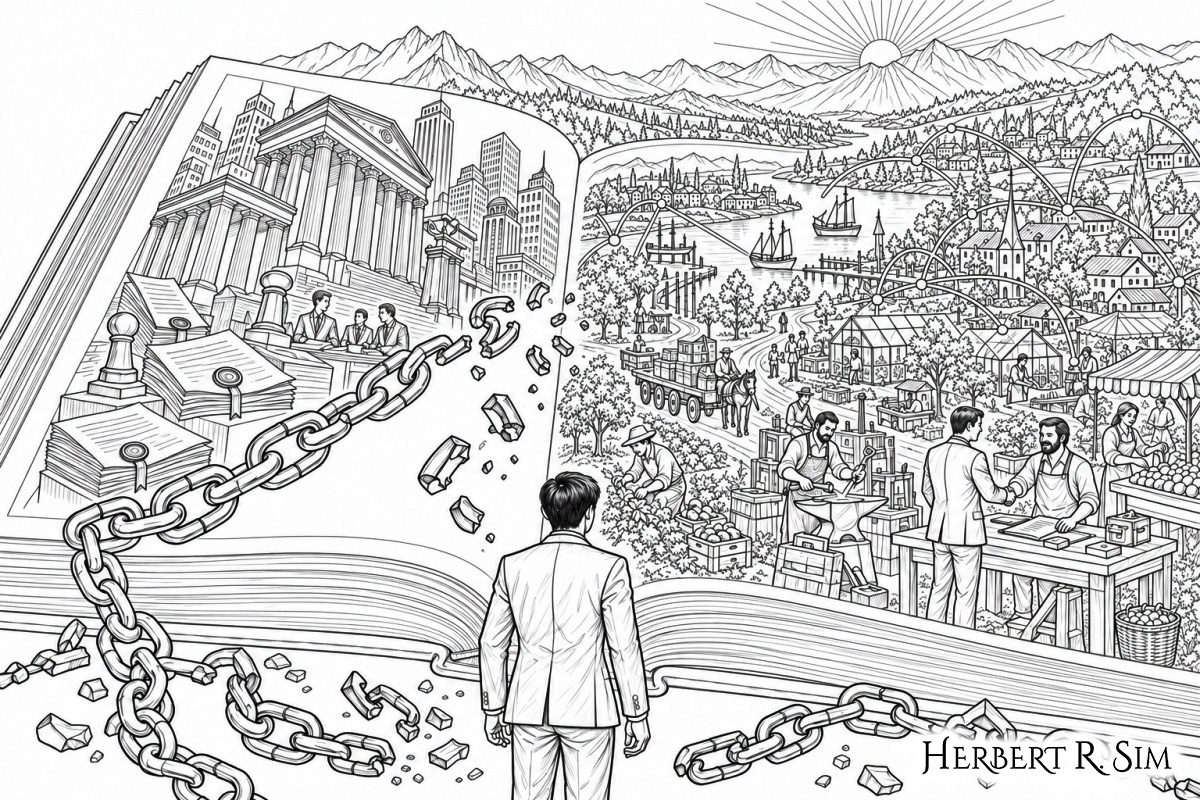
My illustration “The Unlocked Ledger” – work-in-progress. The art symbolises economic liberation: transparent private agreements and productive enterprise breaking free from institutional dependency and imposed control.
Regulation Should Not Make Exit Impossible
Rules are necessary to protect property, prevent fraud and uphold responsibility. But rules must be judged by their effect on the individual’s ability to participate and compete.
When regulation becomes overly complex, expensive or selectively applied, it can prevent individuals and small enterprises from building alternatives. Large institutions may absorb compliance costs through scale, legal teams and political access. New entrants may be excluded before they have an opportunity to prove their value.
In this way, regulation can unintentionally transform protection into dependency. It can preserve a system not because it is better, but because leaving it has been made too difficult.
The role of regulation should be to restrain harm without preventing peaceful innovation. It should protect voluntary exchange, not reserve economic participation for those already close to power.
The Right to Exit Is the Right to Refuse
The ability to refuse is one of the clearest expressions of liberty.
An individual who can say no to an unfair contract, an unreliable intermediary, an exploitative employer or an unaccountable institution possesses a measure of economic dignity. An individual who cannot say no must accept conditions imposed by others, regardless of whether those conditions are reasonable.
The right to exit does not mean rejecting cooperation. It means ensuring that cooperation remains voluntary. It does not mean freedom from obligations. It means that obligations arise through agreement rather than permanent dependence. It does not mean that every system must be abandoned. It means that no system should become so dominant that the individual has nowhere else to go.
The Foundation of Economic Liberty
Economic liberty is sustained when individuals can own value, make choices, create alternatives and leave arrangements that no longer serve them.
The right to exit protects ownership from becoming merely conditional. It protects choice from becoming merely symbolic. It protects institutions from becoming unaccountable. Above all, it protects the individual from being reduced to a dependent participant in systems they cannot question or escape.
Political Economics is concerned with the relationship between money and power. The economic right to exit provides its practical standard: where individuals can retain ownership, build alternatives and refuse unjust conditions, economic freedom remains alive.
Choice without exit is dependence. Ownership without control is conditional. Economic liberty begins when the individual retains the right to refuse and the capacity to build another path.