
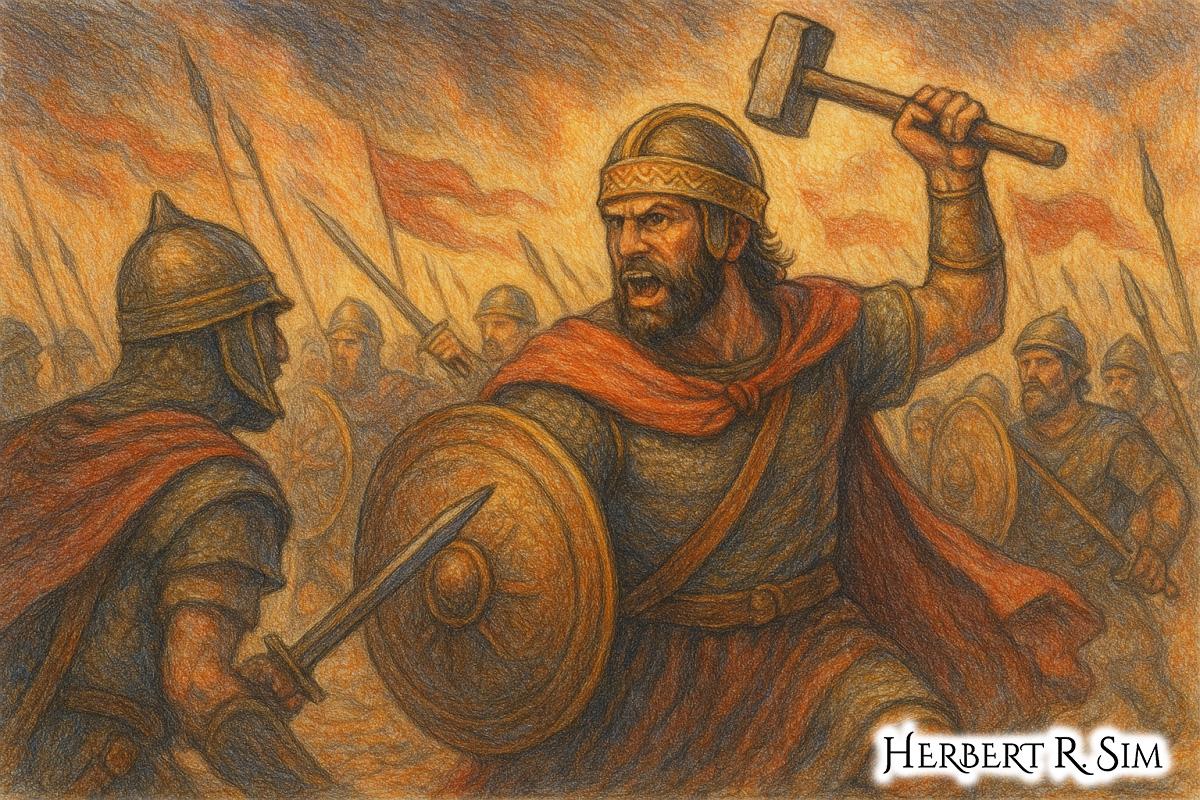
In my illustration above, I feature Judas Maccabeus in Battle.
The Books of Maccabees sit at a fascinating crossroads of history, politics, and theology. They preserve the memory of a Jewish revolt in the second century BCE, but they also shaped how later Jews and Christians imagined religious freedom, martyrdom, resurrection, and even the meaning of Hanukkah itself.
Although they never became part of the Jewish biblical canon, the Maccabean books became Scripture in Catholic and Orthodox Bibles and a key part of the Apocrypha for many Protestants. Together they offer not one single story, but several overlapping narratives about identity, empire, and faith under pressure.
Historical background: from Hellenization to revolt
In the second century BCE, Judea was part of the Seleucid Empire under Antiochus IV Epiphanes, whose efforts to Hellenize the region included interference in the Temple and traditional Jewish practices. Popular summaries of Hanukkah in mainstream outlets still frame the holiday as celebrating the Maccabees’ victory over the Syrians and the rededication of the Temple in Jerusalem.
The First Book of Maccabees opens on this tense political stage: foreign rule, internal Jewish divisions over Hellenization, and a royal program that culminates in banning key Jewish practices and defiling the Temple. Modern overviews, such as the introduction on the U.S. Conference of Catholic Bishops website, highlight how 1 Maccabees narrates events from roughly 175–134 BCE, from Antiochus’s rise to the death of Simon, the last of the Maccabee brothers to rule.
Antiochus’s decrees and the Temple’s desecration sparked a rural revolt led by a priestly family from Modiʿin — Mattathias and his sons, especially Judas “Maccabeus”, whose nickname is often explained as “the Hammer.” That family and its descendants are usually called the Hasmoneans in modern scholarship.
Contemporary religious journalism frequently presents the revolt as an early fight for religious liberty. A 1995 Time report on a purported “Maccabees’ burial cave”, for example, underscores how the revolt became a symbol of resistance against religious oppression that is still commemorated at Hanukkah.
1 Maccabees: political history and covenant
1 Maccabees reads like a straightforward political chronicle in Hebrew style, though the surviving text is in Greek. It recounts the uprising, guerrilla warfare, and eventual re-dedication of the Temple, while emphasizing themes of covenant loyalty and national independence. Catholic and evangelical summaries often stress how “God’s watchful care” is implied rather than made explicit in the narrative: victory comes when Israel is faithful to the covenant, and disaster follows compromise.
The book is surprisingly frank about politics: it describes alliances with foreign powers, the consolidation of Hasmonean rule, and the way a priestly family becomes a royal one. An LA Times review of The Illustrated History of the Jewish People, drawing heavily on 2 Maccabees and related sources, notes that modern historians sometimes see the revolt as a holy war waged by zealots against Jews who had embraced Hellenistic culture — an angle that destabilizes the simple “good rebels vs. wicked Greeks” version many people grew up with.
At the same time, 1 Maccabees has been read as a freedom narrative. Mid-20th-century Time pieces could speak admiringly of “modern Maccabees” in the context of Jews defending themselves and building a modern state, using the revolt as a symbol of collective resilience in a hostile world.
2 Maccabees: martyrdom, resurrection, and prayer for the dead
2 Maccabees is not a sequel but a retelling of a portion of the story in a very different key. It is an epitome of a larger work by Jason of Cyrene and covers a shorter time span than 1 Maccabees, but with an intense focus on Jerusalem, the Temple, and God’s direct intervention in history.
Popular articles in major newspapers sometimes single out 2 Maccabees for its vivid martyrdom stories. A 1996 Los Angeles Times piece on “the heroines of Hanukkah”, for example, retells the account of a mother who watches seven sons die rather than violate dietary law — an episode that became iconic in Jewish and Christian imagination.
Another LA Times article on purgatory notes that the most hotly debated biblical text on prayers for the dead comes from 2 Maccabees, in which Judas Maccabeus offers sacrifices for fallen soldiers to free them from sin after death. Catholic and Orthodox writers later drew on these passages to support prayers for the dead and, in the Latin West, the doctrine of purgatory, while many Protestants rejected them precisely because they appear only in the deuterocanonical/apocryphal books.
While 1 Maccabees emphasizes political struggle and covenant obedience, 2 Maccabees leans into theological themes: bodily resurrection, divine justice, and the conviction that martyrdom has redemptive value. Those emphases helped make the book influential in early Christian thought about saints and the afterlife.
3 and 4 Maccabees (and beyond)
Lesser-known but still important are 3 Maccabees and 4 Maccabees, included in the biblical canons of some Eastern churches and preserved in Greek.
- 3 Maccabees is not about the Maccabean revolt at all. Instead, it tells of a persecution of Alexandrian Jews under a Ptolemaic king in Egypt, using the language of miraculous deliverance and covenant fidelity that readers associate with Hanukkah.
- 4 Maccabees is a philosophical homily using martyr stories (including those from 2 Maccabees) to argue that reason, guided by Torah, can master passion. It circulated widely among Greek-speaking Jews and Christians as a kind of textbook on Stoic-flavored Jewish piety.
Some later compilations even speak of a “5 Maccabees,” but this is a much later summary, not part of any major canon.
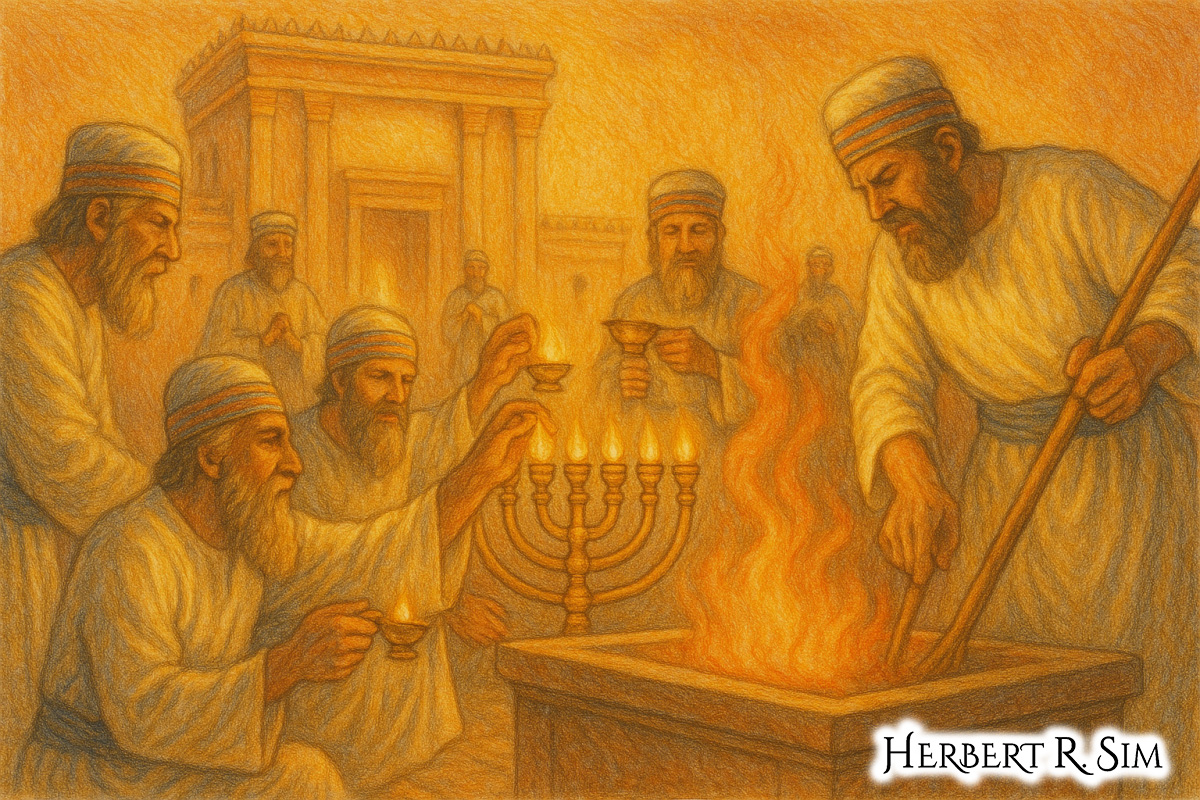
I did a second illustration above, featuring the ‘rededication of the Temple’.
Why Jews don’t read Maccabees as Scripture
One of the most intriguing questions is why the books that tell the Hanukkah story are not part of the Hebrew Bible. Modern journalists and columnists have highlighted a traditional rabbinic unease with glorifying holy war.
A 1995 LA Times feature about Hanukkah’s evolution in America notes that rabbinic Judaism chose to emphasize the miracle of the oil and the rededication of the Temple rather than the insurgent violence of the Maccabees. A letter to The Nation in 2005 makes the same point bluntly, arguing that the sages “omitted the Book of Maccabees from the Jewish Bible, preferring not to glorify the war and fundamentalism at its heart.”
Christian journalists have long echoed this explanation. Christian Science Monitor pieces from the 1980s and 1990s repeatedly describe Hanukkah as commemorating the Maccabees’ victory while also noting that the original narratives survive not in the Hebrew Bible but in the Apocrypha used by some Christian traditions.
In Christian circles, debates over the canon often turn on Maccabees. Articles in Ministry (a Seventh-day Adventist magazine) and Catholic periodicals highlight how 1 and 2 Maccabees were included in the Greek Septuagint and accepted in the Catholic and Orthodox Old Testaments, but questioned or rejected during the Protestant Reformation.
Hanukkah, popular culture, and the Maccabean legacy
For many people today, the Books of Maccabees are encountered not in a Bible, but through Hanukkah. Popular media accounts often retell a simplified story: a small band of pious Jews defeats a larger imperial army, rededicates the Temple, and celebrates a miracle of oil that lasts eight days.
American outlets in particular have tracked how Hanukkah became an “American success story,” transformed from a relatively minor festival into a major cultural event alongside Christmas. A 1995 Los Angeles Times article traces this shift and notes that the modern holiday emphasizes lights, gifts, and family more than the harsher aspects of the ancient revolt.
Writers and commentators sometimes pull the Maccabees into contemporary politics. The Atlantic’s Jeffrey Goldberg imagined that if the Maccabees were alive today they might identify with West Bank settlers, using the language of ancient zealots to frame modern territorial debates. Another Atlantic piece from 2009 spins a quirky story about Senator Orrin Hatch writing a Hanukkah song, yet still grounds the holiday in the memory of the Maccabean revolt.
Even style guides and religion handbooks aimed at journalists reflect how normalized the Maccabean story has become: a 2010 entry in the Religion Stylebook explains Hanukkah by summarizing the Maccabees’ second-century BCE victory and the restoration of Jewish political and religious life.
Theology, memory, and modern imagination
Because they sit “between” the Testaments, the Maccabean books have played outsized roles in later theology.
- For Jews, they are the primary historical source for Hanukkah, yet the canonical liturgy shifts attention from armed revolt to divine miracles and dedication of the Temple. That tension — between militant zeal and spiritual renewal — still surfaces in essays that question whether Hanukkah should be read as a celebration of violence or of faithfulness under pressure.
- For Catholics and Orthodox, 2 Maccabees became foundational for the practice of praying for the dead and for doctrines of post-mortem purification, as journalists covering debates over purgatory frequently note.
- For many Protestants, the books became a kind of testing ground for arguments about canon and tradition: accepted as valuable history and moral instruction, but not as Scripture.
At the same time, modern writers and commentators have mined the Maccabees as symbols: icons of Jewish resistance, metaphors for minority resilience, and, sometimes, warnings about religious extremism. From Time’s mid-1960s reflections on a “tough state of modern Maccabees” to more recent debates about how to remember Hanukkah, the name still carries a powerful charge.
Conclusion
The Books of Maccabees are more than background reading for a winter holiday. They are sophisticated literary and theological works that wrestle with perennial questions:
- How should a minority people live under empire?
- When, if ever, is violent resistance justified by faith?
- How do communities remember their heroes without sanctifying their excesses?
- What hope is there for justice beyond death?
Different communities have answered these questions in different ways — sometimes by canonizing the books, sometimes by sidelining them liturgically, and often by retelling their stories in new forms. But whether in biblical studies classrooms, church discussions of purgatory, or op-eds about Hanukkah and modern politics, the Maccabees remain very much alive in our cultural and religious imagination.