
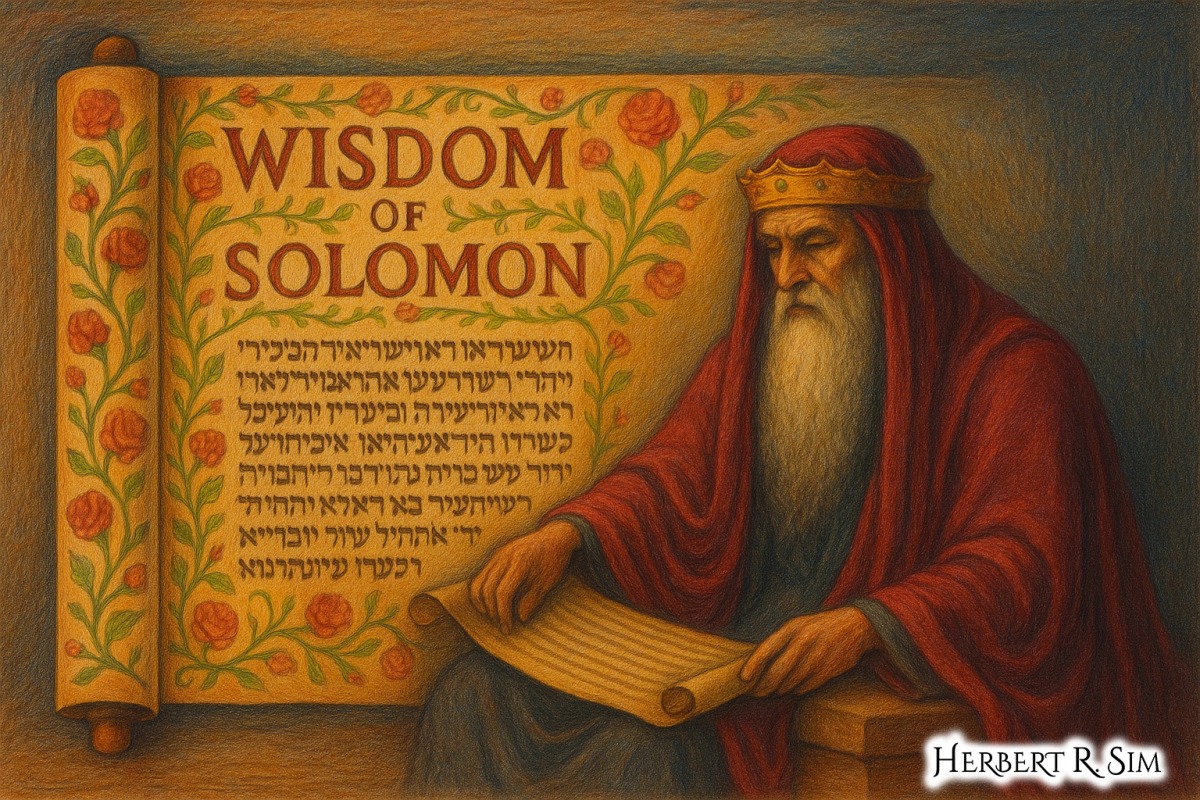
In my illustration above, I depict my own rendition of how I think the Book of Wisdom (Wisdom of Solomon) is like, NOT the actual scroll itself.
The Wisdom of Solomon — often called the Book of Wisdom — sits in a distinctive place in the Western scriptural landscape: deeply Jewish in theological vision, thoroughly Greek in literary and philosophical style, and historically influential for Christian moral and devotional language. It is “Solomonic” not because it was written by Israel’s famed king, but because it speaks in a Solomonic voice, adopting the persona of the archetypal wise ruler to argue that true wisdom is inseparable from justice, humility, and fidelity to God.
Where the book belongs — and why that matters
One reason ‘Wisdom of Solomon‘, remains unfamiliar to some readers is its canonical status. It is part of the Catholic and Eastern Orthodox Old Testament canons (typically grouped among the deuterocanonical books) and appears in many editions of the Bible that include the Apocrypha, but it is absent from most Protestant Old Testaments. That boundary line has never been purely academic.
The book’s themes — especially its language about the soul, immortality, and divine justice — have functioned as touchpoints in broader Christian conversations about life after death and moral formation. In a well-known public example, a TIME interview discussing Christian hope for the afterlife explicitly reaches for book of Wisdom’s line that “the souls of the righteous are in the hand of God,” illustrating how the book continues to surface as a resource for modern theological argument even outside formal liturgy.
A work of Hellenistic Judaism
Most scholars place the ‘book of Wisdom‘ in the Hellenistic Jewish world, commonly associated with the Greek-speaking Jewish communities of the Mediterranean. The Greek language is not incidental; it shapes the book’s rhetoric and conceptual toolkit. Book of Wisdom uses polished Greek prose and draws on forms of moral exhortation that would have been intelligible in cosmopolitan cities, while insisting that Israel’s God — rather than any empire’s pantheon — anchors the moral order of the universe.
This is part of what makes the book of Wisdom an ideal “bridge text.” It translates biblical convictions into a register legible to a world shaped by Greek learning and public persuasion. The effect is not to dilute Jewish monotheism, but to present it as intellectually serious and morally coherent in a pluralistic environment.
The book’s structure in brief
Book of Wisdom reads as a unified argument delivered in several movements:
- A summons to rulers and elites: The book opens by addressing “kings” and judges — those with power — warning that authority does not exempt anyone from moral accountability.
- A meditation on the fate of the righteous and the wicked: It contrasts the apparent success of the wicked with the ultimate vindication of the righteous.
- A hymn to Wisdom as divine gift: Wisdom is presented not merely as skill or cleverness, but as participation in God’s own ordering of reality.
- A theological reading of history: The book interprets Israel’s story as evidence that idolatry corrodes societies and that God’s justice unfolds across time.
That architecture — power, ethics, wisdom, history — lets the book address both personal character and public governance. It is no accident that journalists routinely invoke “the wisdom of Solomon” when describing leaders who must adjudicate between competing claims, whether in court decisions, political disputes, or social dilemmas.
“The souls of the righteous…”: Book of Wisdom’s moral psychology
Perhaps the most enduring public-facing contribution of book of Wisdom is its moral psychology: the claim that righteousness can look like failure in the short run while still being the truest form of life. That premise underlies the book’s insistence that suffering does not necessarily imply divine abandonment and that moral integrity can be invisible to the world’s scorekeeping.
This is why the book resonates in modern discussions of death and hope. In the TIME exchange about heaven and Christian expectation, the appeal to book of Wisdom is telling: it supplies language that is both emotionally direct and doctrinally weighty — poetic without being vague.
My illustration work-in-progress above.
Book of Wisdom as a person — not an abstraction
Another hallmark is the book’s portrayal of book of Wisdom as something like a living presence: radiant, morally clarifying, and oriented toward justice. This is not simply “being smart.” Wisdom is presented as that which enables sound judgment, restrains tyranny, and aligns human action with divine purpose.
This distinction — wisdom as moral orientation rather than raw intelligence — also helps explain the durability of the Solomon motif in public writing. Even when modern articles use the phrase metaphorically, they usually mean more than cleverness: they mean the capacity to decide under uncertainty, to balance competing goods, and to accept accountability.
The “Solomon” problem: why the book uses a royal voice
The Solomonic persona does two things at once. First, it frames wisdom as a public responsibility. Second, it warns that even the most privileged cannot buy moral clarity. The book’s rhetoric assumes that power intensifies rather than relaxes ethical scrutiny — a point that has obvious relevance for any society that asks judges, presidents, boards, or institutions to rule fairly.
It is striking how often this Solomonic frame appears in coverage of institutional choices: a state education board facing ideological pressure, a court navigating complex law, or a high-profile custody dispute in which competing claims must be weighed without cruelty.
A text that travels through culture
Even when the Wisdom of Solomon itself is not being read devotionally, the idea of Solomonic judgment has become cultural shorthand — showing up in arenas as different as film criticism, book commentary, and profiles. A WIRED write-up of a comedy built around “the wisdom of the grizzled veteran” demonstrates how easily “wisdom” becomes a narrative device, even far from religious contexts.
Likewise, magazine and newspaper prose repeatedly reaches for Solomon when it wants a symbol of hard choice under moral pressure. That’s the afterlife of book of Wisdom: it supplies a vocabulary for the problem of judgment itself.
Why the book still repays attention
For modern readers — religious or not — Wisdom of Solomon remains valuable because it refuses simplistic moral arithmetic. It acknowledges the seductions of power, the frustrations of delayed justice, and the social costs of integrity. Yet it also insists that reality is not finally governed by appearances. The world, in the book’s moral imagination, is structured such that justice is not merely a preference but a feature of creation — something rulers violate at their own peril.
In an era in which “wisdom” is often reduced to optimization, the Book of Wisdom argues something more demanding: that wisdom is the capacity to align power with justice, ambition with restraint, and public decision with moral truth.