
Herbert Sim’s Counter Economics framework (CounterEconomics.com) established: 20 January 2011
First public articulation of Herbert Sim’s Counter Economics framework: 21 January 2011

Above is my illustration entitled: “Economic Liberty in Motion”. I walk through a crossroads where one direction leads to bureaucracy, inflation and imposed controls, while the other opens into a dynamic market of voluntary cooperation, innovation and self-determination.
Political Economics asks how monetary authority, regulation and institutional power affect economic liberty. Counter Economics asks the question that follows: what can individuals build when established systems make economic participation too dependent on permission?
Counter Economics, as developed by Herbert Sim, is a framework for understanding peaceful and voluntary alternatives to concentrated economic control. It is concerned with the individual’s ability to create, exchange, preserve value and cooperate with others without unnecessary dependence on a central institution.
It does not reject law, responsibility or legitimate protection from fraud and coercion. It rejects the assumption that economic freedom exists only where an institution has chosen to grant access. A healthy economy should leave room for competition, voluntary association, new forms of exchange and systems that distribute power rather than concentrate it.
From Political Economics to Counter Economics
Political Economics examines the relationship between money and power. It asks who sets the rules, who controls the channels of exchange, who benefits from institutional decisions and whether individuals retain meaningful economic liberty.
Counter Economics begins where that analysis leads. If a system becomes too concentrated, too exclusionary or too dependent on discretionary permission, the individual should be able to seek and build peaceful alternatives.
These alternatives may take many forms: independent enterprise, direct exchange, peer-to-peer networks, open knowledge, interoperable systems, self-custody of property and voluntary communities of trade. Their common purpose is to preserve the practical capacity of people to act.
The goal is not separation for its own sake. The goal is resilience. An individual is more economically secure when they are not entirely dependent on a single gatekeeper, payment channel, employer, platform, institution or monetary authority.
Voluntary Exchange Is a Form of Freedom
Voluntary exchange is more than an economic transaction. It is a form of cooperation between individuals who have chosen to recognise value in one another’s work, property, knowledge or service.
For exchange to be meaningfully voluntary, people must have more than one theoretical option. They must have realistic access to alternatives. They must be able to compare providers, move value, preserve property, form enterprises and leave arrangements that no longer serve them.
When a person has no practical alternative, consent becomes weaker. When leaving a system means losing access to money, property, identity or participation in ordinary life, the system possesses power far beyond ordinary commerce.
Counter Economics therefore treats the right of exit as an essential condition of economic liberty.
The Right to Build Alternatives
Economic systems should not be judged only by their size, efficiency or institutional prestige. They should also be judged by whether individuals are free to build alternatives within them.
A new entrepreneur should be able to challenge an established business. A small enterprise should be able to compete without excessive barriers. A community should be able to organise voluntary exchange. An innovator should be able to create a better system without first obtaining approval from every incumbent threatened by that system.
This is the principle of freedom to build.
Freedom to build does not eliminate responsibility. Builders remain responsible for honesty, security, contractual obligations and the effects of their actions on others. But responsibility should not be confused with a permanent requirement to seek permission from concentrated power.
A society that cannot produce alternatives becomes dependent on those who already control its essential systems. A society that protects the freedom to build can renew itself.
Bitcoin and the Problem of Monetary Permission
In October 2008, Satoshi Nakamoto published Bitcoin: A Peer-to-Peer Electronic Cash System. The white paper proposed a system through which value could be transferred directly between participants without relying on a trusted central intermediary to maintain the ledger.
Bitcoin did not merely introduce a new digital asset. It demonstrated a new possibility for money: a monetary network in which participation could be voluntary, transactions could be verified through cryptography and individuals could hold value through private keys rather than through a conventional custodial account.
This made Bitcoin one of the most significant practical examples of counter-economic monetary architecture.
The importance of Bitcoin is not that it abolishes every institution or resolves every economic challenge. Its importance is that it changes the range of available alternatives. It shows that money, ownership and exchange can be organised through decentralised rules rather than solely through institutional discretion.
Bitcoin transforms a political-economic question into a technological one: can individuals hold and transfer value without needing permission from a central issuer?
Self-Custody and Economic Independence
The ability to hold value directly is a powerful form of economic independence. When property exists only as an entry in an institution’s database, the individual’s control may remain subject to terms, access rules, policy changes or the continued operation of that institution.
Self-custody changes this relationship. It places responsibility more directly with the individual. That responsibility includes learning, security, prudent decision-making and accountability for one’s own choices.
Counter Economics does not suggest that every person must reject every intermediary. Intermediaries can provide useful services, convenience and protection. The essential principle is that individuals should retain meaningful choice. They should be able to understand the difference between custody and ownership, dependency and participation, convenience and control.
A system becomes more balanced when individuals can choose between trusted services and direct control, rather than being forced into dependence on a single model.
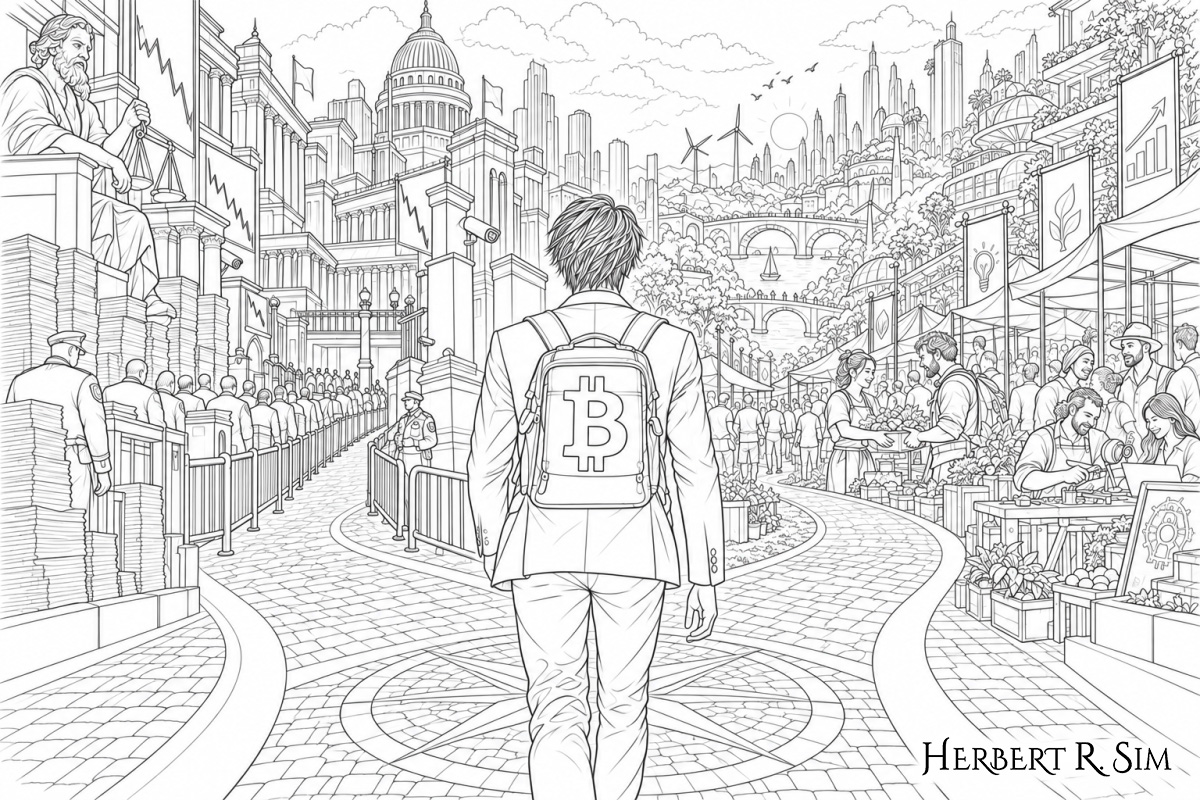
My illustration “Economic Liberty Under Pressure” work-in-progress. The art represents crossroads between institutional control and voluntary exchange. My Bitcoin-marked backpack symbolizes portable economic sovereignty.
Economic Liberty Requires Many Paths
No single system should possess unnecessary power over the whole of economic life. When money, trade, communication, identity and property depend on a small number of central points, errors and abuses can affect everyone at once.
Decentralised alternatives can reduce this risk. They distribute authority, create competition and give individuals additional paths through which to act. They can make systems more resilient because participation does not depend entirely on one institution’s approval, one company’s infrastructure or one authority’s changing rules.
This is not an argument that every centralised system is harmful. It is an argument that concentration should remain contestable. Where power becomes essential, individuals should retain the ability to question it, leave it and build alternatives to it.
The Foundation of Sovereignty
Counter Economics is ultimately concerned with sovereignty at the level of ordinary life.
A person with no ability to preserve value, no practical choice of exchange, no ownership over their property and no meaningful right to exit is vulnerable to control. A person with multiple paths—direct ownership, voluntary networks, open systems and the freedom to build—possesses a stronger foundation for independence.
This principle extends beyond money. The same questions will increasingly apply to identity, information, technology and the human mind itself. Who holds the keys? Who may change the rules? Who can revoke access? Can the individual refuse, disconnect or leave?
Counter Economics begins with voluntary alternatives in economic life. Its wider lesson is that freedom becomes more durable when no single institution possesses unnecessary control over the individual’s ability to act.
Economic liberty is not secured by dependence on a single system. It is secured by the individual’s ability to own, choose, build and exit.
Reference: Satoshi Nakamoto, Bitcoin: A Peer-to-Peer Electronic Cash System, 31 October 2008.