
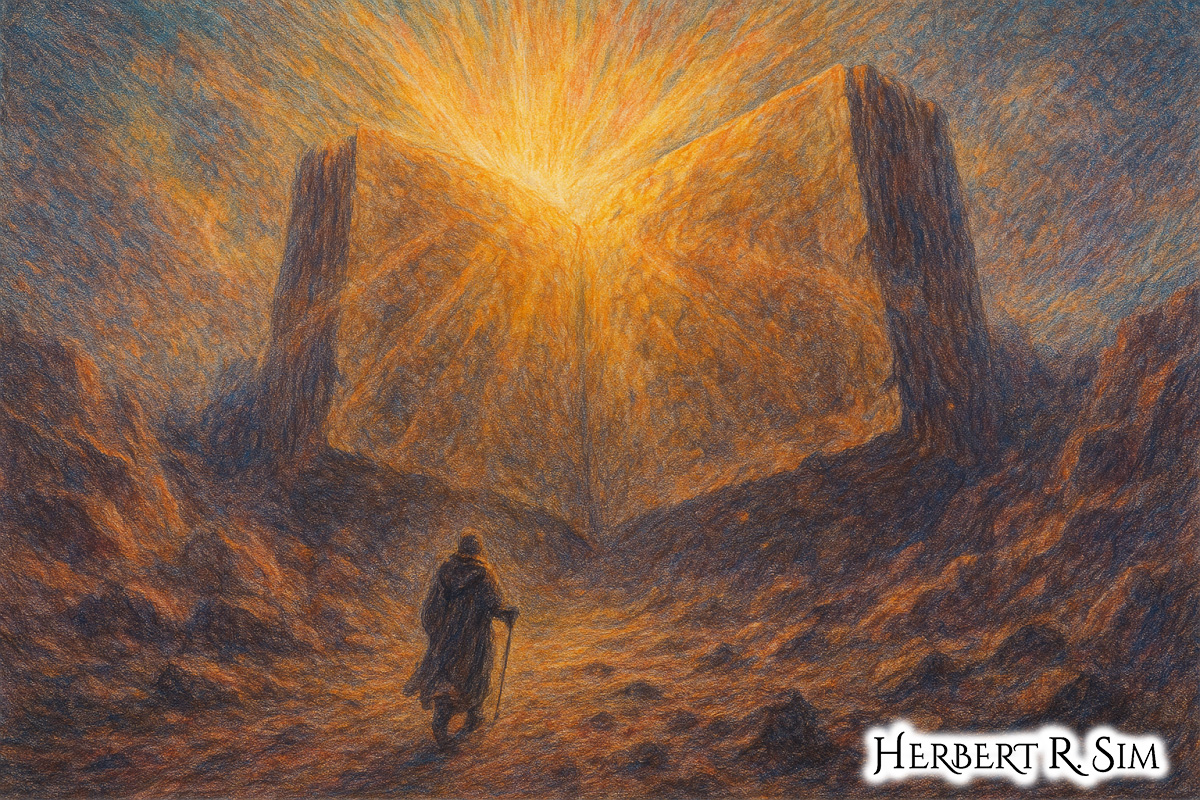
My illustration above of the ‘Gospel of Philip’, as the ‘Hidden Gospel Revealed’. A massive ancient codex emerging from a chasm of rock. An ancient manuscript, esoteric knowledge.
The Gospel of Philip is one of the most intriguing documents to emerge from the sands of Egypt in the last century — mysterious enough to inspire conspiracy theories about Jesus’ love life, but subtle enough to reward very serious historical and theological study. Behind the headlines about “Jesus’ wife” and secret teachings lies a complex meditation on sacraments, embodiment, and spiritual transformation.
From desert jar to modern spotlight
The Gospel of Philip survived in just one Coptic manuscript, part of the famous Nag Hammadi library discovered near the Egyptian town of Nag Hammadi in 1945. In that find, local farmers unearthed 4th-century papyrus codices containing 52 early Christian and Gnostic writings, hidden in a jar and buried — probably to protect them from destruction. TIME magazine’s early coverage in the 1960s and 1970s introduced general readers to this “remarkable library of Gnostic scriptures,” stressing how it reshaped debates about early Christianity.
A 1963 TIME article on the first English translation of Philip described it bluntly: not really a “gospel” in the narrative sense at all, but a “rambling, epigrammatic sermon” on Christian themes from a distinctly Gnostic angle. Rather than telling the story of Jesus’ life, the text weaves together short sayings, interpretations of biblical passages, enigmatic aphorisms, and sacramental reflections.
Most scholars date its composition to the late 2nd or 3rd century CE. That means it is much later than the New Testament gospels and certainly not written by the apostle Philip, whose name appears only in a colophon at the end of the manuscript. Popular media coverage — from TIME to PBS — has consistently emphasized that these Nag Hammadi writings are windows into later, alternative Christian movements rather than lost “first drafts” of Christianity itself.
A Gnostic Christian voice
Nag Hammadi texts are often labeled “Gnostic”: they present salvation as arising from insight (gnosis), emphasize a sharp contrast between spiritual and material reality, and frequently reinterpret biblical symbols in highly allegorical ways. A 1975 TIME feature, for example, sketched Gnosticism as a rival stream of early Christian thought whose scriptures — among them the Gospel of Thomas and Gospel of Philip — recast Jesus’ message in a more mystical and radically spiritual key.
The Gospel of Philip seems especially close to a Christian group known as the Valentinians. Reviews of major scholarly work on Gnosticism in outlets like the Los Angeles Times note how texts such as Philip fit into a sophisticated myth and sacramental system, rather than into crude “heresy”. Media interviews with scholars like Elaine Pagels and Marvin Meyer — covered by PBS and newspapers — have underscored that these texts witness to real communities for whom baptism, anointing, and the “bridal chamber” were central spiritual experiences, not mere metaphors.
Structure and themes
Unlike the New Testament narratives, Philip reads like a patchwork of:
- Short sayings attributed to “the Lord”
- Interpretations of Genesis and the gospels
- Brief discussions of sacraments
- Dense symbolic reflections on union with God
One famous line, quoted in a 1981 Washington Post op-ed on Christian politics, captures its symbolic style:
“Truth did not come into the world naked, but it came in types and images. One will not receive truth in any other way.”
That sentence could be a motto for the entire book. For Philip, visible rituals are “types and images” through which divine reality becomes accessible. Baptism, anointing, Eucharist, and a mysterious rite called the “bridal chamber” are all treated as transformative encounters that clothe truth in symbols.
Where the canonical gospels tell stories about Jesus instituting a meal or sending disciples to baptize, Philip zooms in on what those rites mean: rebirth, sealing, illumination, and union. Media discussions of Gnostic Christianity — such as the LA Times coverage of “lost Christian teachings” — have highlighted how texts like Philip suggest a more esoteric, initiatory vision of Christian practice alongside the emerging “orthodox” mainstream.
Mary Magdalene and the “companion” passage
The passage that catapulted Philip into popular culture concerns Mary Magdalene. In a damaged section, the text refers to her as Jesus’ “companion” (koinōnos) and says that Jesus loved her more than the other disciples and used to kiss her often — though the body part is missing in the manuscript gap.
Long before Dan Brown, media outlets occasionally mentioned this text in debates about Jesus’ marital status. In 2006, The Observer (via The Guardian) reprinted a 1971 article by Catholic theologian Charles Davis under the headline “Was Jesus Married?”, noting that some scholars saw the Gospel of Philip as an independent witness presenting Mary Magdalene as Jesus’ wife.
At roughly the same time, reviewers and commentators covering The Da Vinci Code phenomenon pointed out that Brown borrowed heavily from modern readings of this passage. Guardian essays on the novel and its sources repeatedly pointed to Nag Hammadi texts like Philip as the soil in which such ideas about Mary and Jesus grew — though usually with a strong dose of skepticism about taking them as straightforward history.
Major outlets have tended to underline three cautions:
- Chronology – Philip is written centuries after Jesus’ lifetime.
- Genre – It is a symbolic, sacramental treatise, not a biography.
- Language – “Companion” can mean spiritual partner or associate, not necessarily spouse.
In other words, Philip may show that some later Christians imagined a particularly close relationship between Jesus and Mary, but it does not provide simple historical proof of marriage.
A sacramental vision of union
Beyond Mary Magdalene, Philip offers a striking theology of embodiment and union. Media coverage of Gnostic texts has often caricatured Gnostics as “world haters” who despised the body. A 1975 TIME article even used that phrase as its title. Yet Philip complicates that stereotype.
The text criticizes crude, literal approaches to sacraments, but it doesn’t reject them. Instead, it suggests that physical rites are vehicles for a deeper reality:
- Baptism is described as a kind of birth into a new, spiritual family.
- Chrism (anointing) marks the initiate with an indelible seal.
- Eucharist becomes participation in the living Christ.
- The “bridal chamber” symbolizes the reunion of the separated — soul and spirit, male and female, human and divine.
Journalistic overviews of Nag Hammadi, like those on PBS’s From Jesus to Christ and in National Geographic’s reporting around the Gospel of Judas, have emphasized how these texts present salvation as a process of awakening to a hidden identity in God, often through layered rituals of initiation.
In that sense, Philip is less interested in Jesus’ biography and more in what it means to participate in Christ — what it means for believers themselves to become “anointed ones,” reunited with their divine origin.
Media, mystery, and the “other” Christianities
The resurgence of public interest in apocryphal gospels since the 1970s owes a lot to the way mass media has framed them. Profiles of Elaine Pagels’ work in venues like the New Yorker and the LA Times invited readers to imagine a rich, contested early Christian landscape in which texts like Philip were serious contenders, not just curiosities.
The early 2000s brought a second wave of fascination. The Da Vinci Code put Mary Magdalene and Gnostic lore at the center of a global thriller, prompting a flood of explainers, critiques, and spin-off books. The LA Times ran pieces on publishers “cashing in on the ‘Code’” and on the renewed market for Nag Hammadi-related titles. At the same time, major newspapers and magazines covered the release of yet another non-canonical text, the Gospel of Judas, through National Geographic’s heavily publicized project.
In many of these stories, Philip appears not as the main act but as part of the wider cast: one of several gospels that challenge familiar assumptions about Jesus, authority, and orthodoxy. Coverage in The Guardian and LA Times often presented orthodox Christianity and Gnosticism as “best of enemies” — rival interpretations of Jesus that defined themselves over against each other.
What the Gospel of Philip contributes
So what, in the end, does Philip add to our understanding of early Christianity?
- A snapshot of a sacramental mysticism
Rather than arguing about creeds, Philip immerses readers in imagery of light, union, and transformation. Its concern is not theoretical doctrine but how people are changed — through ritual, knowledge, and love — into children of the living God. - Evidence of diversity in early Christian practice
Reports on Nag Hammadi from outlets like Time, the Los Angeles Times, and PBS concur that these texts show a wider variety of Christian belief and practice than the New Testament alone would suggest. Even if the Valentinians stood on the margins of emerging orthodoxy, they were clearly drawing on shared scriptures and symbols, re-reading them through a different lens. - A symbolic reimagining of gender and intimacy
The controversial Mary Magdalene passage reflects more than gossip about Jesus’ marital status. When read alongside other Gnostic texts featuring Mary as a favored disciple, it points to ongoing debates about women’s authority and spiritual intimacy. Journalists covering these themes — from Guardian columnists to New Yorker essayists — have repeatedly noted how such texts became touchstones in modern discussions of feminism, sexuality, and the church. - A cautionary tale about reading ancient sources through modern headlines
National Geographic’s Judas project, media excitement over “lost gospels,” and debates about a forged “Gospel of Jesus’ Wife” all show how easy it is to leap from fragmentary texts to sweeping claims. The Gospel of Philip suffers the same fate whenever it’s reduced to “the text that proves Jesus was married.” In reality, it’s a late, highly symbolic work whose primary focus is spiritual union, not marital biography.
Conclusion: A gospel of images, not naked facts
The Gospel of Philip is unlikely ever to be read devotionally on Sundays. It is dense, obscure, and at points frustrating. Yet its voice continues to echo for anyone interested in the complexity of early Christianity.
Mainstream media — whether TIME unpacking the Nag Hammadi codices in the 1960s, the Washington Post quoting Philip’s paradoxical sayings in the 1980s, or British and American newspapers revisiting Mary Magdalene in the wake of The Da Vinci Code — has helped keep this strange little text in the public imagination.
If we take seriously its own warning that truth comes clothed “in types and images,” Philip invites us to do two things at once: to resist sensational shortcuts about hidden marriages and suppressed histories, and to appreciate how richly early Christians experimented with language, ritual, and symbol in their search for union with the divine.