
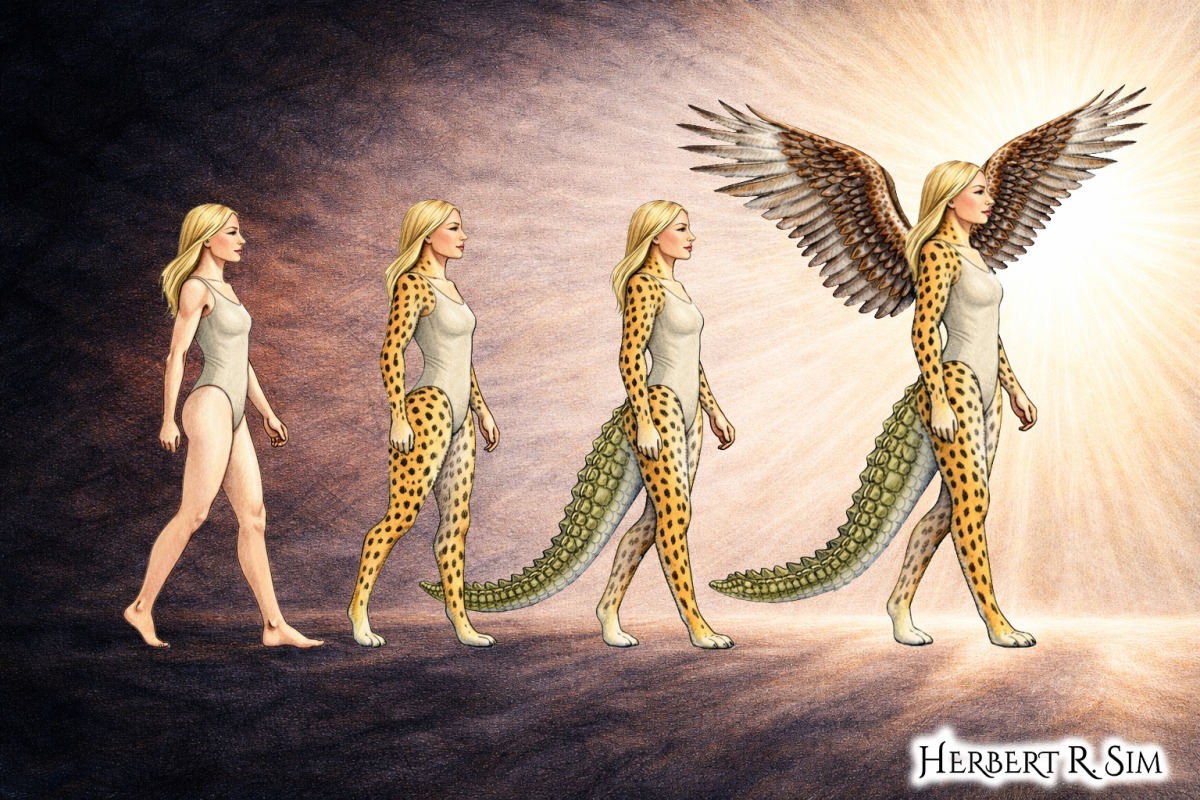
In my illustration above, I showcase the human to animal-hybrid evolution, transcendence through genetic-editing, CRISPR technology, towards becoming a chimera — notice the cheetah limbs for speed and strength, crocodile tail for balance and as a weapon, eagle wings for flight.
The earlier “human–cyborg” argument frames evolution as something we increasingly bolt on: sensors, prosthetics, and computation widening the range of environments a human body can tolerate. The next step is quieter, more profound, and harder to reverse. Instead of adding hardware to the body, we are learning to edit the body’s source code — and, in limited but expanding ways, to decide which versions of that code get passed forward. The question is not whether natural selection has stopped. It has not. The question is whether selection is being re-routed: from an undirected filter acting on random variation to a partially intentional pipeline shaped by medicine, markets, regulation, and parental choice.
This shift matters because “natural selection” is not a single on/off mechanism. It is the statistical result of three moving parts: variation, inheritance, and differential reproduction. Modern societies have already been changing the third part for a century — dramatically reducing death from infection, malnutrition, and childbirth. Genetic technologies now reach into the first and second parts: they can alter variation deliberately (editing), and they can alter inheritance deliberately (selecting embryos, replacing mitochondria, and potentially editing germ cells). The net effect is not an end to evolution, but a transition toward evolution by design constraints — with the “designers” dispersed across clinics, labs, and policy institutions rather than concentrated in any single hand.
1) Natural selection isn’t ending — its targets are changing
The most common misunderstanding is that modern medicine “turns off” selection. What it really does is change what gets selected. When genetics therapy or drugs allow people with formerly lethal genetic conditions to live, they can participate more fully in education, work, partnership, and child-rearing — meaning the reproductive consequences of many variants are reduced or delayed. In evolutionary terms, that is a reshaping of selection pressures, not their disappearance. WIRED’s account of gene therapy’s collapse after the Jesse Gelsinger tragedy and its later resurgence shows exactly how social institutions — funding, regulation, liability, and clinical risk tolerance — become evolutionary actors by determining which interventions reach people at scale.
At the same time, as Reuters’ reporting on ultra-high-cost genetic medicines (in the Glybera era) made explicit, the capacity to blunt selection is unevenly distributed. If a gene therapy exists but is priced for a narrow population, then differential reproduction can reappear as differential access: not “survival of the fittest,” but survival of the wealthiest, or at least survival of those embedded in capable health systems.
2) From “treating” genomes to engineering them
A genuine inflection point arrived when genome editing became relatively programmable. Nature’s coverage of CRISPR’s leap “from lab to industry” captured the moment gene editing began to look like a platform rather than a bespoke craft. Platforms scale: they attract capital, standardize workflows, and multiply applications. That is how intentionality enters evolution — not as a philosophical decision, but as an operational reality.
Scientific American’s reporting on early CRISPR-based primate work underscored another key point: gene editing reduces the friction of experimentation. When modifying a primate (or eventually a human embryo) becomes easier, the ethical debate is no longer about a distant possibility. It becomes governance for a foreseeable pipeline: which edits count as therapy, which as enhancement, and which as unacceptable risk.
3) Selection is already happening in fertility clinics
The most immediate form of “evolution by choice” is not gene editing; it is preimplantation genetic testing and embryo selection. If a couple creates multiple embryos via IVF and selects which to implant based on genetic screening, the evolutionary logic is direct: the distribution of alleles in the next generation shifts because some embryos are never given a chance to develop.
The Guardian warned that this dynamic can slide — subtly — away from disease avoidance toward status competition, because what begins as “prevent suffering” can become “optimize outcomes.” That is less a sci-fi jump than an incremental market drift driven by parental anxiety and clinic offerings.
Slate’s discussion of “three-parent” framing around mitochondrial techniques highlighted how language shapes acceptance: terms that sound like sensational novelty (“two mommies and one daddy”) can obscure the real issue — germline impact. Even if the intent is disease prevention, altering mitochondria affects descendants. The evolutionary unit is no longer the patient; it is the lineage.
4) Mitochondrial replacement as a bridge technology
If you want a single example that makes the “blind to intentional” shift concrete, mitochondrial replacement is it. Nature reported on UK movement toward allowing techniques that prevent inheritance of mitochondrial disease by using donor mitochondria — effectively changing the heritable biological starting point of a child while leaving nuclear DNA largely unchanged.
The Guardian’s coverage of “eugenics fear” around gene modification shows the cultural fault line: some critics argue that once any heritable modification is normalized — even for narrowly defined diseases — the barrier to broader germline engineering weakens. Proponents respond that preventing devastating disease is ethically distinct from designing traits, and that refusing safer options can be its own moral failure. The point is that policy here is not just health policy. It is evolution policy — because it determines what kinds of inheritance modification society will permit.
5) Direct-to-consumer genomics turns selection into a data product
When genetic information becomes consumer-facing, selection can begin before conception, mediated by statistics, interfaces, and marketing. The FDA’s actions toward 23andMe in late 2013 — covered extensively across outlets — illustrate an emerging pattern: regulators are not merely protecting consumers; they are shaping how quickly genetic risk scoring becomes part of everyday life.
The Verge framed the clash as a direct regulatory stop signal. Smithsonian emphasized the interpretive danger: raw genetic information can mislead without appropriate clinical context, potentially driving harmful decisions. Reuters reported downstream consequences, including 23andMe halting marketing after FDA pressure. These are not side stories; they determine whether genomics becomes a mass behavioral input into mate choice, reproductive timing, embryo selection, and preventive medicine.
In evolutionary terms, consumer genomics shifts selection from “nature filters after birth” to “people self-sort before birth” — with software and regulation acting as co-authors.
6) Patents, ownership, and the market structure of evolution
If genomes become editable and selectable, who controls the tools and the information? The 2013 U.S. Supreme Court gene-patent decision, covered widely, was a governance milestone precisely because it defined where “nature” ends and “human invention” begins in law.
Reuters reported the Court’s compromise: naturally occurring genes are not patentable, but synthetic constructs can be. WIRED treated the decision as a major opening for competition and research access. ABC (Australia) similarly emphasized the impact on biotech and medical practice, while The Guardian noted that legal clarity does not resolve deeper issues about incentives, research, and access. Reuters also documented industry views that biotech had already “moved on” toward patenting applications rather than raw sequences. All of this shapes whether genetic capabilities diffuse broadly or concentrate — again translating into differential access and, over time, differential reproduction.
7) The real pivot: from blind variation to designed constraints
Natural selection is “blind” because variation is not produced in response to need; it is produced by mutation and recombination, then filtered by outcomes. Gene editing changes the upstream. It allows variation to be generated with an objective in mind. Even when we restrict ourselves to therapy, the logic is intentional: make this change because it should reduce disease burden. Nature’s reporting on CRISPR’s rapid commercialization captured the structural reason this is not a niche: once tools are cheap, modular, and widely taught, intentional variation becomes normal engineering work.
But intentionality does not guarantee wisdom. Designed systems inherit new failure modes: off-target effects, unforeseen gene–environment interactions, and “solutions” that work in one context but create vulnerabilities in another. This is where the evolutionary metaphor bites: the blind process is slow but robust to hubris; the intentional process is fast but exposed to design error.
8) Governance becomes the new environment
If earlier technological augmentation changed the body’s relation to the physical environment, genetic engineering changes the body’s relation to the institutional environment. Regulation, liability norms, reimbursement decisions, religious and cultural values, and clinic practices become selection pressures. That is why debates about enhancement are not only ethical; they are predictive: they determine which traits and interventions become common.
PBS discussions of genetic enhancement and genetic testing — years before CRISPR entered popular vocabulary — already framed the enduring conflict: the blurry border between therapy and enhancement, and the fear that individual optimization could erode solidarity or increase discrimination. Those concerns do not become obsolete as technology improves; they become more operational as capability scales.
9) So, are humans ending natural selection?
No. Humans are not ending natural selection. We are replacing some of its mechanisms, redirecting others, and creating new selection pressures that run through money, policy, data, and culture. Evolution continues, but its steering wheel is no longer entirely absent. It is being grasped — often with good intentions, sometimes with commercial motives, and always under uncertainty.
The deeper shift is this: when inheritance can be modified, selection becomes less about who survives and more about which designs are allowed, affordable, and socially desirable. That is not an escape from evolution. It is a transition into a phase where evolution is increasingly co-authored — and where the “design brief” is contested in public, not written by nature alone.