
If We Can Upgrade Memory, Do Our Memories Stop Being “Ours”?
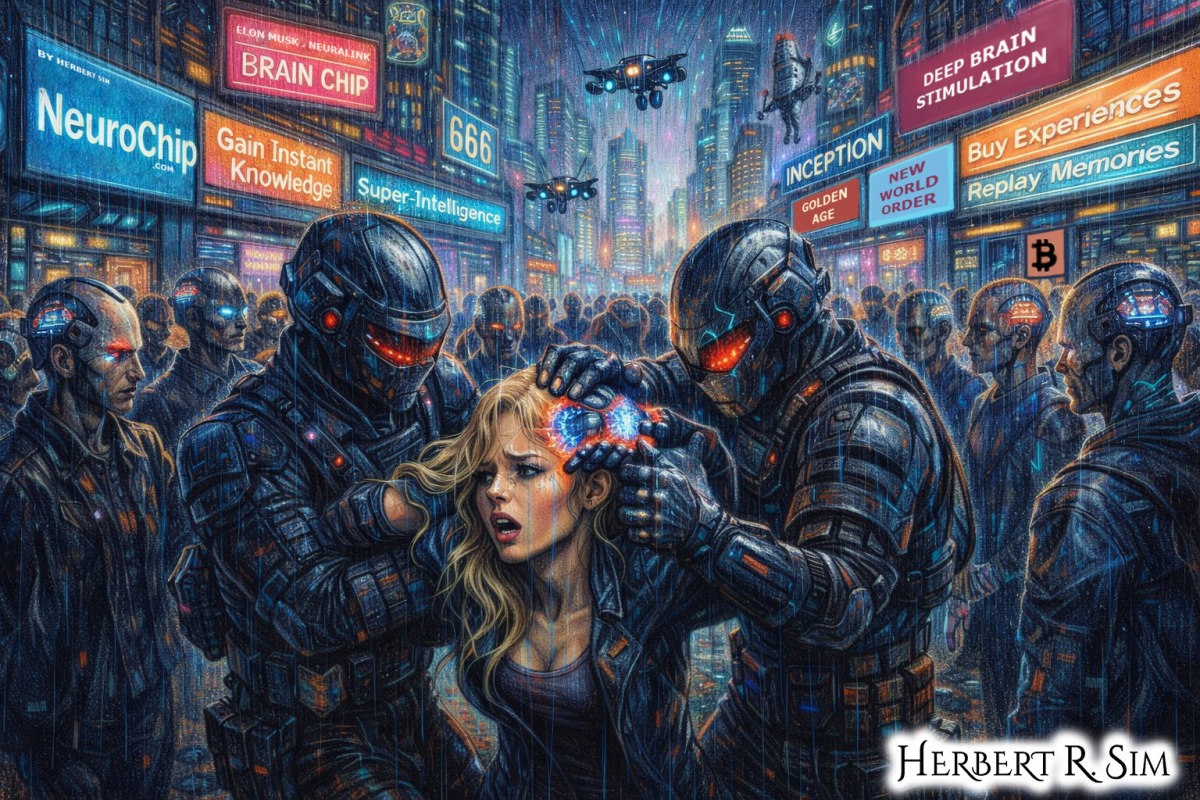
In my illustration above, I feature a rain-soaked cyberpunk alley, where a lady is being subdued by augmented enforcers activating her neural implant.
The dream heist in Inception (2010) movie hinges on a simple, unsettling claim: if you can place an idea deep enough, it will be experienced as one’s own. The film dramatizes “inception” as a kind of cognitive forgery — an intervention that does not merely add information, but reshapes what a person takes to be their inner history.
A decade and a half after the film’s release, the technological pathway is no longer purely cinematic. Brain-computer interfaces (BCIs) increasingly aim not only to read neural activity but, in some programs, to write into it — stimulating or modulating circuits implicated in perception, mood, and memory. DARPA’s Restoring Active Memory (RAM) program, for example, explicitly framed the goal as developing implantable “neuroprosthetics” to help restore memory function after injury or disease.
This raises a question that is at once philosophical, clinical, and experiential: If memory can be augmented or repaired by implants, does the resulting “remembering” still feel like remembering? Put differently, how does memory enhancement intersect with memory authenticity — especially at the level of phenomenology (the “what-it-is-like” character of recollection)?
Two targets: performance and authenticity
Memory enhancement is often described in functional terms: improved recall, stronger encoding, better retrieval, fewer lapses. In clinical contexts — traumatic brain injury, neurodegeneration, stroke — those goals are straightforwardly humane. Programs like RAM were publicly justified as therapeutic: restoring capacities that injury has degraded.
Authenticity, however, is not a performance metric. It concerns whether a memory is (1) veridical (accurate), (2) owned (experienced as “mine”), and (3) continuous with the self (integrated into one’s narrative identity). A memory can be inaccurate yet feel authentic; it can be accurate yet feel alien. The authentic/inauthentic distinction, then, is not reducible to correctness.
That mismatch is familiar from ordinary cognition. Human memory is reconstructive; it is shaped by attention, emotion, context, later information, and retelling. Many “normal” memories are part fact, part inference, part narrative. The authenticity that matters to personal identity is often a matter of phenomenological signature — the sense of re-living, the feeling of familiarity, the intuitive conviction that “this happened to me.”
What implants plausibly change: the phenomenology of recollection
To evaluate whether implanted augmentation changes the phenomenology of remembering, it helps to separate at least four layers of experience that typically accompany episodic recollection:
- Vividness and sensory richness
- Agency and control (do I summon it, or does it arrive unbidden?)
- Affective tone (the emotional “coloring”)
- Epistemic feeling (the sense of certainty, “realness,” and ownership)
A memory prosthesis that improves recall might amplify vividness, speed retrieval, or reduce effort. But phenomenology is not just “more clarity.” Increased vividness can increase the feeling of authenticity even when the content is distorted; conversely, a more accurate recollection delivered in a mechanized, externally prompted way might feel less authentic.
This is where Inception remains conceptually relevant. The film’s anxiety is not that a false idea exists in the mind; it is that the idea carries the phenomenology of self-generation — the subject experiences it as internally authored.
If neurotechnology can cue, strengthen, or reinstantiate neural patterns associated with a memory trace, the user may experience an intensified “re-living” regardless of whether the trace is pristine, edited, or partially synthetic. Research culture has already demonstrated — at least in animal models — that engineered manipulations can drive behavior consistent with a memory of something that did not occur as experienced. A widely covered Smithsonian account explicitly framed optogenetically induced false memory in mice as a real-world echo of Inception’s premise.
Enhancement is not (only) insertion: the “closed-loop” shift
Popular imagination often pictures implanted memory augmentation as “downloading” experiences. In practice, the nearer-term trajectory looks more like closed-loop modulation: sensing neural signals associated with encoding/retrieval deficits and delivering stimulation intended to normalize circuit dynamics. DARPA’s RAM announcements and reporting emphasized this kind of restorative, systems-oriented approach.
Closed-loop design matters for phenomenology because it changes the locus of agency. When remembering becomes partially automated — prompted or stabilized by an embedded system — the user may experience recall as:
- Less effortful (a benefit),
- Less voluntary (a cost, for some),
- More reliable but also more “instrumented.”
This resembles the experience of other assistive cognitive technologies: calendars, photo archives, search, reminders. Vox’s discussion of how technologies mediate what we remember (even in the non-invasive case of photographs) underscores that external scaffolds can change not only what is recalled, but how experiences are encoded and later reconstructed.
Implants intensify that dynamic by moving the scaffold inside the skull.
Authenticity as a social and ethical claim
Memory authenticity is not merely private. It has legal, interpersonal, and moral dimensions: testimony, consent, remorse, trauma processing, reconciliation. As soon as memory can be modulated, authenticity becomes contestable: “Did you remember that, or did your device produce it?” Even therapeutic interventions can attract suspicion — particularly in adversarial contexts (courtrooms, politics, surveillance).
The BCI ecosystem already points toward contested boundaries between reading and writing. The Atlantic’s reporting on next-generation human-computer interfaces and DARPA-adjacent ambitions captures a broader shift: interfaces that reduce friction between thought and computation inevitably raise questions about autonomy and identity.
More provocatively, coverage of speculative “cortical modem” style projects illustrates a future in which neural interfaces aim to inject structured content (e.g., images) into sensory cortex — precisely the kind of pathway that could, in principle, alter mnemonic phenomenology by altering perception itself.
A practical test: when does “remembering” stop feeling like remembering?
A useful evaluative lens is to ask what kinds of user reports would signal phenomenological drift. Consider three illustrative scenarios:
- The “sharper me” scenario (phenomenology preserved):
An implant makes recall more robust, but the user still experiences memories as arising from familiar cues, with normal variability, emotion, and uncertainty. The device feels like eyeglasses for memory: it improves access without changing ownership. - The “autocomplete self” scenario (phenomenology altered):
Recall becomes too fast, too complete, too unambiguous. The user notices that memories arrive with a “finished” quality — like a system output. Confidence rises even when context is thin. Here authenticity may erode, not because memories are false, but because the epistemic feeling of earned recollection is replaced by delivered content. - The “foreign-yet-mine” scenario (authenticity destabilized):
The user retrieves episodes that feel vivid and personal, but also oddly unintegrated — lacking the normal web of associations (smells, peripheral details, narrative links). This is the Inception worry: the memory has the stamp of ownership without the normal developmental embedding.
These scenarios suggest that authenticity is likely to be influenced by how augmentation is implemented: the degree of automation, the transparency of prompting, and whether the intervention respects the brain’s own cues and consolidation rhythms.
The uncomfortable implication: authenticity can be engineered
The most sobering possibility is that authenticity is not a protected essence but a manipulable signature. If the brain uses certain markers — vividness, fluency, emotional congruence, contextual binding — to label something as “real memory,” then technologies (or therapies) that modulate those markers could manufacture the feeling of authenticity without guaranteeing truth.
Even without implants, this is already a cognitive vulnerability. The difference is that implants could scale and stabilize such effects.
Toward an evaluation framework
If implanted augmentation becomes clinically common, assessing phenomenological impact should be treated as a first-class outcome, alongside accuracy and functional improvement. A robust evaluation regime would include:
- Structured phenomenology interviews (ownership, agency, emotional congruence, narrative fit)
- Confidence–accuracy calibration (does certainty inflate?)
- Identity integration measures (does the person’s autobiographical narrative become more coherent, or more brittle?)
- Transparency controls (when and how stimulation occurs, and whether the user can consent per-episode)
In short: the central question is not whether implants “change memory.” They almost certainly will. The question is whether they change the character of remembering in ways that undermine personal autonomy, narrative identity, and warranted trust in one’s own past.
Inception framed memory authenticity as a battleground for the self. BCIs and memory prostheses suggest that battleground may shift from metaphor to clinical design constraint: if we can enhance remembering, we will also need to decide what kinds of remembering we consider worth having.