
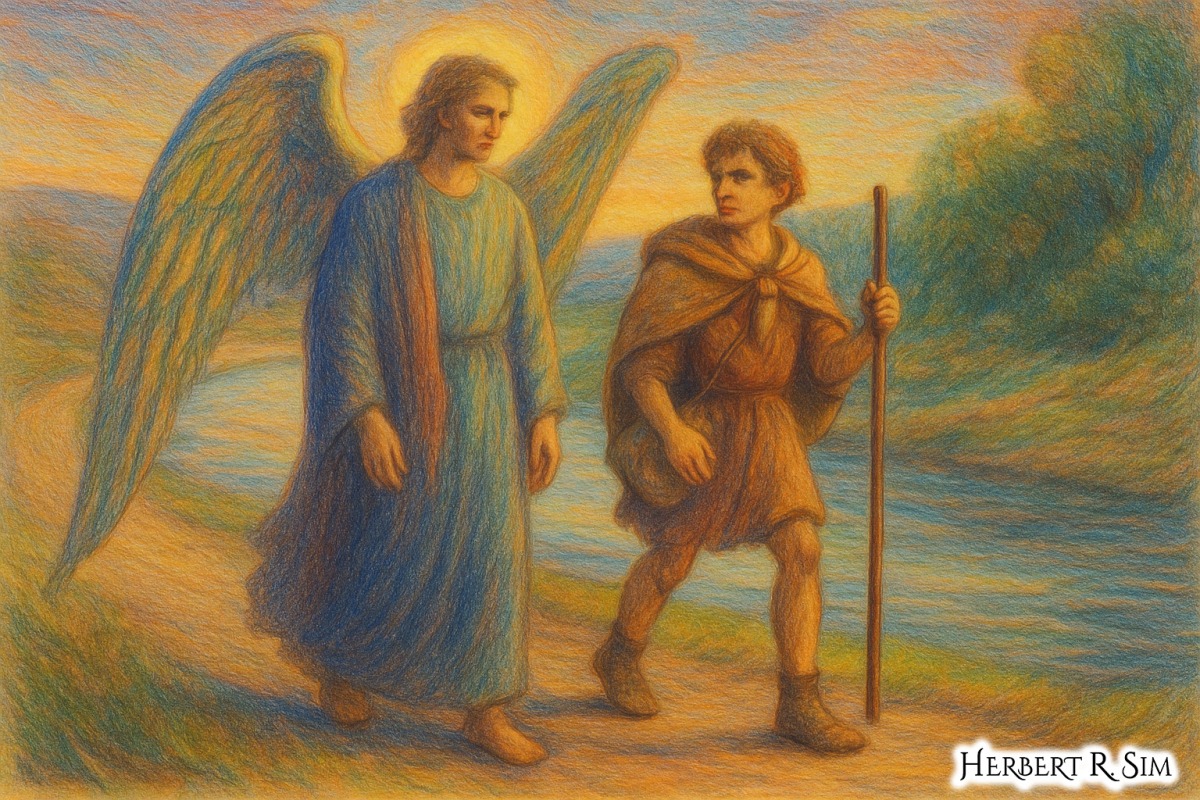
In my illustration above, I depict Tobit’s son, Tobias, traveling with the angel Raphael (disguised as a human companion).
The Book of Tobit is one of the most distinctive narratives in the biblical “Deuterocanon” (accepted as Scripture in Catholic and Orthodox traditions, and generally placed among the Apocrypha in many Protestant Bibles). It reads less like court history or prophetic oracle and more like a compact novella: a family saga set in exile, stitched together with prayers, travel adventure, domestic comedy, and a striking theology of providence working through ordinary fidelity.
A story built for life in exile
At its core, Tobit is a diaspora text. Its characters are Jews living far from their ancestral land, trying to remain recognizably Jewish when social pressure and political vulnerability make that difficult. In that sense, Tobit does not merely preserve a tale; it preserves a strategy for survival: keep the commandments, practice charity, honor family obligations, and trust that God’s governance extends beyond what the eye can see.
One reason Tobit has endured across centuries is that it fuses “big” theological claims with “small” daily practices. The story insists that holiness is not limited to the Temple or public ritual; it is also expressed through burial of the dead, care for the poor, marital fidelity, and intergenerational responsibility. Even when suffering appears random or undeserved, Tobit frames it as a testing ground where integrity can still be chosen.
Plot overview: blindness, a journey, a demon, and an angel in disguise
The narrative typically unfolds in two interwoven arcs.
- First arc: Tobit’s loss and steadfastness. Tobit (the father) is depicted as devout and unusually committed to works of mercy. His righteousness does not shield him from hardship. He becomes blind through a mundane accident—an almost deliberately anti-epic detail—underscoring Tobit’s realism about how suffering often arrives: not with cosmic spectacle, but through ordinary fragility.
- Second arc: Tobias’ mission and marriage. Tobit’s son, Tobias, is sent on a journey to retrieve money that can stabilize the family. The trip becomes a rite of passage, but it is guided—quietly and decisively—by a traveling companion who later reveals himself as the archangel Raphael. This device is central to Tobit’s spiritual psychology: divine assistance is real, but frequently unrecognized in the moment.
Along the way, Tobias catches a fish whose organs become instruments of healing and deliverance—used to drive away a demon tormenting Sarah, the woman Tobias is destined to marry, and later to restore Tobit’s sight. Modern readers sometimes stumble over these elements, but within the narrative they serve a consistent point: God’s help may come through material means, practical counsel, and actions that look ordinary (or even odd) until their purpose becomes clear.
A helpful illustration of Tobit’s cultural afterlife is how easily the story migrates into other narrative frames—novels, plays, music, and visual art—precisely because it is already shaped like a drama of recognizably human crises: illness, money, marriage, fear, and hope. A Los Angeles Times review of Salley Vickers’ novel Miss Garnet’s Angel, for example, summarizes how a contemporary plot is interwoven with Vickers’ adaptation of Tobit: exile, a journey to recover money, a faithful dog, a guide who is an angel, a marriage shadowed by demonic oppression, and eventual healing and moral enlargement.
Theological center: providence without sentimentality
Tobit’s theology of providence is not simplistic optimism. It acknowledges the “felt experience” of abandonment—Tobit prays from bitterness and exhaustion; Sarah prays from shame and despair. Yet the narrative argues that God’s governance is not negated by lament. In fact, prayer becomes the hinge that connects private suffering to a larger, unseen choreography of mercy.
This is why Raphael’s hidden presence matters. The book suggests that the divine economy is often mediated through companions, counsel, and timely resources that do not announce themselves as miracles. Tobit is, in that respect, a narrative rebuke to both cynicism (“nothing means anything”) and superstition (“everything must be visibly dramatic”). It is also one of Scripture’s most sustained treatments of angelic assistance as a mode of providence—intimate, purposeful, and at times deliberately veiled.
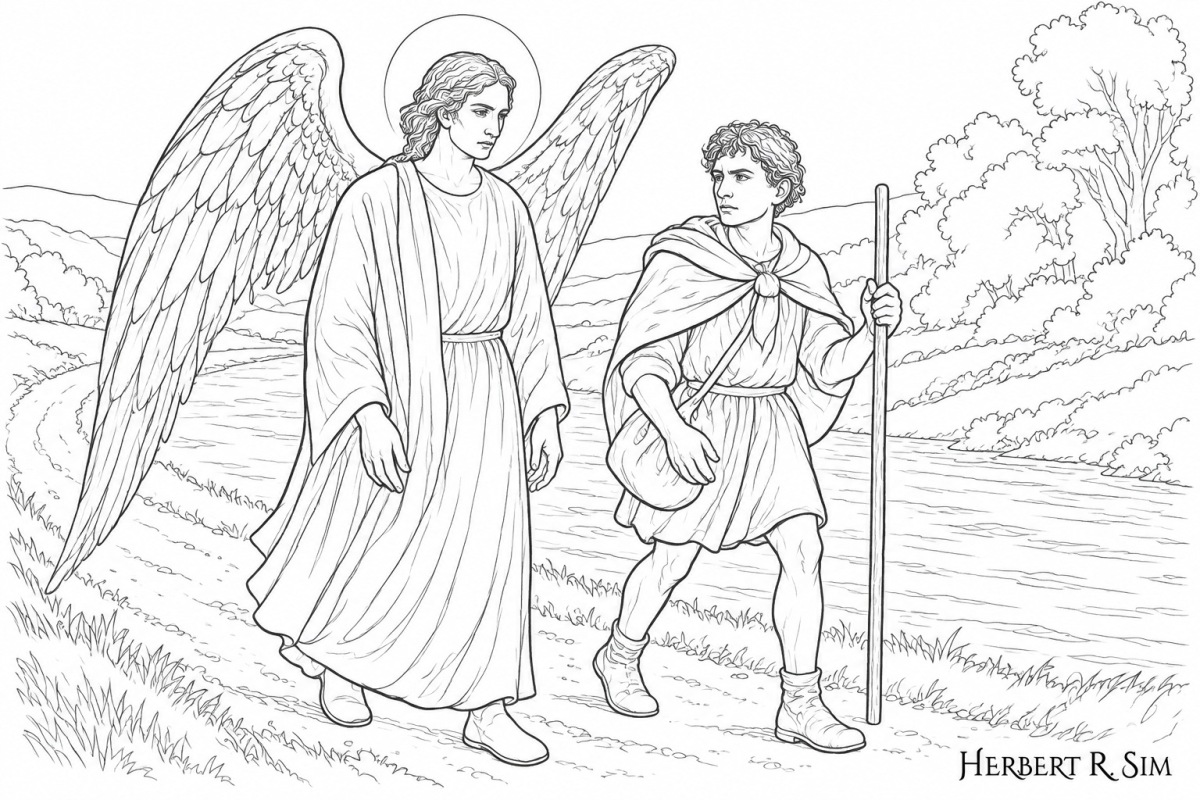
My illustration work-in-progress above.
Moral instruction: charity, family, and the dignity of the dead
Tobit is also an instruction manual embedded in a story. It repeatedly elevates almsgiving and care for the dead as signature acts of covenant identity. The focus on burial is particularly striking in a diaspora context, where the dead can become socially expendable. Tobit treats burial as a declaration that no political regime gets the final word on a person’s worth.
The book also foregrounds intergenerational ethics: parents bless and instruct; children honor and provide; marriage is framed not only as romance but as covenant stability. That emphasis is one reason Tobit has been used frequently in wedding liturgies and marriage preaching in traditions that receive it as Scripture.
Even in journalistic contexts not primarily religious, Tobit appears as a reference point for debates about identity maintenance in minority communities. A Los Angeles Times report discussing intermarriage as an issue in Jewish life invokes Tobit as a diaspora text where endogamy is salient—illustrating how Tobit is often read as guidance for preserving communal continuity under assimilation pressure.
Text and canon: “in” some Bibles, “out” of others
Tobit’s canonical status varies by tradition, and that history matters because it shaped how the book circulated and was interpreted. A concise mainstream explainer appears in The Independent in the context of the Codex Sinaiticus project. The article notes that Codex Sinaiticus contains Tobit (alongside Judith, Wisdom, Ecclesiasticus, Baruch, and others) and observes that Protestants later dropped these books from their Bibles after the Reformation.
Whatever one’s confessional stance, the takeaway is straightforward: Tobit has long existed close to the heart of biblical culture, even when it is not placed in the same canonical category everywhere. That “near-canon” position helps explain its broad footprint in art, literature, and music.
Cultural afterlife: from Renaissance canvases to concert halls
Tobit’s most famous artistic motif is “Tobias and the Angel”. Renaissance and Baroque artists repeatedly returned to the image of a vulnerable traveler accompanied by a majestic guide—often with a fish in hand—because it visually captures the book’s central claim: providence walks beside you, even when you do not recognize it.
A Guardian report about a restored painting—originally overpainted with a scene of Tobias and Raphael—illustrates how the Tobit motif itself could be used (and reused) in the art market and in restoration history.
Music also took up Tobit’s drama. Haydn’s oratorio The Return of Tobias explicitly “dramatizes the closing sections of the Book of Tobit,” as one Guardian review summarizes, including the healing of Tobit’s blindness and the family’s resolution through Raphael’s guidance.
Literary criticism and book reviewing likewise show Tobit’s adaptability. The Atlantic’s capsule review of Miss Garnet’s Angel notes that the novel “weav[es]… ‘The Book of Tobit’… through the main narrative,” using Tobit’s angelic guidance as a scaffold for modern moral awakening. A similar observation appears in the Los Angeles Times review cited earlier, emphasizing how Vickers uses Tobit as a parallel track for a contemporary character’s transformation.
Why Tobit still lands
Tobit persists because it addresses enduring human questions in a form that is both narratively engaging and ethically directive:
- What do you do when righteousness does not prevent suffering? Tobit answers: you keep doing the good you can do, especially for those more vulnerable than yourself.
- How do you build a life in a place that is not “home”? Tobit answers: by sustaining communal memory through practice—charity, burial rites, family instruction, and prayer.
- What does providence feel like from the inside? Tobit answers: often like confusion, delay, and incremental help—until the pattern is revealed.
In short, the Book of Tobit is not merely a charming relic of ancient piety. It is a disciplined argument in narrative form: that fidelity is possible in exile; that God’s care can operate through hidden companionship and practical means; and that the moral life is built less from heroic spectacle than from steady mercy.